Pick any commercial street or trading estate on the south coast and the roofs split into a handful of families. Long profiled sheets cover the units. Felt, rubber and plastic membranes cover the shop extensions and the flats above them. Slate, tile and sheet metal sit on offices, halls and older frontages. The covering you have decides how the roof leaks, how it is mended and how long you can expect it to last.
Appearance is part of the brief too. A shopfront roof is seen from the pavement, a unit roof is seen from the car park and a church hall roof is seen from half the village. A roof that is sound but patched in three colours says something about the business underneath it. The best commercial roofing choices weigh looks and function together, and they do it before the first sheet is ordered.
Here we go through each system in turn, then through the questions that decide between them: the deck underneath, the falls, the insulation, the street and the way the building trades. Where a topic has its own guide, we link to it, and the wider picture sits on our commercial roofing page.
Profiled sheets on units and warehouses
Most industrial roofs in Worthing, Lancing and Shoreham are sheeted. The sheets are corrugated or trapezoidal in section, which gives them stiffness over long spans, and they are screwed to purlins, the horizontal beams that run between the building's main frames. Steel sheets carry a factory coating over a zinc layer. Aluminium is lighter. Fibre cement sheets, the old grey corrugated type, are still on a great many 1960s and 1970s buildings.
Single skin, built-up and composite
A single skin sheet is one layer, with nothing between the inside air and the weather. Warm air meets the cold underside, condensation forms and it drips onto stock, which is why a dry roof can seem to leak. A built-up roof adds a liner below the outer sheet with insulation sandwiched between, held apart by spacer bars. A composite panel is factory made, with the insulating core fixed between two metal faces. Panels go up quickly and look tidy, but a damaged joint can let water into the core, where it spreads unseen.
Where sheeted roofs fail
Water gets in at the end laps, at the fixings that pierce the sheet, along the ridge and around every rooflight. Edges that have started to rust are a frequent culprit, and the cause and cure are set out in our guide to cut edge corrosion. Translucent rooflight sheets are a separate topic, because they age faster than the metal around them. HSE's advice for premises that date from before 2000 is to presume asbestos until a survey rules it out, and old grey cement sheets are where it usually turns up on an industrial roof.
Ask for the build-up to be recorded on the survey. Two roofs that look identical from the car park can be a single skin on one unit and an insulated sandwich on the next, and the repair differs completely.
Felt, single-ply and GRP on flat roofs
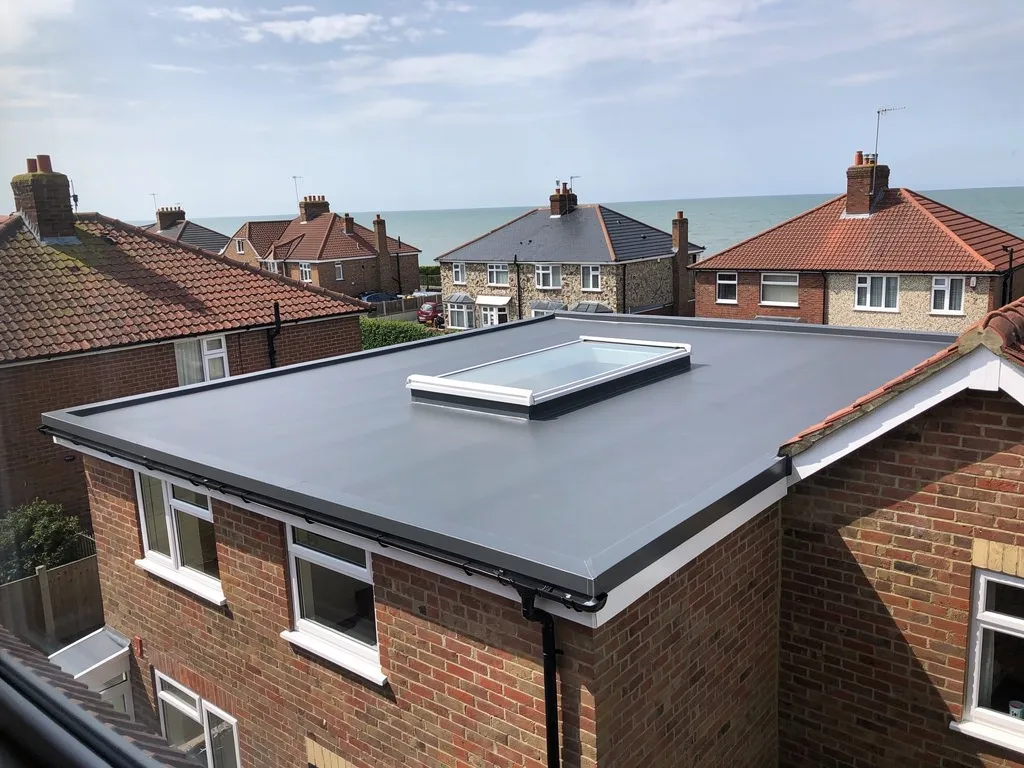
Shops, offices, surgeries and the roofs above flats mostly carry a flat covering. There are four main routes, and each suits a different kind of building.
Built-up or torch-on felt is the familiar one: layers of bitumen sheet welded down by a roofer who runs a flame across the underside as the roll unwinds. It is quick, simple to patch and forgiving on awkward shapes, but Less puts its typical life at 10 to 20 years, and it sits at the cheaper end of the market. MyBuilder (updated 21/08/2026) gives a typical UK range of £70 to £100 per m² for felt, £90 to £130 for EPDM, £95 to £140 for PVC and £95 to £150 for GRP.
Single-ply membranes are factory-made sheets of synthetic rubber or plastic, laid as one layer and joined at the edges. They are covered in full in our single-ply guide. GRP stands for glass-reinforced plastic: resin and glass fibre are laid wet and set into one continuous shell with no laps to open. Less gives it 25 to 40 years. It suits small and complicated roofs, like a porch roof or a bay, but it is rigid, so movement in the deck below can crack it.
Falls and drainage
Whatever the covering, a so-called flat roof must still slope a little. Rainwater has to run to an outlet. IKO, citing the 2018 edition of BS 6229 (since revised), recommends a finished minimum fall of 1:80, designed at 1:40 so that building tolerances do not swallow it. Water left standing for weeks ages any membrane faster, so ponding is the first fault we look for on a tired flat roof.
Metal, slate and tile on offices, halls and older frontages
Not every commercial roof is flat or sheeted. The upper floors of a high street, a surgery in a converted villa, a village hall or a school often keep a pitched roof, and the covering follows the building's age. Natural slate and clay tile are common. MyBuilder gives slate 80 to 100 years or more when well installed, and Marley reports a research-body finding of at least 60 years for its clay tiles. Neither figure is a promise.
Sheet metal is the other family. Lead is the traditional choice for flashings, gutters and the flat roofs of prestige buildings, and MyJobQuote says lead flashing can last over 80 years. Zinc suits curved and standing-seam roofs, and its maker VM Zinc puts a well-installed zinc roof at more than a century. The same maker says zinc performs well in coastal settings, though sheltered surfaces that rain never washes, soffits for one, can show permanent salt staining within 1 km of the sea. Both metals are costly to lay and need a skilled fitter, so they usually go where appearance justifies the outlay.
Pitched roofs on commercial buildings
Tiled and slated roofs on commercial premises follow the rules that apply on houses. The covering is only as good as its fixings, its underlay and the flashings at every wall and chimney, and gutters hidden behind a parapet are the usual weak point. Where a parapet or box gutter sits between two roofs, a pitched covering can still behave like a flat roof along its edges.
Lifespans quoted for any of these materials are typical ranges. Where the building stands, the quality of the installation and the upkeep all pull those figures up or down, and a manufacturer warranty is a separate matter from the roof's real service life.
Choosing between systems: what the building decides
People often start with the covering. We start with the building, because it rules most options in or out before cost enters.
The deck comes first. Timber, concrete and profiled steel each take different coverings and fixings, and a deck that has soaked for years may need patching before anything new goes on. Loading is next: a membrane laid over insulation will not carry plant, pallets or regular foot traffic without walkways. Falls follow. A roof with none may need tapered insulation, or a new deck, to give water somewhere to go. The insulation matters just as much. A warm roof puts it under the waterproofing and keeps the structure above freezing, while a cold roof puts it below with a ventilated void. Part L can bring a thermal upgrade once enough of the roof surface is renovated, which is one more reason we ask your building control body before specifying a covering.
Looks, the street and consent
A good-looking roof comes from many small decisions: sheet colour, the profile, a clean line at the eaves, a neat parapet capping and a matching rooflight. In a conservation area or on a listed building, appearance is also a consent matter. Planning permission is not normally the issue when a roof is re-covered like for like. Switching to a different material or colour on a visible slope may be, and listed buildings need listed building consent for anything that changes their character. Raise it with the Adur & Worthing planners before you order, or with the South Downs National Park Authority where the Park applies, and the answer will be on record.
Trading while the work goes on
Phasing matters on occupied premises. A composite panel roof can be recovered in sections, while a torch-applied flat roof needs a fire plan and a clear working area. We explain how the work will run around your staff, deliveries and customers before the quote is agreed.
Keeping any system going: inspection and upkeep
Every roof type lasts longer when someone looks at it. BS 6229, as summarised by GreenSpec, recommends inspecting a flat roof every spring and autumn, with extra visits near trees or in harsh settings, clearing debris and organic growth, and dealing with small defects as soon as they show. The same rhythm suits sheeted roofs and pitched roofs. Gutters and outlets get blocked by leaves, bird debris and windblown litter, and a blocked outlet turns a minor detail into a flooded roof within a single storm.
Coastal sites add salt. Salt that settles on a roof is rinsed away where rain can reach, but tucked-away surfaces such as soffits, fascias and the undersides of sheets stay dirty, and the Sussex coast brings gales and driving rain that test every joint. The zinc maker suggests a freshwater wash at least twice every year for zinc, and the same habit does no harm on other metal surfaces. Our guide to commercial roof maintenance sets out the visits we would plan.
What a survey tells you
A survey with photographs is the sensible start before choosing between repair, overlay and replacement. We look at the covering, the fixings, the falls, the outlets, the rooflights and what is happening under the roof, then recommend the least work that settles the problem for good, even if that is less than you feared. MyBuilder (updated 21/08/2026) puts a standard inspection at £150 to £250 across the UK, and £150 to £500 once drone and thermal surveys are counted. The price you are given is a single written total issued after the survey, shaped by access, the covering, how large the roof is and anything the survey exposes. Because we photograph the roof as we go, you can see each fault for yourself and ask about it before agreeing anything.