
Question answered
What tile finishes suit a solid conservatory roof?
The short answer
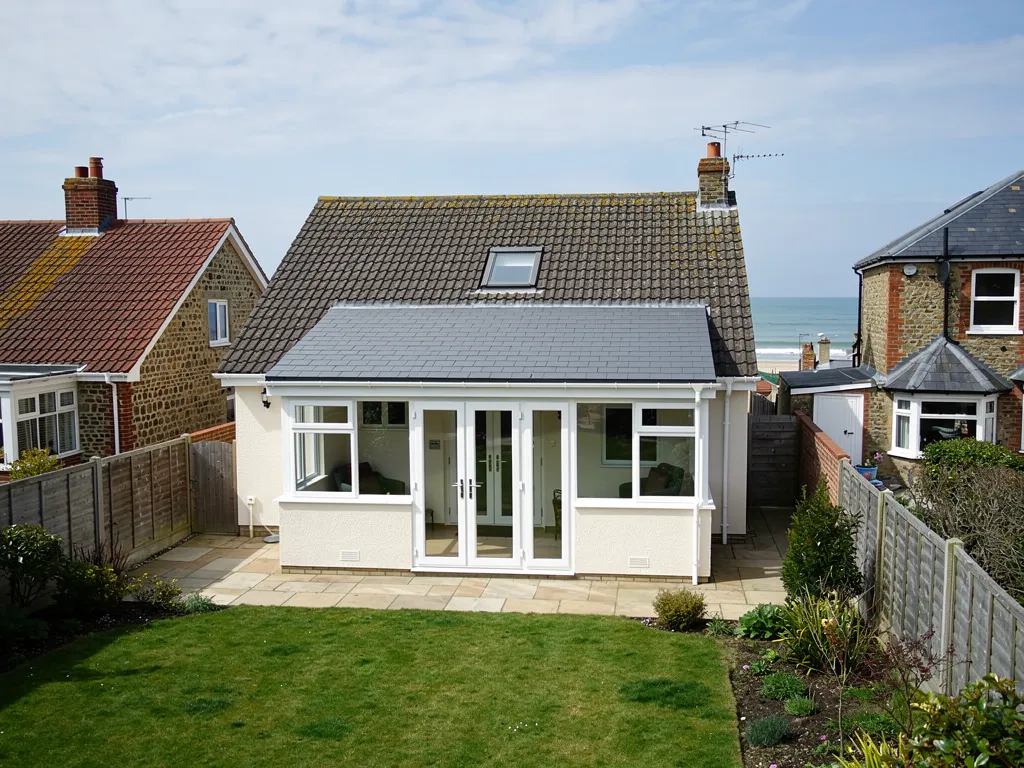
Choose a finish that matches the house roof in colour and texture: a slate-effect grey beside slate, or a clay red or brown beside tiles. Lightweight tiles sit on a solid roof structure, so weight and fixing details come first, and a solid roof needs a building control application. In a conservation area, or where a local Article 4 direction applies, ask the Adur & Worthing planning team before you settle on a finish.
A lightweight tile or slate-effect finish can make a solid conservatory roof look as though it belongs to the house. The best choice matches the main roof as it is now, not as it was on the day it was laid.
What a lightweight tile finish is
A solid conservatory roof swaps the old glazing for an insulated structure with a weatherproof top layer. That top layer is often a lightweight tile, made far lighter than clay or concrete so an existing conservatory frame has a chance of carrying it. The surface is usually textured and coloured to imitate slate or a plain clay tile, and some products are stone-coated, and others are a coloured metal sheet pressed into a tile profile. Each behaves differently in rain, so ask how noisy the surface is under a downpour.
The finish sits on a build-up of rafters, insulation, a vapour layer and battens, so the colour is only the part you see. Our guide to solid conservatory roofs goes through that build-up layer by layer. Because the structure changes, HomeBuilding counts the move from glazing to solid cover as a material alteration, which means a building control application before anyone starts.
Matching the house roof
The easiest match is a neutral one. Slate grey sits well beside slate and many concrete tiles, while warm reds and browns suit clay roofs. Look at the house roof from the garden in daylight, and notice that it has weathered: moss, lichen and years of sun change a colour a great deal.
A brand-new tile beside a weathered one will always look brighter at first. Ask for a physical sample and hold it against the existing roof on a dry day and a damp one, because colours shift when wet. Slightly darker is often the safer pick, since the new covering fades toward the old as it ages. Colour names vary between makers, so the sample matters more than the label, and so does the light in which you view it, which is why a bright morning and an overcast afternoon can give different answers.
Conservation areas and Article 4 directions
Living in a conservation area does not, on its own, rule out a finish. Adur & Worthing Councils explain that an Article 4 direction brings planning permission only for the matters it lists, and a few local directions do touch roofs. The ones for Old Shoreham and Kingston Buci withdrew permitted development rights for roof alterations, roof coverings included, on any side of a house that looks onto a public road or path.
Across in Worthing, the Warwick Gardens direction reaches a change to what a roof slope is made from, or how it is shaped, where that slope faces a street or open space. If your home is in or near one of these areas, ring the shared Adur & Worthing planning office before you place an order. Our wider guide to conservation-area conservatory roofs gives the background, and the council can tell you whether the conservatory counts as part of the dwelling for that purpose, which is the point that decides whether a direction reaches it.
Weight, insulation and the structure below
A lightweight tile is lighter than a normal one, but it still weighs more than polycarbonate, and the structure has to cope. Where a new covering is far heavier than the old one, the Planning Portal suggests an engineer or surveyor assesses the building beforehand, and Approved Document A calls a loading increase of more than 15% significant. Ask the supplier for the finished weight per square metre and give it to whoever checks the frame.
Insulation matters too. A solid roof is a chance to make the room usable in winter, and according to the Planning Portal a replacement conservatory roof has to be safe structurally, efficient in energy terms and properly ventilated. Our guide to conservatory roof insulation covers how it is built up, and the supporting wall also needs checking, which the conservatory dwarf wall page explains.
Details that change the look
Colour is only part of it. The ridge, the fascia, the roof edge and any roof windows alter the look as much as the tile itself. Matching the fascia to the window frames, for example, usually looks cleaner than a contrasting tone, and a ridge in the same colour as the field of the roof keeps the line calm.
To bring daylight into a solid roof, a roof window in a conservatory roof is the usual answer. At the survey we photograph what is there, and the written quote that follows is a single total, so you can judge how a finish would sit against your own house before committing. The conservatory roof replacement page sets out the other options if you are still deciding between solid and glazed.
Choosing a finish: two common questions
Can I pick any colour for a lightweight tile roof?
Within the range the maker offers, yes, but that range is smaller than for house tiles. Ask for samples early and check them against the main roof and the fascia. Where an Article 4 direction might apply, speak to the planners first, not after the tiles arrive.
Will a tile-effect roof make the conservatory darker inside?
Yes, a solid roof removes the overhead daylight that glass or polycarbonate gave you. Roof windows and glazed gable ends put some of it back. Many owners find the room feels more like part of the house, and easier to heat, once the glare and the summer heat are gone.
Tell us about your roof
Describe what is happening and we will call you back to arrange a visit.
- Photographs of what we find
- A written quote with one total price
- Or call 01903 299063
10-year workmanship guarantee, in writing.