After a gale has taken tiles off the roof or driven rain through a ceiling, a claim feels like the natural next step. It can be, but a roof claim is rarely decided on the damage alone. The insurer wants to know if a storm really happened, if the damage looks like the work of one, and if something else, such as age or poor upkeep, did the harm. Your job is to make those questions easy to answer in your favour with clear facts.
This guide sets out the claim in the order you meet it. First comes how the Financial Ombudsman Service looks at storm cases, because it shows what an insurer is weighing. Then comes the evidence to gather, the claim itself, temporary repairs and receipts, the excess, and the steps to take if you disagree with the outcome.
It describes the general picture and is not advice on your policy, whose wording has the final say. Nothing here promises that a claim will be paid. For the wider question of what buildings insurance usually covers, see is roof damage covered by home insurance. For the practical steps while water is still coming in, start with our emergency roof repairs page.
The three questions an ombudsman asks about a storm
When a storm claim ends up in dispute, the Financial Ombudsman Service looks at three questions, and they are a good guide to how your own insurer will think. They are: first, whether a storm struck on the day in question; second, whether the damage resembles what storms usually leave behind; and third, whether the storm was the leading cause or the damage would probably have appeared regardless.
As the service puts it, a storm brings violent wind, typically alongside rain, hail or snow. A wet and breezy day does not make a storm on its own, and a clear, still night does not, however severe the damage looks. Many policies add their own definition, and Which? reports that insurers often use a definition that sets a minimum gust speed. Your policy documents will tell you which wording applies to you.
Why the third question matters most for roofs
Roofs wear out, and insurers know it. The Financial Ombudsman Service notes that exclusions in policies often cover gradual damage, and Which? offers a poorly kept roof letting rain in as its illustration of wear and tear. A tile that has been loose for years and finally slips in a gale invites the question of whether the storm was really the main cause.
The same service also says the burden sits with the insurer, which has to show that an exclusion applies. That does not mean every claim succeeds, but it does mean a refusal has to be explained and supported, not just stated. You can read the ombudsman's own explanation on its storm damage page.
The evidence that makes a claim easier to assess
Think about each of the three questions and collect something that answers it. The more specific the evidence, the less room there is for the insurer to guess.
For the storm itself, note the date and time you noticed the damage, what the weather was doing, and when it began. A weather report for that day from a reliable source is easy to save, and so are local news items about the storm. Neighbours with similar damage are worth a mention, because damage across a street suggests a common cause.
For the damage, take photographs and short videos before anything is moved. Start wide, to show the house, the slope and the position of the damage, then move in close. Include dislodged tiles on the ground, a bent ridge, a flashing hanging off, a fallen branch and any internal staining. Pictures of the loft are useful if it is safe to enter. Stay off the roof to take them, and for a closer look at the roof, a roofer's survey photographs add a view that you cannot safely get yourself.
Showing the roof was in good order
The third question is where records help most. Any receipts for earlier repairs, a recent survey, a previous roofer's invoice or photographs of the roof from before the storm all show that the roof was looked after. If your roof has had a good record, say so. If it has been neglected, the claim will be harder, and being open about the roof's age and condition is better than having it discovered at inspection.
Keep everything in one folder, on paper or on your phone, so that you can send it quickly. The guide to roof checks after a storm lists what to look at from the ground.
Making the claim, step by step
Ring your insurer or use its claims line or online form, and give the facts in a plain order: what happened, when, what you can see, and what you have done so far. Ask for a claim reference and write it down. Follow up the call with an email so that there is a dated record of what you reported.
The insurer will usually ask for your photographs, may ask for a repair estimate, and for larger claims may send a loss adjuster to inspect. A loss adjuster is someone who investigates a claim on the insurer's behalf, and their visit is a good moment to point out everything you have noted. Be present if you can, show them where the water entered, and keep your own record of what was said.
What a roofer's survey adds
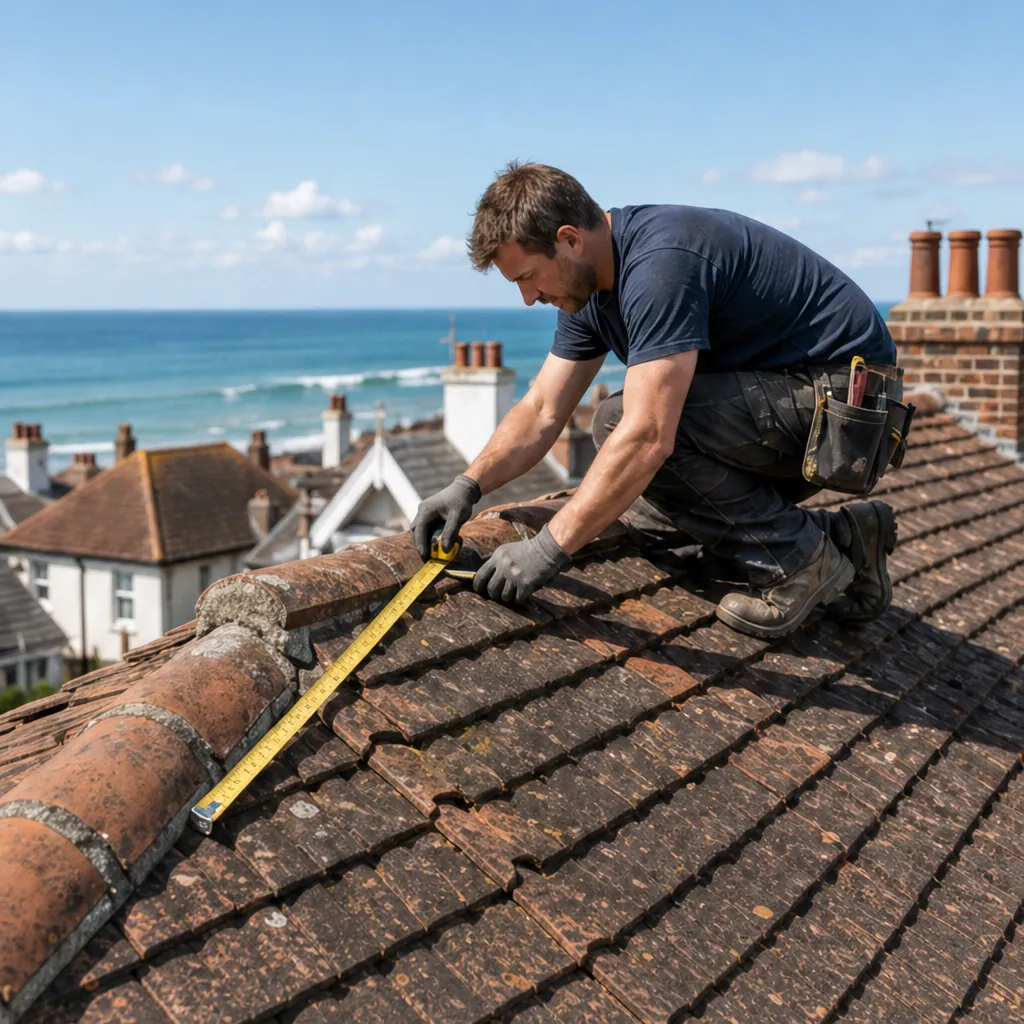
A written estimate for the repair is often needed, and a roofer's survey can do more than price the work. Photographs of the damage on your roof, taken from safe positions, together with a written description of what has been found, give the insurer something concrete. Our survey photographs and the written quote that goes with them are yours to pass on to your insurer. A roofer's report cannot settle whether the policy covers the damage. That decision belongs to the insurer.
Keep the roofer's findings honest and factual. If the survey shows old, worn flashing alongside the storm damage, it is better that the report says so. An account that distinguishes new from old damage is easier to trust than one that ascribes everything to the storm.
Do not let a claim hold up work that is urgent for safety. Where rain can get into the building, make it safe, document everything, and tell the insurer what you have done and why.
Temporary repairs and keeping the receipts
Water entering a house keeps doing harm until it is stopped, and most policies expect you to take reasonable steps to prevent further damage. That is why temporary work, such as sheeting a slope or fitting a tarpaulin over a damaged section, is usually worth doing without delay.
The usual advice after a major storm has two halves: phone your insurer before anything else, and only then book a stopgap repair to hold the damage where it is. Following both halves is sensible: ring the insurer, tell them about the make-safe, and ask whether they have a preferred contractor or conditions about the work. Where a call cannot be made in time because water is pouring in, do what is needed to stop the damage and report it afterwards.
What to keep
Keep the invoice and photographs for the temporary work, taken before the sheeting goes on. Keep the old materials, such as broken tiles, if you can store them, until the insurer says they are not needed. Receipts for any costs arising from the damage, such as drying equipment or a hotel stay, should be filed with the claim. Ask the insurer whether your policy pays for emergency work in addition to the permanent repair, since policies differ.
Temporary cover is meant to last days or weeks, not a season. A claim that drags on is no reason to leave a tarpaulin in place for months, because a poor stop-gap can cause fresh damage.
What each form of temporary cover does well, and how long it can be expected to hold, is explained in our guide to temporary roof repairs. Do not start the permanent repair until the insurer has agreed it, unless the roof cannot safely wait.
Excess, cost and whether to claim at all
Your excess is the slice of every claim that stays with you. It is stated in the policy schedule, and some policies set a different excess for different types of claim. If a repair costs less than the excess, a claim brings you nothing. If it is a little over, the payout may be small enough that other considerations tip the balance.
Those considerations include the effect on future premiums and on how insurers view your property. Ask your insurer or broker how a claim will be recorded, and whether a claim you decide not to pursue still needs to be reported. Some policies require you to tell the insurer about an incident, even when you do not intend to claim.
Do not assume the claim will be paid
Which? reported in November 2025 that, on Financial Conduct Authority figures, only 32% of storm-related claims made in 2024 resulted in a payout. That figure covers all storm claims, not roof claims alone, and says nothing about your own, but it is a reminder not to commit to expensive work on the assumption that a payout will follow. Where the cost is high, it is reasonable to wait for the insurer's decision on the permanent repair, if the make-safe has made the roof stable and dry.
If the claim is unlikely to succeed, perhaps because the roof was clearly worn, the repair still has to be paid for. Costs are not fixed, and a typical UK range from MyBuilder (updated 21/08/2026) for storm fixes is £500 to £1,500. What moves a price within and beyond that range is a matter for the survey.
A written quote and photographs from a roofer help whichever way the claim goes. They give you the facts you need to decide, and they give the insurer something to assess.
If the insurer refuses, or pays less than you expected
A refusal is not the end of the road. Ask for the decision in writing, with the specific policy wording the insurer relies on and the reasons it gives. Compare that wording with your policy, and look at whether the reasons answer the three questions set out earlier. A refusal that says only that the damage was wear and tear, with no supporting evidence, is worth challenging.
Start by complaining to the insurer. Per the Financial Ombudsman Service, the complaint can go to it if no final response has arrived within eight weeks, or if the answer leaves you unhappy. Once you hold a final response, the limit is 6 months from its date. The service is free and easy to use, according to its own website.
Making the complaint stronger
Send your evidence again, in an organised bundle: dated photographs, the weather record, any neighbours' reports, the previous maintenance record and a roofer's written findings. If the insurer's own inspection said the damage was long-standing, ask for a copy of the report, and ask a roofer to comment on the specific points in it. If two professional opinions differ, that difference is exactly what an ombudsman is there to weigh.
A roofer can report what was found on the roof. Whether the policy covers it is a question for the insurer, and for the ombudsman if it gets that far.
Whatever the outcome, the roof still has to be made sound. If the claim is rejected, our page on what counts as a storm may help you to see where the disagreement lies, and a repair that closes the opening properly still protects the house.