
Question answered
How long should a lead roof last?
The short answer
Lead flashing can outlast 80 years, and more than 100 years in the heavier codes, according to a MyJobQuote cost guide updated in September 2026. A Less cost guide gives a lead flat roof 50 to 100 years. Those are typical ranges, not promises. How thick the sheet is, how it was laid, whether it can move and what damage follows later will decide where a particular roof lands.
Lead is among the longest-lived roofing metals, but a lifespan is a rough band, not a pledge. What sets where your lead falls in it is the detail and the weight.
The published figures for flashing and flat roofs
Cost guides are where homeowners usually meet lifespans, and they agree that lead lasts. MyJobQuote, in a guide updated on 22 September 2026, reckons flashing in lead can run past 80 years, and well beyond a century in the heavier codes. For a lead flat roof, the Less cost guide offers 50 to 100 years.
Both are typical ranges from national guides, so they say nothing certain about your particular roof. They describe what well-laid lead can do. A lifespan is also different from a warranty, which is a separate undertaking from an installer or a maker and covers different things.
The figures sit well above most other coverings. Less puts torch-on felt at 10 to 20 years and GRP at 25 to 40, while MyBuilder says a flat roof typically lasts 15 to 30 years. Lead is often chosen for the junctions of a roof because it will see out the tiles or slates around it.
Why the code of the lead matters
Lead sheet is sold by code, and the bigger the number, the thicker the sheet. Code 3 is 1.32 mm, code 4 is 1.80 mm, code 5 is 2.24 mm and code 6 is 2.65 mm, with codes 7 and 8 above that. Leadworx says code 4 is now the everyday weight for flashing, while code 3 is recommended for soakers only.
The MyJobQuote figure of over 100 years for higher codes reflects a plain fact: more metal takes longer to wear through. A thin code asked to cover a long run will tire sooner than a heavier one over a short piece, and the difference shows up in the cracks and thin patches that arrive later in the roof's life.
Choosing the code is therefore part of the design, not a line to trim. We pick it for each part of the job according to the length of sheet, the exposure and the detail, and we put it on paper, so you know exactly what weight of lead is going onto your house.
Detailing, movement and the lead's real age
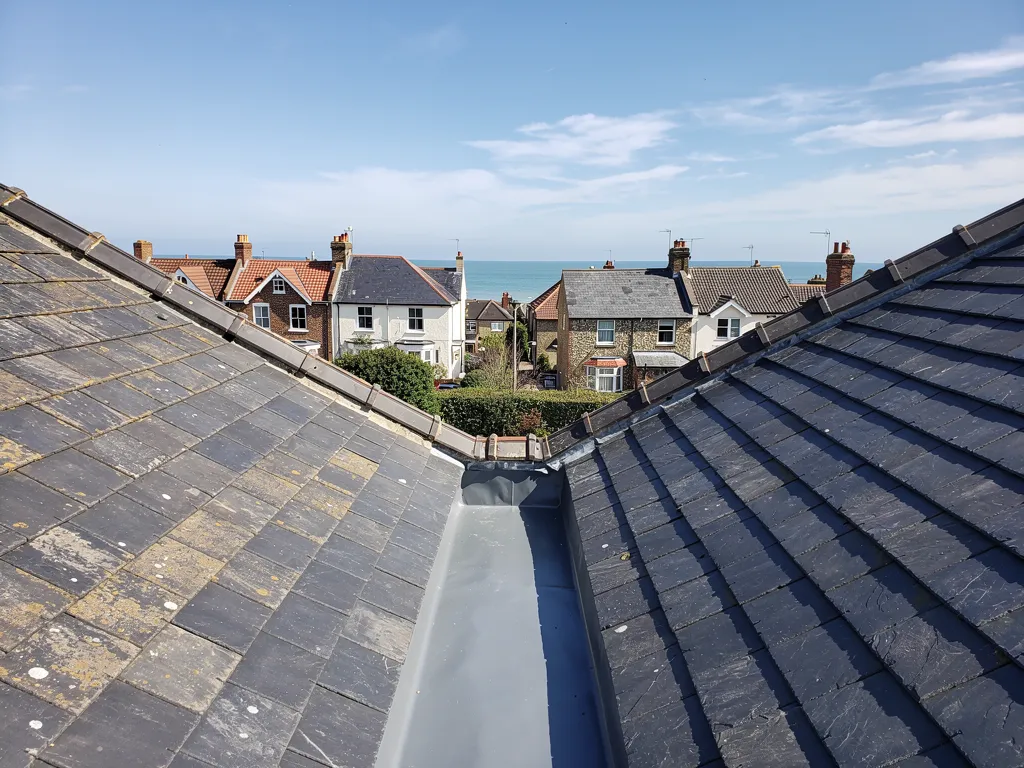
Lead swells and shrinks with the temperature. A flashing, valley or flat roof fixed so that it cannot move will work against its own fixings and split along the line of greatest strain. A roof broken into sensible lengths, with rolls or drips and clips that let the sheet slide, can serve for a lifetime.
The page on lead rolls and drips explains how those joints are made, and why lead cracks deals with the failure when they are missing. A lead roof can be fifty years old and sound, or ten years old and already split, depending on those details.
The published figures also assume the lead went down to a good standard on sound timber. A lifespan in a cost guide cannot be used to argue that an early failure is normal, and it does not stand in for workmanship. When a young roof has split, the cause is nearly always in how it was laid.
What shortens a lead roof's life
Lead itself rarely wears out. What goes wrong is usually something around it. Foot traffic on a flat roof dents and thins the sheet. A failed outlet or blocked gutter lets water stand against laps. Poor detailing at a chimney or wall lifts the edge of a flashing, and wind then works at it until it pulls from the joint.
Fixings and what lies beneath can give out before the metal does. Rotten boarding under a lead roof lets the sheet sag, which stresses the seams. Old repairs that used sealant or bitumen to patch a split can hide a problem that keeps growing underneath.
Theft can also end a lead roof early. Where lead has been stolen, the choice of replacement is a separate question, and the page on whether roofers still use lead covers the alternatives that owners weigh up.
Checking the lead you already have
Check the flashings from the pavement or through an upstairs window. Lifted edges, gaps against the wall, white powdery deposits and visible cracks all suggest the lead needs a closer look. In the loft, check for staining on timbers or on the underside of the boarding near a flat roof or chimney.
Do not climb on a lead roof to test it, because the sheet is soft and the surface underneath may be weak. Photographs taken with a zoom from a safe spot are enough for a first look.
When we survey, we check the thickness where it can be seen, the way the sheet is jointed and how much movement has been allowed. That tells us whether the lead has years of life left or whether a repair or renewal is the sensible step. Our lead roofing page lists the work, and a written total price follows once we have photographed your roof and talked you through what the pictures show.
Lead roof lifespan: two more questions
Is a hundred-year lead roof a promise?
No. The published figure is a typical range for well-laid lead. A warranty is a separate undertaking from an installer or manufacturer. Weather, movement, workmanship and later damage all affect what a particular roof does, so treat the number as a guide.
Should I replace lead flashing just because it is old?
Not necessarily. Old lead that is still sound, flat and properly dressed can carry on for many years. Age alone is not the test; splits, lifted edges, thin patches and failed joints are. We look at the condition and say whether repair or renewal makes sense.
Tell us about your roof
Describe what is happening and we will call you back to arrange a visit.
- Photographs of what we find
- A written quote with one total price
- Or call 01903 299063
10-year workmanship guarantee, in writing.