
Question answered
Why does roof lead crack?
The short answer
Roof lead cracks mainly because it swells and shrinks with every change of temperature, and a sheet that is too long or fixed too tightly cannot move, so it fatigues and splits. A code that is too thin for the run makes it worse, as do badly made joints, foot traffic and a structure that has shifted beneath. The remedy is usually correct detailing, not a dab of sealant.
Lead is a tough metal, but it moves with the weather and it does not forgive being held still. Most cracks have the same few causes, and they can be found.
Heat and cold make the sheet move
Lead expands a good deal for a roofing metal. Put plainly, it grows when the sun warms it and shrinks when it cools, over and over, on every clear night and bright morning. A sheet that is free to slide takes this in its stride. A sheet that is stuck cannot, so the movement turns into stress in the metal.
The stress builds in the same places each time, usually at a fixing, a fold or the edge of a seam. After enough cycles the lead work-hardens and cracks across the line. The process is slow, which is why a roof can seem fine for years and then show several splits in the same season.
A south-facing coastal roof gets full sun and cold clear nights, so the metal is working constantly. That is not a reason to avoid lead, but it is a good reason to detail it properly from the start.
Sheets cut too long and fixed too hard
The usual fault is length. One piece laid over a long run, a wide valley or a big flat area has more metal moving at once, and the total movement is larger at the ends. Good practice is to break the lead into short pieces joined by rolls, drips or lapped seams, so each section slides independently. The page on lead rolls and drips shows how those are formed.
The second fault is fixing. Lead clipped or nailed at too many points is held rigid. It should be secured along the top edge with a restricted number of fixings and held at the bottom with clips that allow it to move.
Sealant or mortar stuck along both edges has the same effect, which is why a split beside a mortar fillet is common. Many cracks we find belong to a roof where length and fixing were never thought through, and where the sheet was simply nailed down along every edge to make it look neat.
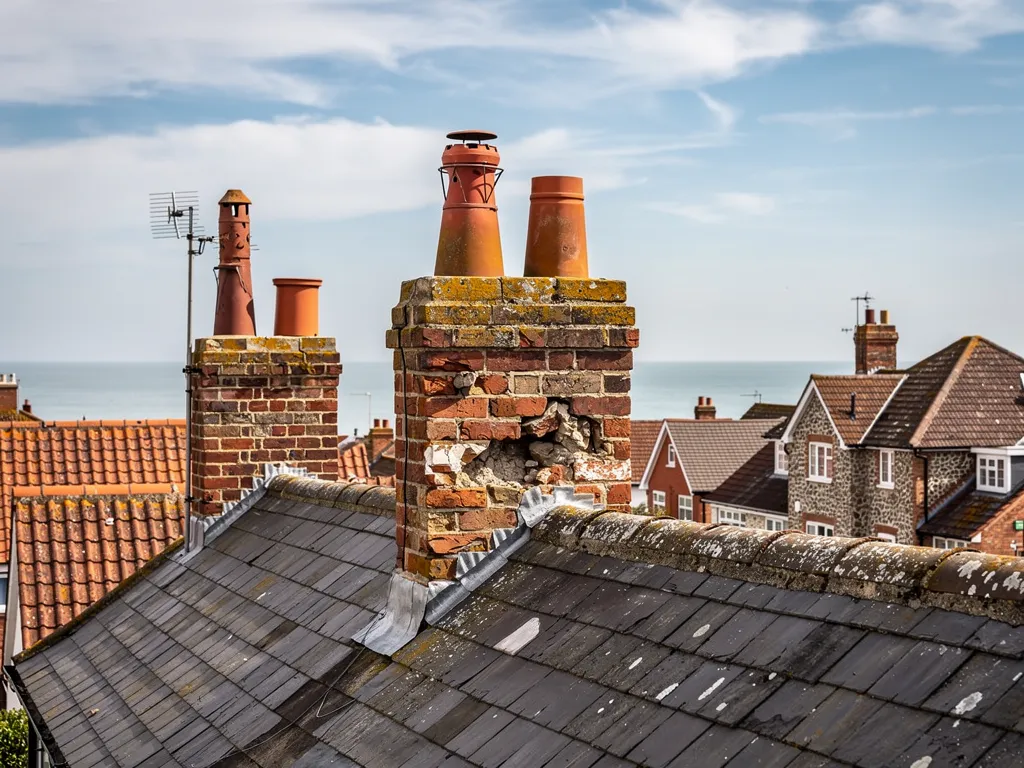
A code that is too thin for the job
Lead sheet comes in codes, and the code is the thickness. Royston recommends code 3, at 1.32 mm, for lead soakers only, and Leadworx calls code 4, at 1.80 mm, the everyday choice for flashing. Code 5 is 2.24 mm and code 6 is 2.65 mm, used for larger roofs and heavier duty.
A thin code is not wrong in itself. It becomes a problem when it is asked to cover too much. A lighter sheet has less material to resist the repeated bending, so it tires and splits sooner, particularly in exposed spots such as a valley or a parapet gutter.
Choosing the code is part of the design, along with the length of each piece. Our page on the lead code for flashing goes into the choice in more detail, and whichever code you are offered should be written down, so you know which weight is going onto the house.
Other causes: walking, structure and old repairs
Foot traffic is a quieter cause. Lead on a flat roof is soft, and repeated walking over a seam or a fold bends it back and forth until it cracks. The same happens when a ladder or a workman's boot rests on a flashing for a season.
Movement in the structure under the lead also matters. A settled wall, a sagging board or a chimney that has shifted pulls at the metal as it goes, and the split appears over the joint below. Rotten timber can do the same, and it is worth knowing about before the lead gets the blame.
Earlier repairs complicate the picture. A split smothered in sealant may look closed, but the sealant can glue the two sides together and restrict movement, so the crack grows beside the patch. Bitumen and mortar do the same. We lift old patching away to see what it was covering, and photograph what lies underneath.
Tracing a split and repairing it properly
We start by finding where the water is entering, which is not always where the stain sits. A split in a valley may leak into the roof space several metres away. Photographs taken on the roof show the split, the fixings and the length of each piece, and we explain what we see.
A small clean split with sound lead around it can sometimes be repaired locally. If the lead is fatigued all along, or the pieces are too long, the right fix is to relay it in shorter sections in the correct code, with joints designed to move. A written total price follows the survey, and it says which of the two jobs you are looking at.
To see where the metal is still chosen, read do roofers still use lead. Our lead roofing page sets out the whole range of work with the metal, from a lifted flashing to a relaid flat roof, and what we look at first on each.
Cracked roof lead: two more questions
Can I seal a crack in lead with sealant or tape?
It may slow a drip for a short while, but it also restricts the movement that caused the crack and can hide the damage. Lead repairs normally need the metal itself dressed, patched in a way that can move, or the section renewed.
Will new lead crack again in a few years?
Not if the sheets are cut to sensible lengths, the code suits the job and the fixings let the metal move. New lead that splits early usually points to the detailing, so ask your roofer how each piece will be fixed and where the joints go.
Tell us about your roof
Describe what is happening and we will call you back to arrange a visit.
- Photographs of what we find
- A written quote with one total price
- Or call 01903 299063
10-year workmanship guarantee, in writing.