
Question answered
Do roofers still use lead?
The short answer
Yes, roofers still use lead. It remains the usual metal for flashings, valleys, soakers, ridges and flat roofs, laid in sheet codes of different thickness, with code 4 the everyday weight for flashing. Alternatives such as zinc, EPDM and GRP appear on some flat roofs and modern designs, but lead still does jobs that are hard to match, and a listed building often needs lead to match what is there.
Yes. Lead is still the usual metal for flashings, valleys and many flat roofs in Britain, and where alternatives appear it is mostly a question of job, cost or consent.
Where lead is still the first choice
Look at the chimneys on any Worthing street. The strip that seals a stack to the tiles is very often lead. So is the stepped flashing along a wall, the soaker tucked under each tile at an abutment, and the valley where two slopes meet. All of these are places where a metal has to bend to a complicated shape and stay put for years.
Lead suits this because it is soft and heavy. It can be dressed tight to brickwork and tile with hand tools, it stays where it is put, and it does not spring back. Leadworx lists code 4 as the weight most often used for general flashing, with code 3 reserved for soakers.
Our guide to lead codes explains how thickness is chosen for each part of a roof, and why a heavier sheet goes on exposed or wide details while the lighter ones are kept for small pieces that tuck under tiles.
Lead on flat roofs and parapets
Lead also covers whole flat roofs, balconies, bay roofs, dormer cheeks and box gutters. MyBuilder's flat roof guide puts lead at £150 to £200 or more per square metre, against £70 to £100 for felt and £90 to £130 for EPDM, so it is the dearest of the common options. Less says a lead flat roof can last 50 to 100 years.
That lifespan is what justifies the price in places that are hard to reach again. A box gutter hidden behind a parapet is a poor spot for a covering that needs replacing every twenty years, because every renewal means scaffold, access and disturbance to the walls around it.
The same logic applies to smaller pieces such as aprons and saddles. They are tiny parts of a roof, but if they fail, water follows the line of the wall into the house. Lead is chosen for them because it lasts, and because it can be reworked later without starting from scratch.
Where alternatives appear
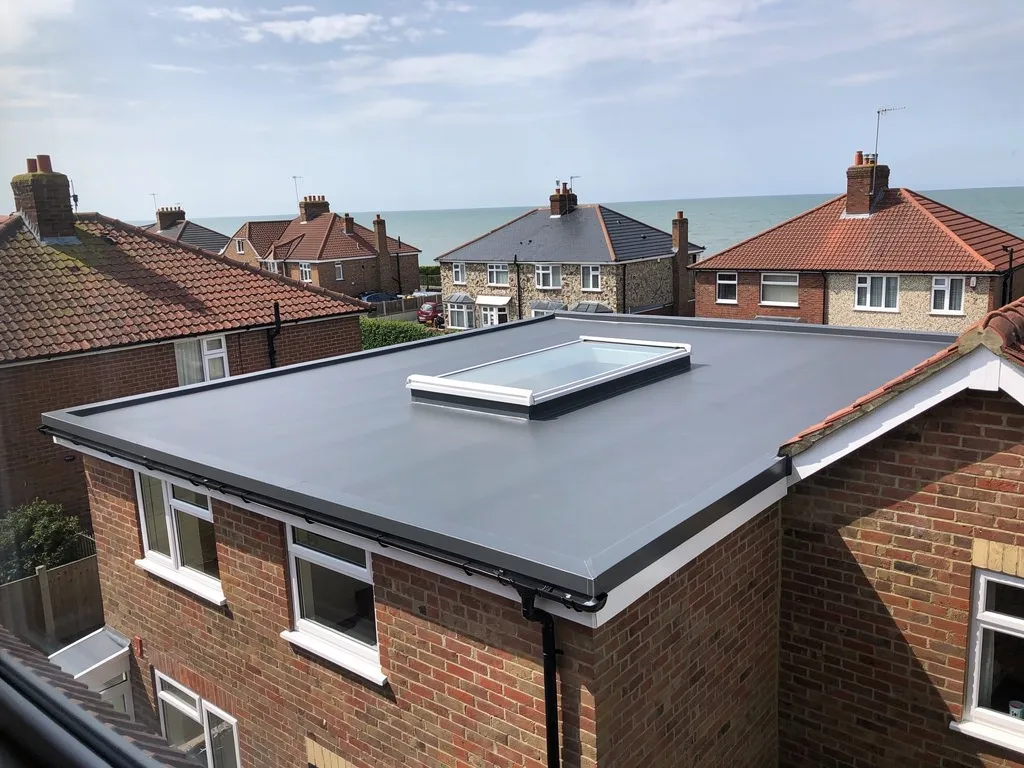
Alternatives turn up in several places. Single-ply EPDM and GRP are common on garage and extension flat roofs, where the shapes are simple and the budget matters. Felt remains in use for lower budgets. Zinc is used on some contemporary buildings and curved roofs, and its maker says it performs extremely well in coastal environments, though it warns that salt air can mark it.
Other metals, such as copper, are chosen for appearance. People also look elsewhere because of cost, and some owners and landlords worry about theft and choose a material with less scrap value. Splitting is another worry, and why lead cracks explains what causes it.
Each alternative has trade-offs. A single-ply membrane cannot be dressed round a chimney stack in the way lead can, so a flat roof in EPDM may still need lead at its junctions with walls and stacks.
Listed buildings and matching materials
On a listed building or in a conservation area, the material of the existing roof matters. The Adur & Worthing listed building guide lists non-matching repairs among works needing consent. Replacing a lead flashing with something else may therefore need the council's agreement, and in many cases lead is simply the material that matches.
Even where no consent is needed, a house whose roof has lead valleys or hips was built to suit lead. Swapping it for a sheet that cannot be dressed the same way can leave awkward gaps, and a mismatched metal looks out of place from the street.
Where we are unsure what the council would accept, we tell you plainly and suggest you check with the planning team before the work starts, because it is easier to ask first than to undo a finished roof.
What we do and what to ask any roofer
We use lead where lead is the right answer, and we tell you when something else would serve better. Photographs of the roof itself come first, then a written price as one sum, with the lead code named so you know what thickness is going on. If lead is not the right answer for part of the job, that is said at the same stage.
Ask any roofer which code they plan to use for each part of the job, and how long the sheets will be. Ask how the lead will be fixed so that it can move. A roofer who answers those questions with confidence is more likely to give you a roof that lasts.
For the lifespan side of the question, see how long a lead roof should last. For handling and health questions, read is lead roofing safe. The jobs we take on with the metal are listed on our lead roofing page, from a single flashing to a full flat roof.
Lead on roofs: two more questions
Is lead being phased out for roofing in Britain?
No. Lead is still laid on new work and repairs across Britain, on pitched roofs and flat ones. What moves a choice towards another material is usually the cost, the design of the building or what the council will accept, so raise it at the survey.
Can zinc replace lead flashing round a chimney?
It can be used, but it is harder to dress tightly into the stepped shapes of a chimney and brickwork, and it reacts differently to its surroundings. Lead is generally easier to work into those details. We would look at the stack and say which suits it.
Tell us about your roof
Describe what is happening and we will call you back to arrange a visit.
- Photographs of what we find
- A written quote with one total price
- Or call 01903 299063
10-year workmanship guarantee, in writing.