
Question answered
What is a dry valley trough?
The short answer
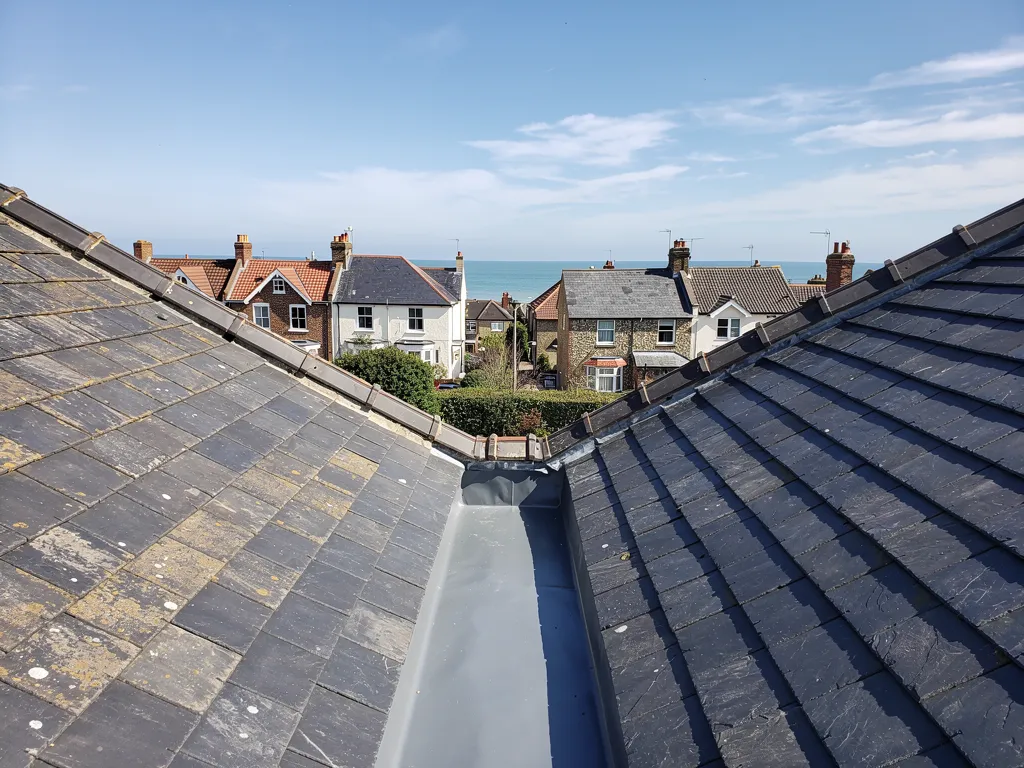
A dry valley trough is a ready-made channel, usually in glass-reinforced plastic (GRP) or a similar moulded material, laid in the valley between two roof slopes. Tiles are cut to its edges and fixed without mortar, so the water runs down the exposed channel. It is a quicker alternative to a lead-lined valley or a mitred tile valley, and it suits plain, regular roof shapes best.
A dry valley trough is a preformed channel that carries rain down the line where two roof slopes meet. The tiles stop short of its centre, so there is no mortar to crack.
What a valley is and what the trough does
A valley is the trench-like line formed where two slopes run down into each other. It gathers run-off from both slopes, so it is the busiest drain on the roof, and a failure there usually makes itself known as a patch on the ceiling below. Faults tend to arrive quickly, because so much water reaches the same spot at once.
A dry valley trough replaces the traditional lining. It is a preformed channel, commonly GRP, with raised edges, laid over the rafters on top of the underlay and fixed with its own clips or screws. The tiles on each side are cut to follow the line of the valley and stop short of the middle, leaving a narrow band of open trough. Dry refers to the fixing method: no mortar bedding is used along the edges, which is why the system does not crack or drop out the way bedded tile edges can.
Dry trough, lead valley or mitred tiles
Three methods dominate. A lead valley lines the channel with sheet lead, with tiles cut and laid on each side to leave a strip of exposed metal. Lead lasts well: MyJobQuote says lead flashing can last over 80 years, and over 100 for higher codes, though that figure is about flashing, and the life of a valley depends on the code and the workmanship. Leadworx calls code 4 the standard for general flashing work, and places code 5, at 2.24 mm, in its general-purpose group.
A mitred valley has the tiles themselves cut and laid to meet at an angle over a lead soaker or tray, so no channel shows from the ground. It looks neat and traditional, and it relies on skilled cutting and well-made soakers.
A dry valley trough sits between the two in effort. It is quicker than lead, needs less cutting than a mitred valley and gives a consistent channel. Its weak points are the join at the head and foot of the run, and how it behaves in a heavy downpour.
Where a trough suits, and where it does not
A trough works best on a plain valley between two similar slopes at a regular angle, such as the rear projection of a 1930s semi. It is a poor fit on a valley with odd angles, a curved or irregular junction, or a roof where slate or Horsham stone wants a traditional lead-lined valley to look right. Always read the maker's instructions for the pitch and covering you have, because a trough is made for specific conditions.
In a conservation area or on a listed building, the choice of valley is a question of appearance as well as water. Swapping lead for plastic can change the character, so ask the council before specifying it. Our page on the disadvantages of pitched roofs covers the weak points that valleys add to any roof, and more of our pitched work is listed on pitched roofing.
What goes wrong with a trough
The main faults are mechanical. If the trough sits too proud, or the cut tiles overhang its edges by too little, wind-driven water blows over the edge and into the roof space. A trough clogged with moss, leaves and broken tile cannot carry a burst of heavy rain, and it spills sideways under the tiles. Plastic also cracks under a boot, so a trough that has been walked on is suspect.
The cut tiles along the edge need secure fixing, because when they lift in wind they let water into the lining. At the foot of the valley the water must discharge cleanly into the gutter. A trough whose lower end stops short of the gutter, or ends at a blocked outlet, backs up. The felt beneath should also be lapped properly; see how roofing felt copes with rain.
Choosing a valley for your roof
We trace the leak first, because a stained ceiling under a valley is not always the valley's fault. A flashing, a cracked tile or a gutter can imitate it. If the valley is the culprit, photographs show you the lining and the cut tiles, and the right fix may be a clean-out, a re-laid trough or new lead. Where a valley does need relining, we explain why a trough, lead or a mitred finish suits the roof, and what each choice means for how the roof looks from the road, so the decision rests on what you can see.
For a wider look at roof shapes and the costs they bring, hip against gable is a useful companion, and tile fixing in coastal wind explains why the cut edges of a valley are fixed so carefully near the sea.
Valley troughs: two more questions
Can a dry valley trough be fitted over an existing lead valley?
It can be done, but it is rarely the best route. Fitting over old lead buries any fault in the existing lining, and the build-up under the tile edges changes. We would inspect the lead first, repair or replace it if needed, and use a trough only where the roof suits it.
Why does my ceiling stain after heavy rain, directly below the valley?
A valley takes the run-off of two slopes, so it overflows first in a downpour. Debris in the channel, a lifted edge tile or a split in the lining lets water under the tiles on either side. A repeat stain after clearing means the lining needs inspection.
Tell us about your roof
Describe what is happening and we will call you back to arrange a visit.
- Photographs of what we find
- A written quote with one total price
- Or call 01903 299063
10-year workmanship guarantee, in writing.