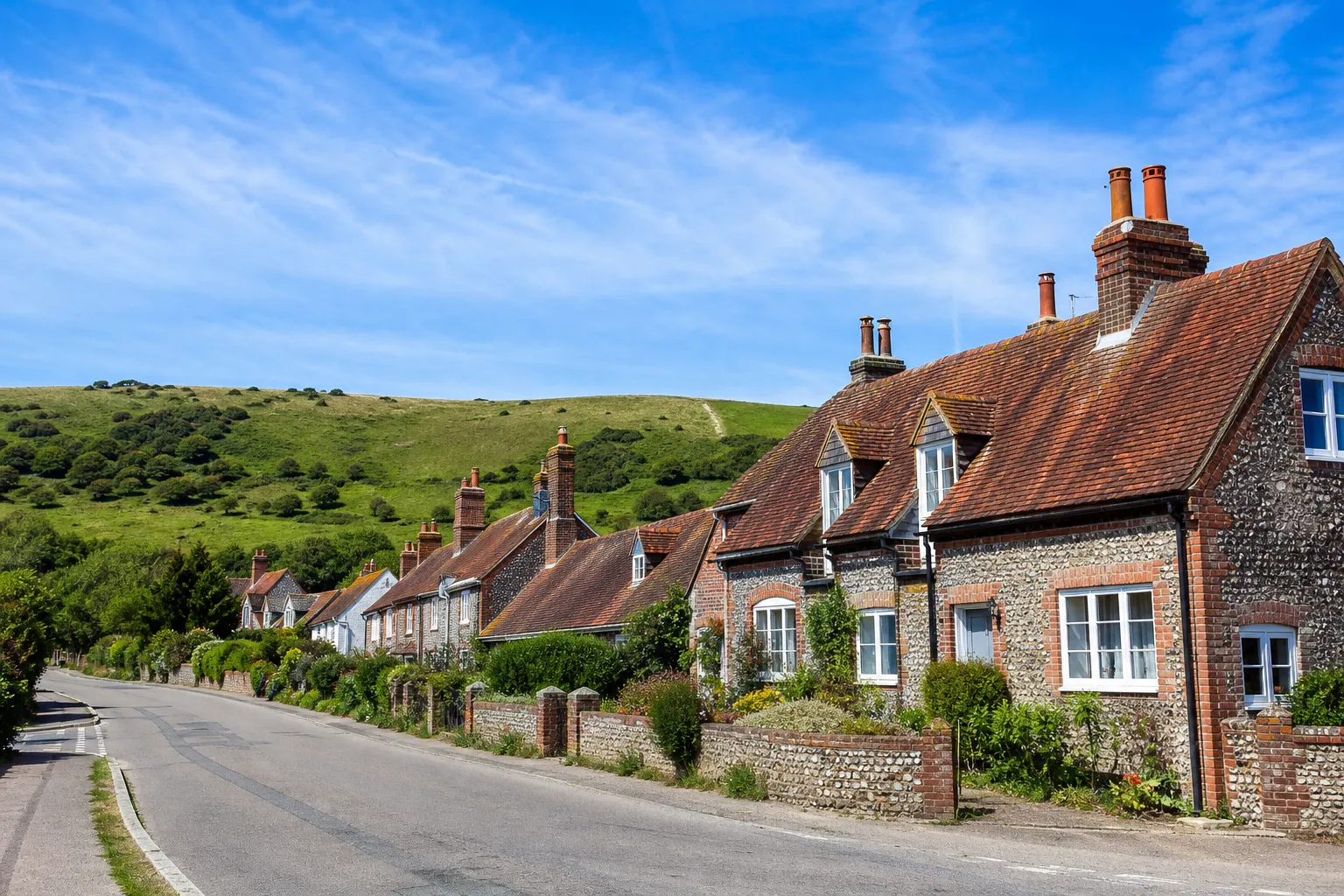
A pitched roof covering has two jobs. It sheds water down the slope, and it stays put in the wind. The material decides how it manages both: how big each unit is, how far one overlaps the next, how steep the roof must be and how every piece is fixed.
The differences are practical long before they are visual. A clay plain tile is small and laid with a double thickness of overlap, so it wants a steep roof. A concrete interlocking tile is large and locks into its neighbour, so it copes with a shallower slope. Slate is thin, and its safe pitch depends on how much each course overlaps the one beneath. Metal and synthetic coverings follow different rules again.
The lifespans below are typical published ranges from tile makers and cost guides. They are never promises, and exposure, workmanship and upkeep move them either way. Pitch figures come from manufacturer data and the British Standard those manufacturers cite, and the data sheet for the exact product always has the last word. If a repair rather than a recovering is what you are weighing, our guide to tiled roof repair costs shows what each covering means for the bill.
Plain tiles: small, double-lapped and finely textured
A plain tile is a small, slightly curved rectangle that hangs from timber battens, the thin strips nailed across the rafters. Plain tiles are laid double lap: every course covers the joint between the tiles below and also overlaps the course under that, so at any point on the slope there are at least two layers of tile. The overlap is what keeps rain out, and it gives plain tile roofs their fine, close texture.
Clay is the traditional material and the one that comes to mind on an older house. Concrete plain tiles copy the same shape. The two are not interchangeable underneath, because they differ in weight and in the pitch they need, and a roof built for one may not suit the other without a look at the timbers.
Lifespan
For clay tile, Marley points to a minimum expectation of 60 years, a minimum that, according to Marley, was determined by the Building Research Establishment. MyBuilder, in a cost guide updated 21/08/2026, says clay tiles are usually replaced somewhere between 40 and 60 years. A hand-made clay roof a century or two old cannot be judged by that number, as the Building Conservation Directory points out, so an older roof is assessed on its own condition.
Minimum pitch
Pitch is the slope of the roof measured in degrees from the horizontal. Marley's data for its clay plain tiles gives 40 degrees for Canterbury, 35 for Ashdowne, and 30 for both Hawkins and Acme Single Camber. Its concrete plain tile needs 35. The steep minimum exists because each tile is short: on a shallow slope, gusts can force rain up through the lap before it has run clear of the joint.
Interlocking tiles: large, single-lap and happier on low slopes
An interlocking tile is a big tile, usually concrete, with a rebate along its edges that engages the tile beside it. It is laid single lap, which means one thickness of tile covers the roof, with only a short overlap at the head. Fewer, larger units go on faster than plain tiles, and the interlock lets the roof run at a lower pitch.
Marley's published minimums for its interlocking concrete range show how much the profile matters: 12.5 degrees for Mendip 12.5, 15 for Mendip and Wessex, 17.5 for Edgemere and Modern, 22.5 for Double Roman, Ludlow and Ashmore, and 25 for Anglia. Two tiles that look the same from the road can sit ten degrees apart.
Fixing a single-lap tile
Tile maker Wienerberger requires at least a single mechanical fixing on each single-lap tile, with the full fixing schedule written for the particular site once altitude, location and local exposure are weighed. That is the practical meaning of BS 5534 on a coastal roof, and it is why a tile fixed on a sheltered inland estate cannot simply be copied onto a house facing the Channel.
Lifespan
Marley's figure for concrete is roughly 60 years, with its own caution that this is not a promise of longevity. MyBuilder puts concrete tile replacement at 30 to 50 years. Taken together, often 30 to 60 years is a fair reading, with the lower end more likely on a bare, exposed slope that has never been checked or re-fixed.
A tile that holds water through winter is more exposed to frost, so surface condition is worth noting at a survey. Whether the roof needs cleaning, re-fixing or recovering is a decision to make on the tiles in front of you.
Pantiles: the S-curve that drains itself
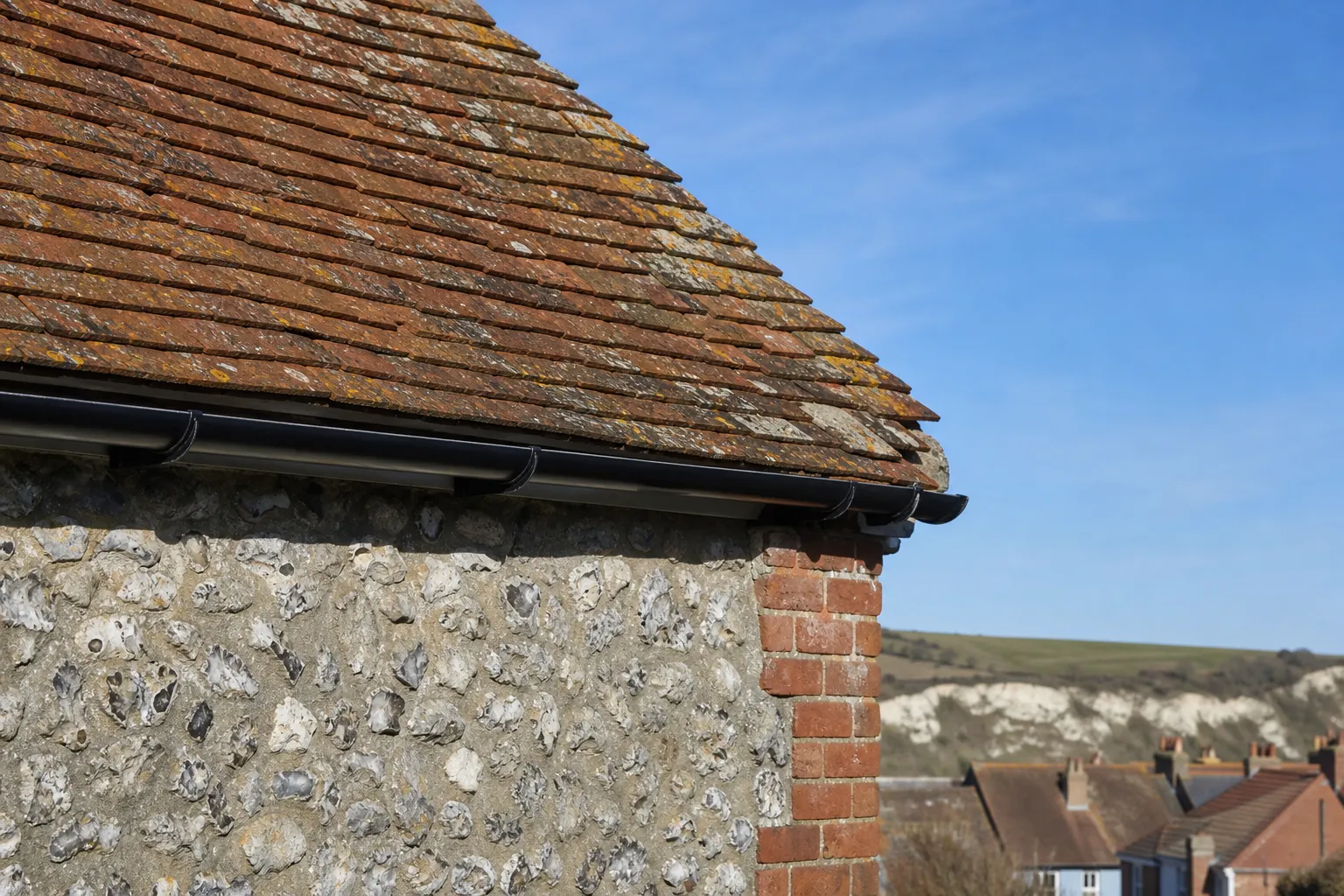
A pantile has an S-shaped profile. One side of each tile curls up and the other curls down, and the next tile tucks its curl over the first. Water runs down the troughs rather than across a flat face, and the rolled edges overlap so the joint between tiles sits high above the flow. Pantiles are single lap, so they share the interlocking family's tolerance of low slopes.
Clay pantiles are the classic, and Marley's Lincoln clay pantile has a minimum pitch of 15 degrees. That is a very low figure for a clay product, and it is why pantiles suit extensions, lean-tos and outbuildings where the slope cannot be raised. Concrete pantile profiles are also made.
What goes wrong on a pantile roof
The troughs show everything. Moss gathers along the channels, a cracked tile leaves a clear gap rather than a hairline, and the ends of the course at the verge and the eaves need careful sealing and fixing because the profile leaves open voids beneath. Replacement tiles must also match the profile: pantiles from one maker do not always nest with another's, which is a common reason a simple repair turns into a hunt for a match.
Every single-lap tile, pantile included, needs a mechanical fixing, as above. A pantile roof held only by old nails is one that has not been brought up to current practice, and that matters most on a slope facing the sea. A survey tells us how many tiles are fixed, how, and whether the battens beneath will still take a new fixing.
Natural slate: thin, hard and very long-lived
Slate is split rock, cut into thin rectangles and hung from battens with nails or hooks. It is laid double lap, and the overlap is called the headlap: the distance by which a course covers the slate two courses below. That figure grows as the roof gets shallower, because water has less slope to run down and wind can drive it further under the slates.
Cupa Pizarras states that BS 5534:2014+A2:2018 indicates a minimum roof pitch for natural slate of 20 degrees, for moderate exposure with a 500 mm slate and a 115 mm headlap. For 500 mm by 300 mm slate, Cupa lists headlaps of 115 mm at 20 degrees, 95 mm at 25, 80 mm at 30, 70 mm at 35 and 60 mm at 40. Below 25 degrees it recommends nails rather than hooks to hold the slates.
Lifespan
MyBuilder's figure for a properly laid slate roof is 80 to 100 years or more, and Welsh slate often passes a century. Checkatrade gives a wider spread of 50 to 200 years, with most easily exceeding 100. Spanish slate is quoted lower, at 75 to 100 years. On an old roof the visible failure is often slipped slates, and the cause is frequently corroded nails or a perished underlay rather than the stone, which is why slate can be repaired for decades before recovering is the sensible answer.
Why it matters near the seafront
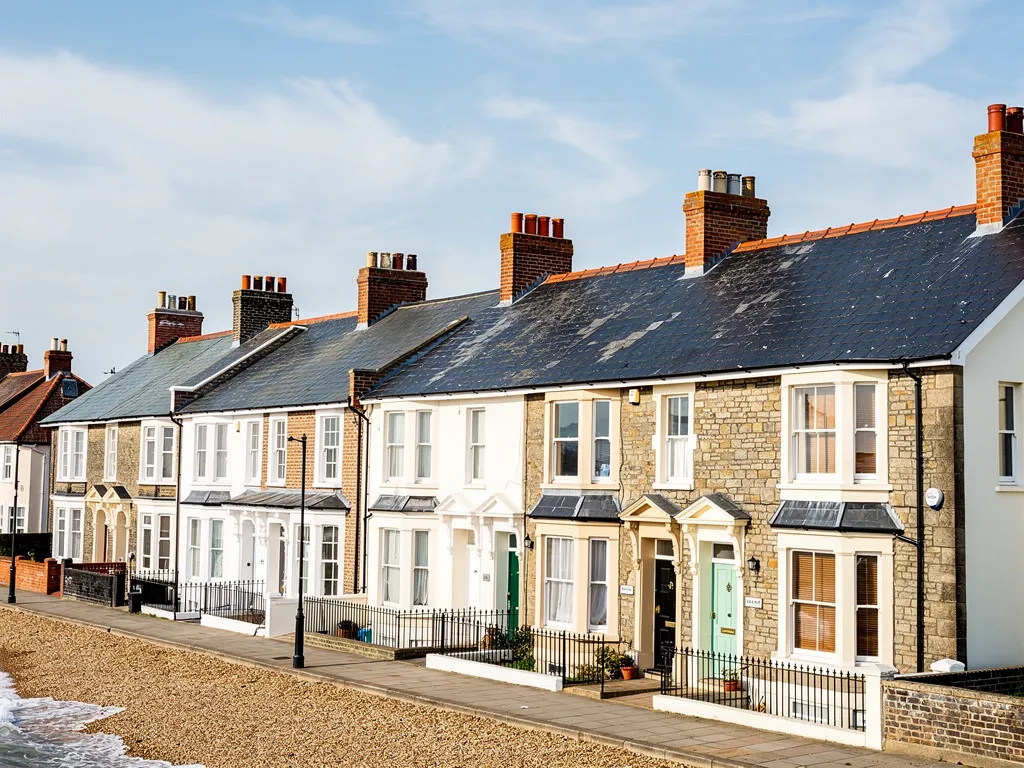
Slate is a familiar sight on the Victorian and Edwardian terraces near the Worthing seafront. Our guide to pitched roof construction describes the timbers that carry it, and why a slate roof with a shallow lean-to section needs a different headlap from the main slope.
Lifespan and pitch side by side
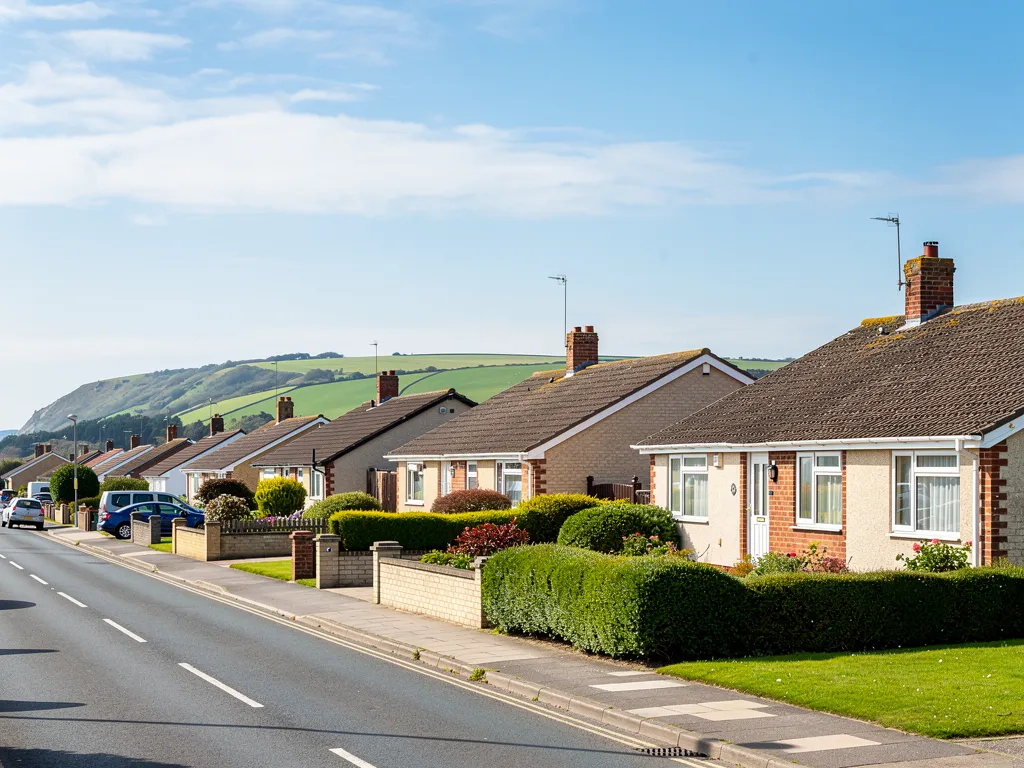
Pulling the figures together makes the trade-off clearer. Pulling the numbers into one place shows what each choice costs you elsewhere. A covering that tolerates a low pitch is not automatically the better choice, and a long life is not automatically worth the extra weight or cost. The table lists the figures as published, with the source named in each row.
| Covering | Typical life | Minimum pitch |
|---|---|---|
| Clay plain tile | 40 to 60 years (MyBuilder); 60 minimum (Marley) | 30 to 40 degrees by product (Marley) |
| Concrete plain tile | 30 to 60 years | 35 degrees (Marley) |
| Interlocking concrete | 30 to 60 years | 12.5 to 25 degrees by product (Marley) |
| Clay pantile | As clay | 15 degrees for Lincoln (Marley) |
| Natural slate | 80 to 100 years or more (MyBuilder) | 20 degrees (BS 5534, via Cupa) |
Two readings follow. A shallow roof narrows the choice sharply: at 15 degrees a pantile or a shallow-profile interlocking tile is in play, and plain tile is not. And the covering is only part of the story. The battens, nails and underlay beneath need their own checks, so a long-lived clay or slate roof can still call for stripping and re-laying before the tiles themselves give out.
A manufacturer's cover applies to the product and says little about how it was fixed, how the battens were chosen or how the ridge was finished. It is a paper assurance about a tile, not about a roof. On a roof exposed to a gale, the fixing is what gets tested first, and a lifespan figure is only as good as the workmanship holding it to the roof.
Metal, synthetic and choosing for your own roof
Metal and synthetic coverings sit outside the tile families. Zinc is a sheet metal laid in standing-seam panels. VM Zinc reports that a zinc roof can exceed 100 years in service and that the metal copes well with coastal air, though white salt deposits form on surfaces the rain does not rinse. Synthetic slate and tile products come in many compositions, and each has its own data sheet for pitch, fixing and life. Neither group is a like-for-like swap for a tiled roof without a check on weight, fixing and appearance.
Matching what is already there
On a house with an existing covering, the first question is whether the replacement should match. Re-covering in an identical material is not normally a planning question, yet listing or an Article 4 direction can alter the position. Before you change the material, put the question to the Adur & Worthing planning team, or the South Downs National Park Authority if the house sits inside the Park.
Weight and the structure underneath
The Planning Portal's test is whether the new covering makes the roof 15 per cent heavier or more, and if so building control approval applies. Swapping clay for heavier concrete, or slate for large concrete tiles, can cross that line, and a structural check is the safe course. The same thinking applies when a roof is reshaped, as in our guide to converting a flat roof to pitched.
We choose the covering after the survey, from the pitch, the exposure, the existing material and what the structure will carry. Once we have been up there, our photographs of your roof arrive with the written quote, which gives one total to approve. The wider range of pitched coverings and work is on our pitched roofing page.