
Question answered
How often should a house roof be cleaned?
The short answer
A house roof should be cleaned when growth starts to cause a problem, not on a fixed timetable. A roof in deep shade or under overhanging trees may need attention more often than one in full sun. Look at it from the ground every year, after autumn leaf fall and after storms, and book a clean when moss thickens, lifts tiles or fills the gutters.
There is no fixed interval that suits every house. A roof under trees needs attention sooner than one in open sun, so the right rhythm comes from your own roof.
Why a fixed number of years does not work
You will see advice that quotes a set gap between cleans. It sounds neat, but roofs do not follow it. Moss needs moisture, shade and a surface to cling to, and every roof offers a different mix of the three. Two neighbouring houses can have the same tiles and age and still need very different care.
What counts is the rate of regrowth on your roof. A north-facing slope next to a tall hedge may be green again quickly after a clean, while a south-facing slope with open sky can stay clear for much longer. Your own roof has to tell you, and the way it does that is by what you see each year.
That is also why a roof that was cleaned, treated and then ignored for years differs from a roof that has been kept tidy. Small, regular attention is usually gentler on tiles than a heavy clean after long neglect. Our roof cleaning and moss removal work follows the same thinking.
What makes growth return sooner
Shade is the biggest factor. Trees, tall buildings and high garden walls keep the sun off the tiles, so the surface stays damp. Overhanging branches also drop leaves and seeds that sit on the roof and rot into a growing bed for moss.
Aspect matters. Slopes facing away from the midday sun stay wetter and go green first. Scrubbing a shaded slope too often wears the tile, so the better answer is to cut the damp. Low pitches hold water longer than steep ones, and rough surfaces such as old concrete tiles give moss more to grip than smooth ones.
Coastal air does not stop growth. A roof near the sea still collects moss and lichen wherever it stays damp, and salt can add its own staining. Wind carries spores from further away, so a clean roof next to a green one will not stay clean on its own.
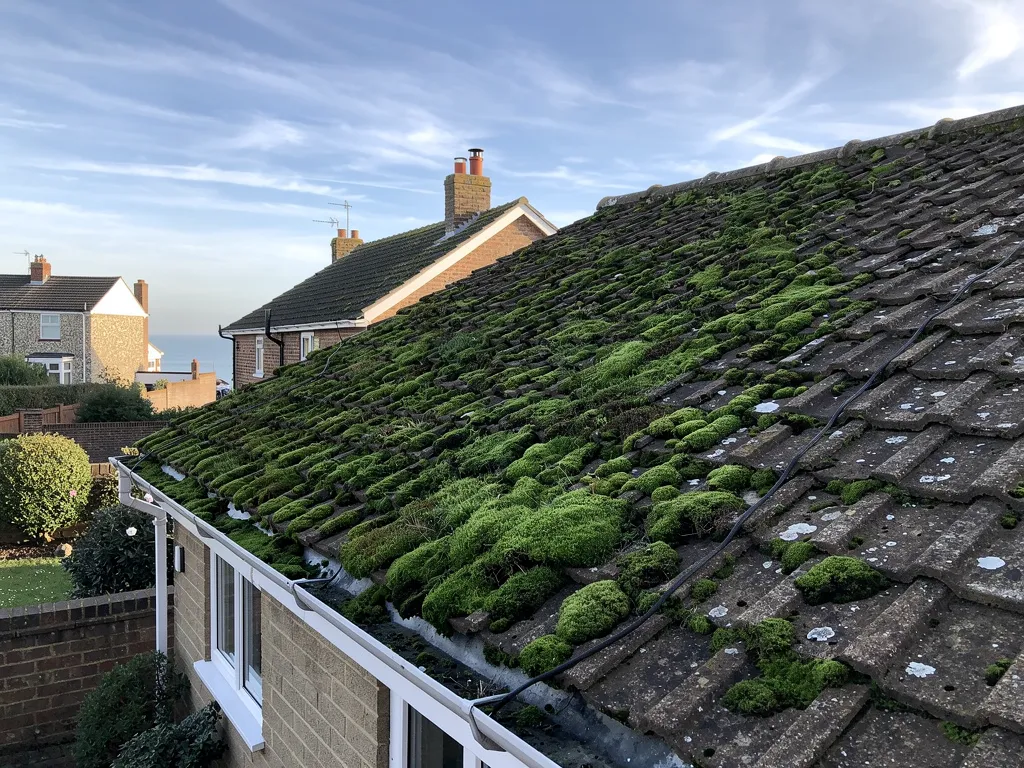
A look from the pavement each autumn
Keeping watch needs no ladder at all. Once a year, and again after a big storm, stand back from the house and look at each slope in good light. Binoculars help. You are checking for patches of green or black, tiles that sit crooked, bits of broken tile in the gutter and moss lumps on the ground below.
Look at the gutters from outside as well. If they overflow in rain or sprout their own growth, the roof above is probably shedding material into them. Keep a phone photograph of each slope from the same spot every year, because comparing this year's picture with last year's shows whether the green is spreading.
If it is thickening, that is the signal to arrange a visit. If it is thin and the tiles look sound, you can wait another season without harm. Make a note in the diary for the same weekend each autumn, so the check becomes a habit rather than something you remember when a gutter overflows.
Signs it is time to book
Thick moss that you can see from the pavement is the obvious one. So are tiles with moss packed under their edges, a valley that runs green, and gutters that fill with grit, which is the tile surface wearing away. If the loft ceiling shows damp marks after rain, get the roof looked at before you decide it is only moss.
Do not clean because of a single leaflet or a stranger at the door. A real inspection should happen first, so that cleaning is not applied to a roof that really needs a repair. If the growth is thin and the tiles are sound, waiting another season does no harm.
When you do book, the written quote follows the survey. It is worth asking whether a treatment will be applied afterwards, as that can stretch the time before the next clean. A shaded slope may still want attention sooner than the sunny one.
Doing less, but doing it properly
Light, regular care is better than aggressive, occasional cleaning. High-pressure washing wears the surface of tiles and can force water under them, so we avoid it on most coverings.
You can reduce how often you need a clean by trimming back branches, keeping the gutters clear and brushing loose leaves from low roofs from firm ground. Before you decide to take the work on yourself, read whether you can remove roof moss yourself, because the risk of falling is the main danger.
A moss killer can help between cleans, but see whether roof moss killers work before relying on one. And if you are choosing a month for the work, the best time of year to remove moss explains the weather and nesting points to keep in mind.
Roof cleaning rhythm
Is it too early to clean a roof that was done recently?
Not if growth has already returned and is thickening in valleys or gutters. A recent clean in deep shade can need a follow-up sooner than expected. Look for the signs rather than counting the years since, and ask for a photograph of the problem area before you agree to anything.
Do new roofs need cleaning?
Not at first, but moss can settle on a new covering wherever it stays damp. Keep an eye on shaded slopes and gutters, and treat early growth before it thickens. A new roof is easiest to keep clear in its first seasons.
Tell us about your roof
Describe what is happening and we will call you back to arrange a visit.
- Photographs of what we find
- A written quote with one total price
- Or call 01903 299063
10-year workmanship guarantee, in writing.