
Question answered
Do roof moss killers work?
The short answer
Roof moss killers work in the sense that they kill moss and lichen, but they do not clean the roof. Dead moss turns brown or black and stays on the tiles until rain, wind or a brush removes it, and it can then wash into the gutters. Used as directed, on a roof already cleaned, a treatment helps slow regrowth. Used alone, it only changes the colour.
They do kill moss, but killing it and clearing it are two different jobs. A treatment is a tool for slowing regrowth, not a way to avoid cleaning the roof.
What a moss killer actually does
Most roof treatments are biocides, chemicals that kill living growth on the surface. You apply the liquid, it soaks into the moss and algae, and over days or weeks the green turns brown, then grey, and begins to flake. The label usually says the effect takes time and that weather helps to wash the dead material away.
That sequence explains a common disappointment. People spray, the moss goes dark, and they conclude it has failed or made the roof look worse. In fact it has started to work. The dead mat is still there, though, and until it falls or is brushed off it still holds some water and can still block gutters.
We do not recommend particular products, because the right choice depends on your tiles, your gutters and what grows nearby. Always read the manufacturer's label and follow it exactly, including any wait before rinsing and any advice on drains and watercourses.
Why dead moss still has to go
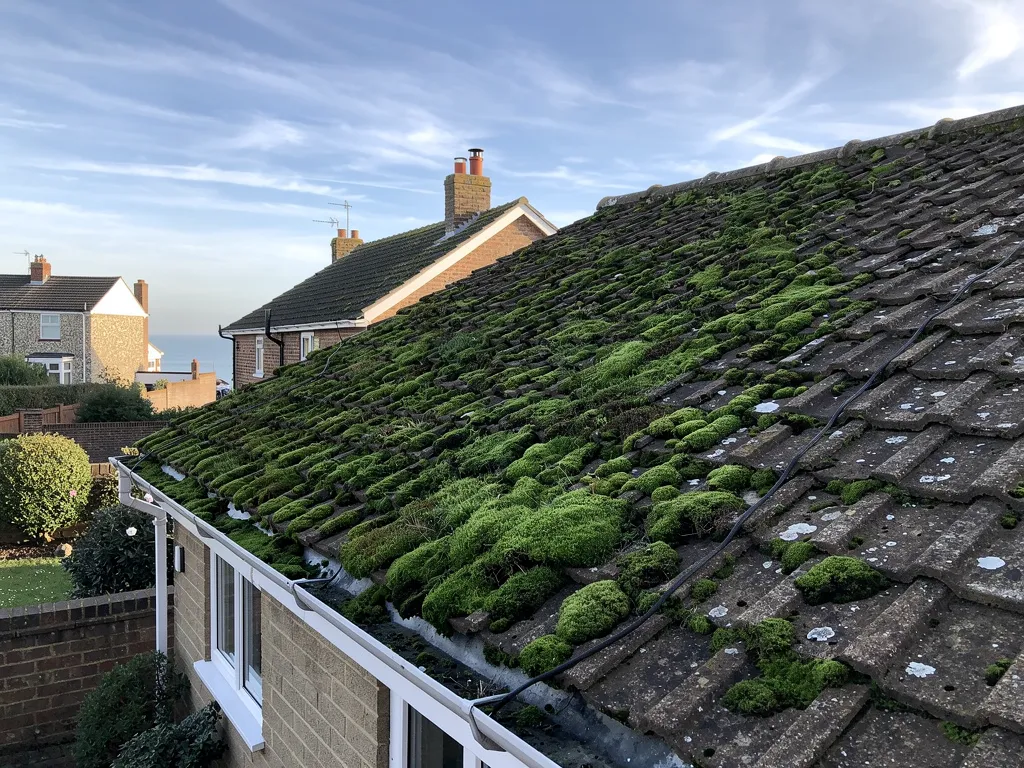
Left alone, a killed layer breaks up in rain and slides down the roof in lumps. These collect in valleys and at the gutter edge, where they can build a dam. That is how a treated roof ends up with a blocked gutter or a valley spilling water into the wall.
The surface also stays a good bed for new growth. Dead material holds dust and seeds, so moss can restart sooner than on a bare tile. The better order is to remove the bulk of the growth by gentle brushing or soft washing, then treat the clean surface to slow what comes next.
Our page on how long before moss grows back explains why shade and aspect matter as much as the product you choose. A treatment cannot change how much sun reaches the slope.
Risks to plants, drains and fittings
Anything strong enough to kill moss can harm other living things. Run-off from the roof lands in gutters, down pipes and the soil beneath, so plants, ponds and lawns can suffer. Check the label for advice about watercourses and drains and cover or water down borders as it directs.
Some formulations can stain fittings, paintwork or the surface of certain tiles. If your roof has copper, lead or older metal features, ask before you apply anything. Never mix products, and never assume that a stronger solution is better.
Bleach and homemade cleaners are a different matter, and we explain the problems in can you use bleach on roof tiles. A purpose-made roof treatment is at least made for the job and carries instructions for it, which a kitchen cupboard product does not.
What makes a treatment work better
Results depend less on the brand than on the preparation and the weather. A treatment works best on a roof that has been cleared of loose growth, on a dry day with no rain forecast, so that it can soak in. On a shaded slope, regrowth will still come back sooner than in open sun.
Professional applications are usually sprayed in a controlled way, with the surrounding area protected, and they are part of a wider plan to keep the roof clear. Another idea is to tackle the cause with better light and airflow, which is why trimming trees often does more than a bottle of liquid.
Lichen behaves differently from moss, being tougher and slower to fade. See lichen on a roof for how it is handled. Our roof cleaning and moss removal page covers how we combine cleaning with treatment.
Using a treatment sensibly
If you decide to try one, apply it from the ground only, in dry settled weather, and wear the protection the label asks for. Never go up on the roof to spread it. Leave time for it to work and for the dead moss to fall, then clear what lands in the gutters rather than leaving it to block them.
Check the forecast first. Rain soon after application can wash the product off before it has had time to soak in, and a very hot, bright day can dry it too fast. Keep the container and the label to hand, and store any leftover out of reach of children and pets.
If you are weighing up whether to do the whole job yourself, our page on removing roof moss yourself covers the safer routes. When the growth is thick or the roof is high, a survey will tell you what is needed.
Keep an eye on the roof over the following months and photograph it from the same spot now and then. If the green returns in the same place, the cause is probably shade or damp, and another dose of liquid will not cure it. At that point the better spending is on light, airflow and a proper clean.
Treating moss
How long does a moss killer take to work?
The label will say. Typically the colour changes over days or weeks, and the dead growth falls away after rain and wind. Do not judge the result too early, and do not reapply before the label allows.
Is a treatment enough without cleaning first?
On a thin film it may be. On thick moss, it leaves a dead mat that holds water and falls into the gutters, so clearing the bulk first usually gives a cleaner result and lets the treatment reach the tile.
Tell us about your roof
Describe what is happening and we will call you back to arrange a visit.
- Photographs of what we find
- A written quote with one total price
- Or call 01903 299063
10-year workmanship guarantee, in writing.