Look at an older tiled roof from the pavement and you will often see flat, crusty patches in grey, pale green, yellow or orange, dotted across the tiles like splashes of dried paint. Many owners assume it is a form of moss and book a clean. Lichen is a different organism, it behaves differently on a roof, and it asks for a different decision.
Moss holds water in thick cushions and can push against the edges of tiles and block gutters. Lichen is thin, slow and tightly stuck to the surface, so it rarely causes the problems that make moss urgent. That does not make it welcome everywhere. A heavy covering can hide cracked tiles from anyone checking the roof, it roughens the surface of a tile, and on a house you are about to sell it can look neglected.
So the honest answer to the question in the title is: usually harmless in the short term, occasionally worth removing, and always worth identifying correctly before anyone quotes. This guide covers how to tell lichen from moss and algae, what it does to clay, concrete and slate, the cases where removal makes sense, and how the cleaning is done without harming the tiles beneath.
A fungus and an alga living as one
A lichen is not a single plant. Two organisms share one body here: a fungus paired with an alga, or sometimes with a bacterium. The fungus provides the structure and grips the surface, while the alga makes food from daylight. Because the pair needs very little, lichen settles on bare stone, bark, walls and roof tiles where almost nothing else will grow.
That is why it tends to arrive after a roof has weathered for some years. A new tile has a smooth, sealed face. As the surface ages and roughens, spores lodge in the tiny pits and begin to grow. Concrete tiles lose their coloured top layer over time, clay tiles develop a pitted face, and natural slate has a grain along which growth can take hold. The roof is not failing when this happens. It is simply old enough to have been colonised.
Why it keeps coming back
Lichen spreads by tiny fragments and spores carried on the wind and by rain splash, so a cleaned roof next to a covered one can be re-seeded. Growth is slow, which means a patch you notice today has probably been forming for a long time.
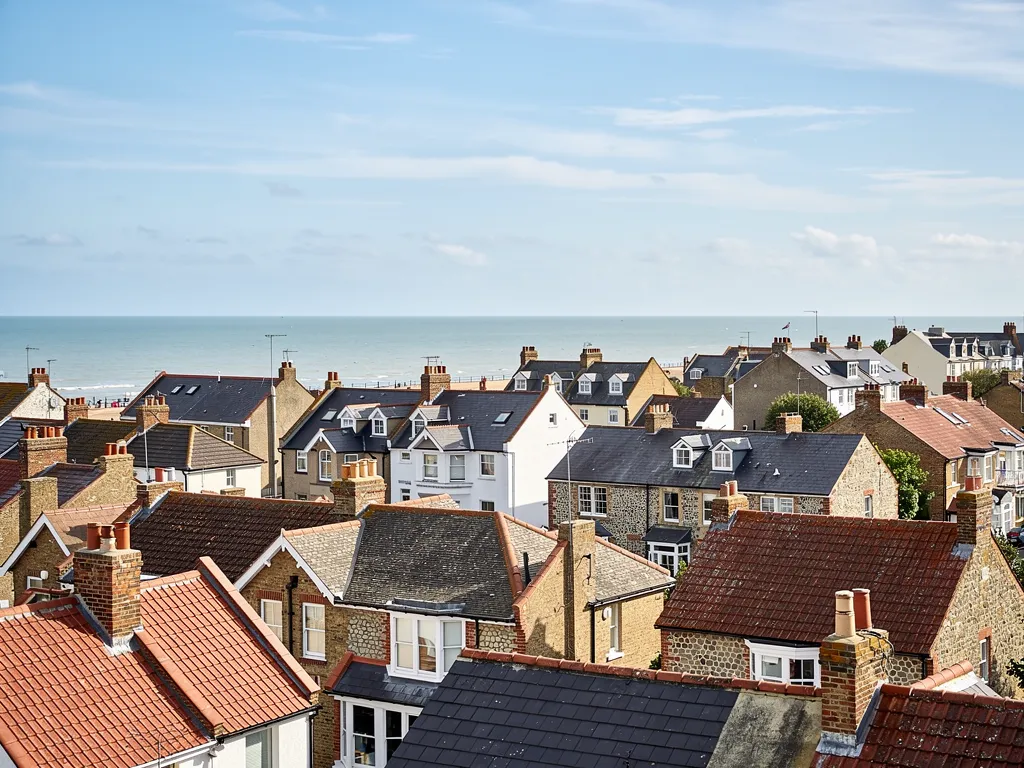
It also copes with conditions that defeat other growth. It can dry out completely and then revive when damp returns, so a dry spell does not kill it. Open, exposed roofs, and the slopes that catch the weather rolling in from the Channel and over the Downs, can carry lichen and moss side by side, with lichen on the bright, drier faces and moss gathering in the shade. Knowing which organism you have is the first step, because the two ask different questions of a roofer.
How to tell lichen from moss and algae
You do not need to climb up to tell them apart. A pair of binoculars from the garden, or a zoomed phone photograph, will show most of what matters.
Lichen forms flat or slightly raised discs and rosettes that look painted on. Colours run from pale grey and sage green to bright yellow and orange, and the patches often grow outwards in a rough circle. When you look closely the edge is crisp and the centre is often pitted. Moss, by contrast, stands up in soft green or brown cushions and tufts, and in damp weather it looks plump and spongy. Algae is the third look-alike. It shows as dark green or black streaks and films, usually running down the slope below a ridge or a chimney, and it makes a roof look dirty rather than furry.
A simple field test
If the growth stands proud of the tile and you could imagine lifting it away in a clump, it is moss. If it is flat, crusty and seems to be part of the tile itself, it is lichen. Dark staining with no texture at all is usually algae. Dark streaks with no texture are a separate case from either.
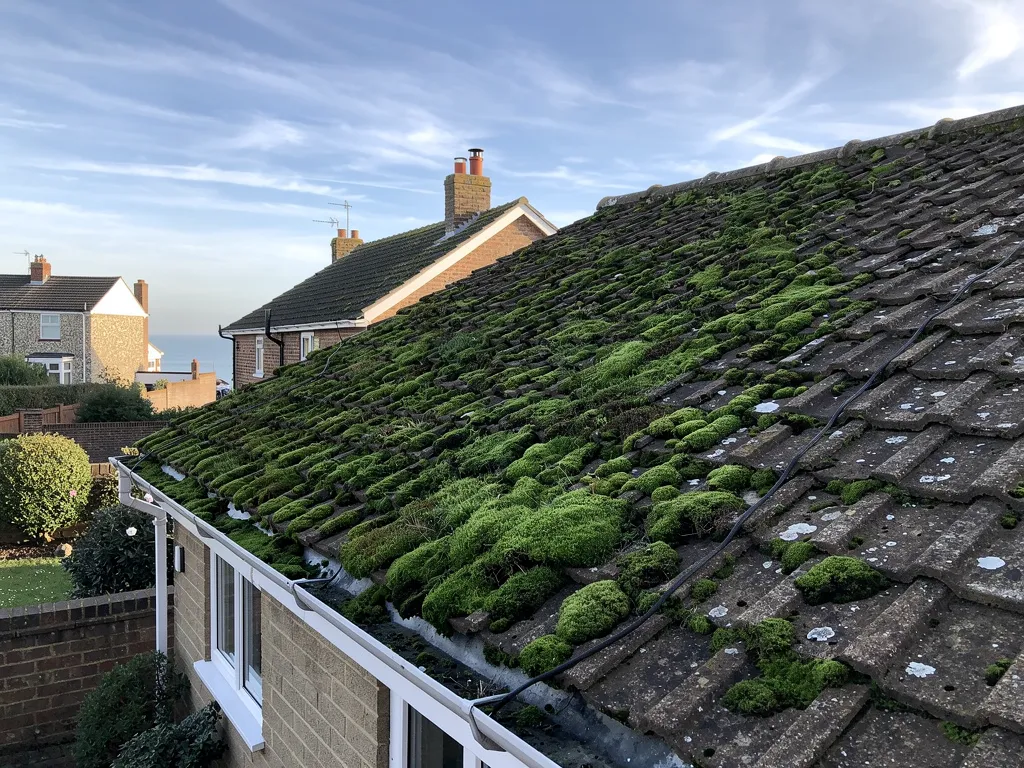
Many roofs carry more than one. A north-facing slope might be green with moss at the eaves, streaked with algae in the middle, and crusted with lichen near the ridge where it is lighter and drier. Treating the whole roof as moss misses that picture.
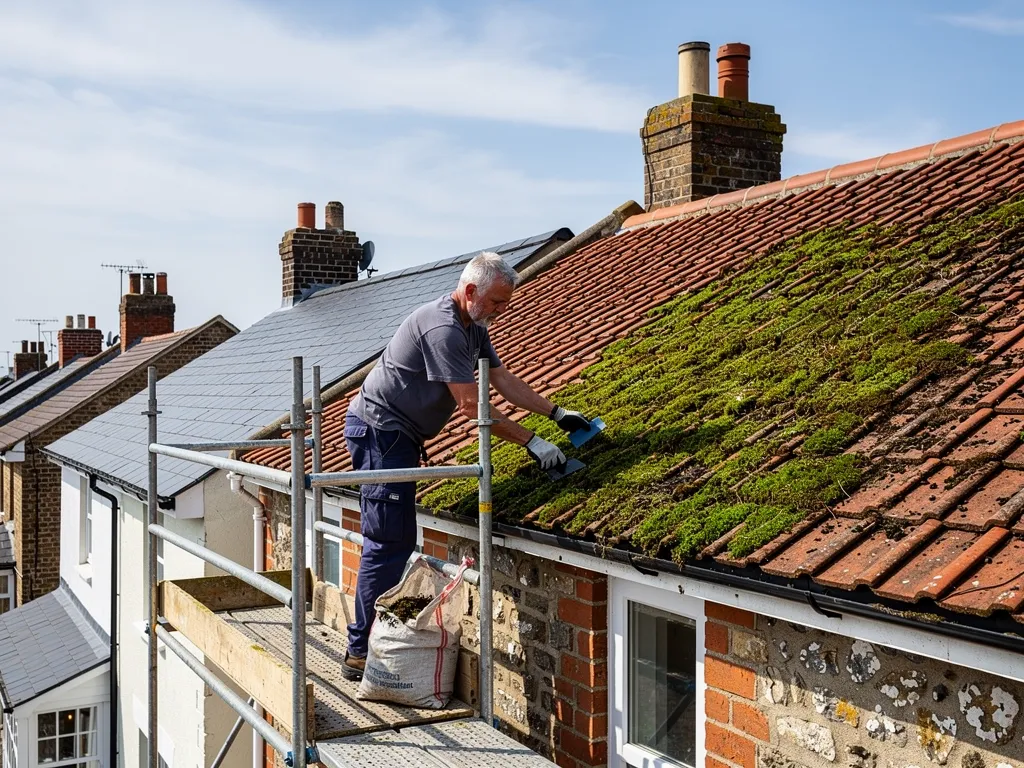
It matters because the methods differ. Moss can be lifted away by hand and scraped from the lower courses. Lichen cannot be lifted, since it is grown into the surface, and that changes both the work involved and the price. We note which growth is on each slope when we survey, and the photographs we send with the written quote show it.

What lichen does to clay, concrete and slate
The short answer is that lichen sits on the surface and does far less than moss. It does not build a thick wet mat, it does not block valleys or gutters in the way moss does, and it does not push tiles apart. A roof with a light covering of lichen and nothing else is rarely leaking because of it.
The effects are quieter. The organism releases mild acids that can slowly etch the face of some materials, and its grip leaves the tile surface rougher, which gives moss and algae a better foothold the next time. On soft, porous clay or an ageing concrete tile that matters a little more than on hard slate. A heavy lichen crust can also hold a film of moisture against the tile after rain, so the covering stays damp for longer than a clean tile would.
The real risk is what it hides
On a thickly covered roof, a cracked tile, a slipped slate or a failed ridge bedding can be almost invisible from below. Crust spreads across the break and the colour matches the neighbours. If you are checking a roof after a gale, or a surveyor is looking at one before a purchase, heavy lichen makes the job harder.
On tiles that are already soft and flaking, the growth and the damage are often found together, so the cause can be unclear. We look at whether the surface is failing under the lichen or whether the lichen is simply sitting on a sound tile.
If a roof is also holding thick moss, the moss is the bigger concern, and whether moss damages roof tiles sets out why. Where lichen is the only thing on the roof, the decision is usually about appearance, access for repairs and the age of the covering.
When lichen is worth removing and when to leave it
Leaving lichen is a perfectly reasonable choice on many roofs. If the covering is sound, the growth is light, the gutters run clear and nobody needs the tiles to look new, there is little to gain from paying for removal. Many older roofs wear lichen as part of their character, and on some period buildings a weathered, mellow look is part of what an owner wants to keep.
Removal starts to make sense in a handful of situations.
- The covering is heavy enough to hide damage, and you want a proper inspection or a repair to go ahead with confidence.
- The roof is going on the market, or the front elevation faces a road where appearance matters to you.
- Moss or algae is growing in the same patches, so there is a real water and gutter problem to deal with anyway.
- The tile surface is already rough and porous, and you want to reduce what holds moisture against it.
Take care on slate and on historic roofs
Hard natural slate carries lichen well and is easily damaged by aggressive cleaning, so the case for leaving it alone is stronger there. The same goes for a listed building or a roof in a conservation area. Light maintenance is one thing, while anything that changes how the roof looks or what it is made of can raise planning questions, so check with the Adur & Worthing planning team before agreeing to anything beyond gentle cleaning.
If you cannot decide, ask for a survey rather than a clean. We photograph each slope, say whether the growth is lichen, moss or algae, say what it is doing and recommend the smallest job that fits. Sometimes the right advice is to leave it.
How lichen is removed, and why it is harder than moss
Because lichen grips the tile rather than sitting on it, scraping alone does not work well. A scraper lifts moss easily, but on lichen it removes a little of the crust and often marks the tile in the process. Pressure washing is the other method people reach for, and Strong jets can harm older, softer tiles, so we do not treat it as a general answer. Jet washing also drives water under overlapping tiles.
The usual approach is a biocide, a treatment that kills the organism where it grows. It is applied by a gentle low-pressure spray, left to work, and then allowed to break down over the following weeks. Dead lichen does not drop off at once. It fades, turns brown or grey and loosens gradually as the rain and wind wear it away, which can take a season or more. The roof may look no better the week after treatment, and that is normal. What biocide treatments do covers the process. Shop-bought moss killers work on the same principle, with less control over the dose.
What it costs
MyBuilder (updated 21/08/2026) gives a typical UK range for roof cleaning of around £300 and up, with tile roofs at £400 to £750, pitched roofs at £450 to £850 and slate at £500 to £1,000. Lichen removal sits within that spread, and the survey sets the final figure through access, roof size, covering type and the weight of growth. You receive a written quote after the survey, giving one total price.
This sits within our wider roof cleaning and moss removal work. Work at height needs proper access, and we make sure the site is cleared and the debris taken away when the job finishes.
A sensible plan for a lichen-covered roof
Start with identification. Work out from the ground whether the roof carries lichen, moss, algae or a mixture, and note which slopes are worst. Photograph them in daylight so you can compare in a year.
Next, check what is underneath. Look from the loft for daylight through the tiles, stained timbers or damp underlay, and from the garden for slipped or cracked tiles. If there is any sign of a fault, a repair comes before a clean, because cleaning a leaking roof only moves the problem.
Then decide how far to go
For a light, stable covering on a sound roof, the best plan may be to leave it and look again after the winter. For heavier growth that hides defects, or lichen mixed with moss that is blocking gutters, a gentle biocide treatment with the loose moss lifted by hand is a sensible middle course. Aggressive removal is rarely the answer.
Some owners ask about a coating afterwards to slow regrowth. That has its own pros and cons, which our guide to roof coatings after cleaning sets out, and a coating is not a substitute for a sound roof underneath.
Whatever you choose, keep the gutters clear, trim back overhanging branches that drop debris and shade the slope, and check the roof after storms. Those habits slow regrowth on any covering.
When we carry out cleaning or repair, we say which method suits the covering, because tiles, slates and fibre cement tolerate washing differently. Ring 01903 299063 or use WhatsApp or the enquiry form, and attach a photograph or two of the slope that worries you. We will tell you what we think is growing there and whether it needs doing at all.