A green mat along the north slope looks like decoration at first, and plenty of people leave it for years. The question of whether it is doing harm has a mixed answer, and a lot of roofing advice online either panics about it or waves it away.
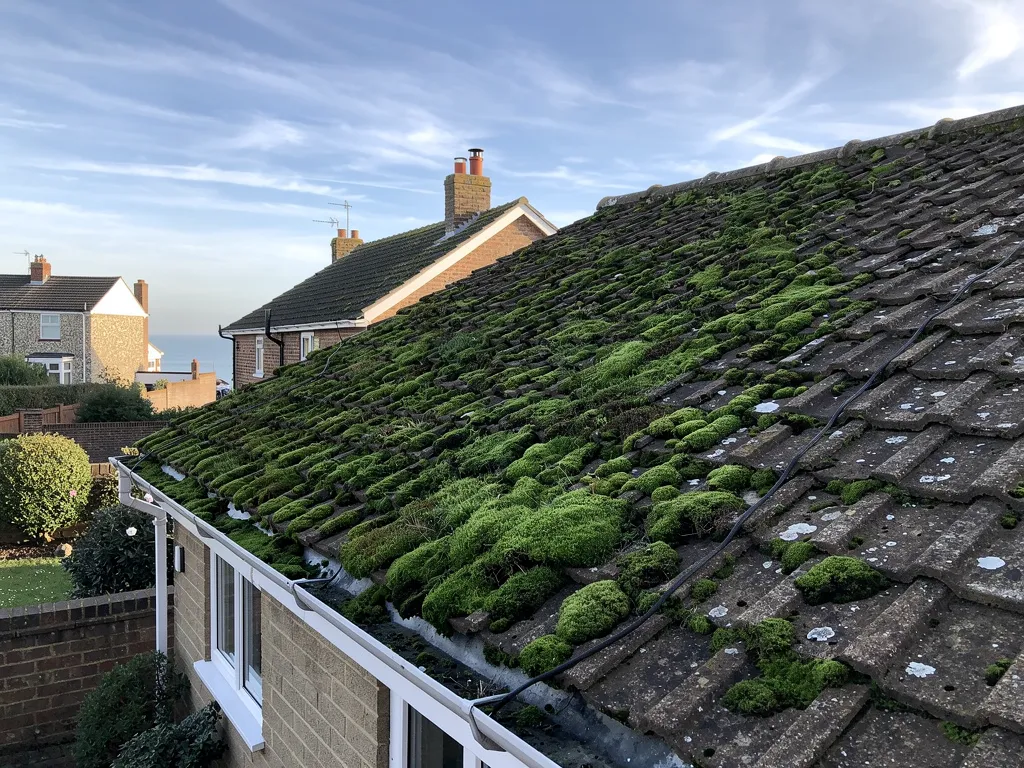
The plain position is this. A moss cushion is a sponge sitting on your roof. It soaks up rain, stays wet long after the tiles around it have dried, and traps leaf litter and grit. On a sound, well-pitched roof that slow dampness does little in a single season. Over many winters it can shorten the life of porous tiles, push against overlaps, fill valleys and gutters, and hide faults that you would otherwise spot early.
So the damage is usually indirect. Moss itself does not eat a tile, but it creates conditions that do. This guide follows the four routes by which a mossy roof can go wrong: water held against the surface, frost working on that water, blocked drainage, and a covering that hides defects. It also says when moss is only cosmetic and can safely wait, and what the sensible next step is for each case.
Moss as a sponge on the roof
Moss has no roots in the way a garden plant does. It holds on with tiny threadlike anchors and takes water straight through its leaves, which means a thick cushion can store a surprising amount of rain and release it slowly. On a dry afternoon the tiles beside it are bone dry while the moss is still damp underneath.
That has two effects on a tile. First, the face under the cushion stays wet for far longer than a clean tile ever would. Porous materials, particularly older concrete tiles and soft clay, take up that moisture and carry it into the body of the tile. Second, the moss builds up a layer of dead growth, leaf mould and fine grit at its base, which keeps the dampness in place and gives new growth a seedbed.
What this does in practice
A tile that is regularly soaked and then dried weathers faster than one that sheds water quickly. The surface can flake or powder, the edges can become friable, and the tile can gain weight when it is saturated. None of this is dramatic from one year to the next, which is why the harm is easy to miss. It shows as an accumulated effect: a roof that looks older than its age, with a rough, eroded face where the moss sat.
Dense hard slate is far less affected, because it takes in almost no water. The damage on a slate roof is more about what the moss traps than what it absorbs, and our guide to cleaning a slate roof safely covers how to deal with it without breaking the slates.
Frost, thaw and the wet tile face
Water that freezes expands. A tile that is full of water on a cold night has nowhere to put that expansion except outwards, so the surface can flake off in thin layers, a process called spalling. Repeated freezing and thawing over many winters is one of the main ways a porous tile ages.
Moss makes that worse because it keeps the tile wet right up to the moment the temperature drops. A clean tile on a clear evening may have shed most of its water by dusk. A tile sitting beneath a wet cushion is still saturated at midnight. The frost then does its work inside the surface, and the following thaw leaves behind a tile that is a little weaker than before.
The edges are where it shows
Tile edges and overlaps are thinner and more exposed, so that is where spalling is usually seen first. Moss also grows in the gaps between overlapping tiles, and as it thickens it can wedge into the joint. It does not lift a sound tile in a dramatic way, but on a tile that is already loose or poorly fixed, a thick pad under the edge can add enough pressure to help a gale lift it.
How much frost damage follows depends on the tile, the pitch and how exposed the slope is. A shaded north slope on the Downs or in the Weald villages can stay wet and cold for long stretches, and so can a sheltered slope behind a tall hedge or a neighbouring gable near the coast.
If you see grit and flakes in the gutter below a mossy slope, the tile face is probably breaking down, and that is worth a closer look from a roofer.
Moss in gutters, valleys and at the eaves
The most serious trouble moss causes is not on the open slope at all. It is where water gathers and has to leave. Valleys sit where two roof planes join at an inward corner, take run-off from both, and are narrow by design. A thick bed of moss in a valley slows the flow, and in heavy rain the water can climb over the edge of the lining and run under the tiles beside it.
Gutters have the same weakness. Moss growing along the lower courses drops clumps and spores into the gutter every time it is brushed by rain or wind. The debris mixes with grit and leaf litter, forms a dam, and the gutter begins to overflow. Water spilling over the back of a gutter wets the fascia, the board that carries it, and runs down the wall. A blocked gutter can also hold water above the tile line, where it creeps up the underlay at the eaves.
Signs to check from the ground
- Water spilling over a gutter in rain that is not especially heavy.
- Green or black marks running down the wall beneath the gutter.
- Moss clumps, grit or tile fragments collecting at the downpipe.
- A damp patch on a ceiling or wall under an eaves or valley.
These are the cases where moss moves from cosmetic to costly. A valley that has been choked for years may also have lead or a lining that has split under the weight of debris, and that is a repair, not a clean. When we survey, we photograph the valleys and the gutter line first.
A covering that hides the faults underneath
Moss does one more thing that is easy to overlook. It covers things. A slipped tile, a cracked slate, a loose ridge or a patch of failed pointing can all disappear under a green mat. The owner sees a roof that looks uniform, and the fault goes unnoticed until damp shows on the ceiling below.
That matters because a leak usually starts small. A slate that has slid a few centimetres lets in a trickle in driving rain, and the water then runs along the underlay for some distance before it shows. The earlier the fault is found, the smaller the repair. A heavy cover of moss delays the finding.
Moss along ridges and hips
The top of the roof gets sun and wind, so it usually carries less moss than the lower slopes. Where it does grow along a ridge, it can break up the mortar joints as it dries and swells, and it makes the bedding harder to inspect. BS 5534 has treated ridge and hip tiles as needing a mechanical fixing too since its 2014 revision, so ask whether yours have one. Moss growing in a bedding joint is a sign that the mortar is porous and the joint is open.
The remedy is not always to clear the whole roof. Often the smart move is to lift the moss from the areas that matter, inspect them, and repair what the cushion was hiding. Lichen can cover a roof in the same way, and our separate guide to lichen on roof tiles is the better read if the growth you have is crusty rather than fluffy.
When moss is only cosmetic
Not every mossy roof is a problem. A light scattering on a sound, well-fixed roof, with clear gutters and valleys and no leaks, is largely a matter of appearance. Moss grows most thickly on shaded slopes, under trees, and on the side of the house that stays damp, and a house in those conditions will grow some again whatever you do.
It helps to treat the decision as a risk question, not an emergency. Ask four things. Is it thick enough to hold water against the tiles? Is it near a valley, gutter or the eaves, where blocked flow causes damage? Is it hiding anything? How old and how porous is the covering? If the answers are no, no, no and a hard slate or a recent tile, you can wait and watch.
Roofs where it matters more
Moss deserves more concern on older concrete tiles with a worn face, on low-pitched slopes where water runs off slowly, and on any roof with a history of slipped tiles or leaks. A low pitch is a particular worry, because water drains slowly and stays among the moss for longer.
The other consideration is time. Moss grows, and the cost of dealing with it rises as it thickens. Manual scraping is typically quoted at £5 to £10 per m² in the MyBuilder roof cleaning guide (updated 21/08/2026), and a basic clean starts from around £300. Waiting rarely saves money if the moss is heading for the gutters.
If you are unsure which side of the line your roof is on, send a photograph taken from the garden, and the survey will show you how the roof really stands.
What to do about a mossy roof
Start with a safe look from the ground. Check the valleys, the gutter line, the north slopes and anywhere a tree overhangs. Photograph what you see, and make a note of any damp patches inside the house.
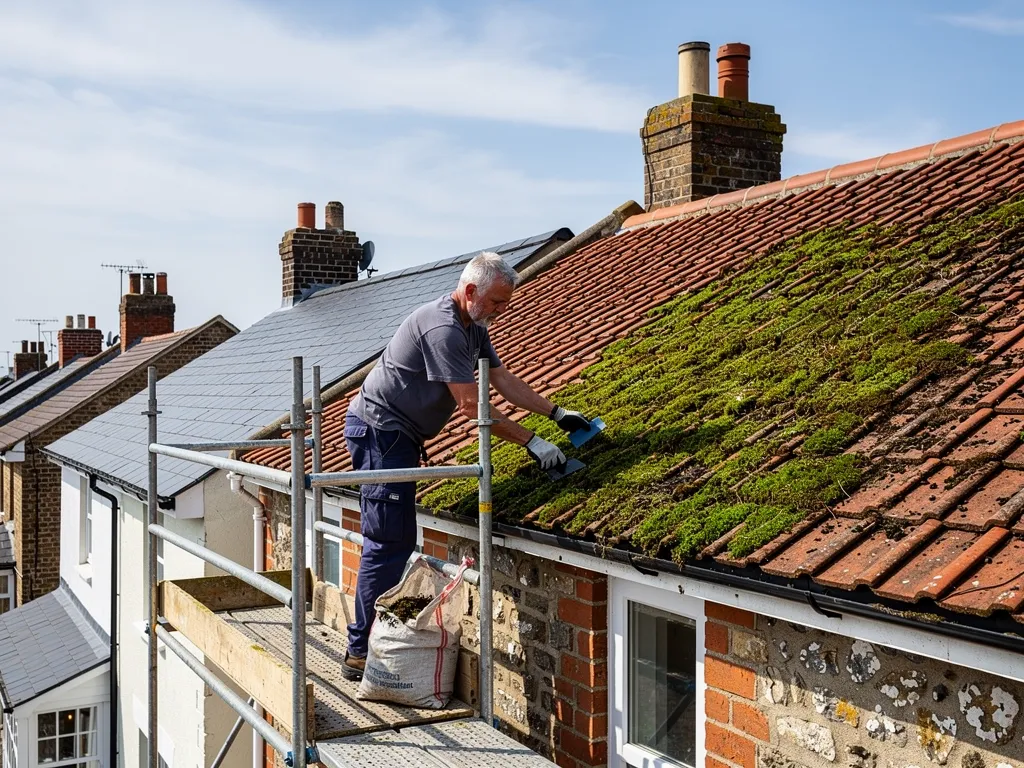
If the moss is light and the roof is sound, the best course is often to clear the gutters, trim back overhanging branches and recheck after winter. Where it is thick, wedged in joints or building up in a valley, the options are brushing and scraping by hand, a low-pressure treatment with a biocide, or a mixture of the two. We prefer to start with the gentlest method that works, because strong jets and stiff brushes can wear the tile face and push water under the overlaps.
Things to avoid
Household bleach is a common DIY choice, and our answer on using bleach on roof tiles explains why it is a poor one. Standing on a wet mossy roof is dangerous, and it is also a quick way to crack tiles, so do not go up yourself.
After the clean
Clearing the growth does not stop it returning, and a coating is one option for slowing regrowth. We cover the pros and cons in our guide to roof coatings after cleaning. Our wider roof cleaning and moss removal page sets out how we approach the job from survey to clear-up.
If the moss sits on a roof with tired pointing or slipped tiles, the survey tells you which of those matters more than the growth itself. Call 01903 299063, message us on WhatsApp or use the enquiry form, and we will survey the roof, send photographs of what we find and give a written quote.