Open a tin or a drum of roof moss treatment and the label will describe a biocide: a chemical made to kill living organisms. On a roof the targets are the plant-like growths that colonise damp tiles, namely moss, lichen and the green or black film of algae. The product is sprayed over the slopes, soaks into the growth, and over the following days and weeks the growth dies and loosens its grip.
That sounds simple, and it is a useful tool, but it is easy to misuse and easy to misunderstand. A biocide is not a cleaner, and on its own it does not leave a tidy roof on the day it is applied. It is a treatment, and its job is to deal with the living part of the problem and to slow the return of growth. The dead remains still have to go somewhere, either by a gentle brush down or by the wind and rain over time.
The rest of this guide takes you through what happens on the roof, the conditions that help or hinder, what to expect week by week, and the care needed with the water that runs off the roof afterwards. It belongs to our wider roof cleaning and moss removal work, where biocide sits beside scraping and soft washing.
How a biocide acts on moss, lichen and algae
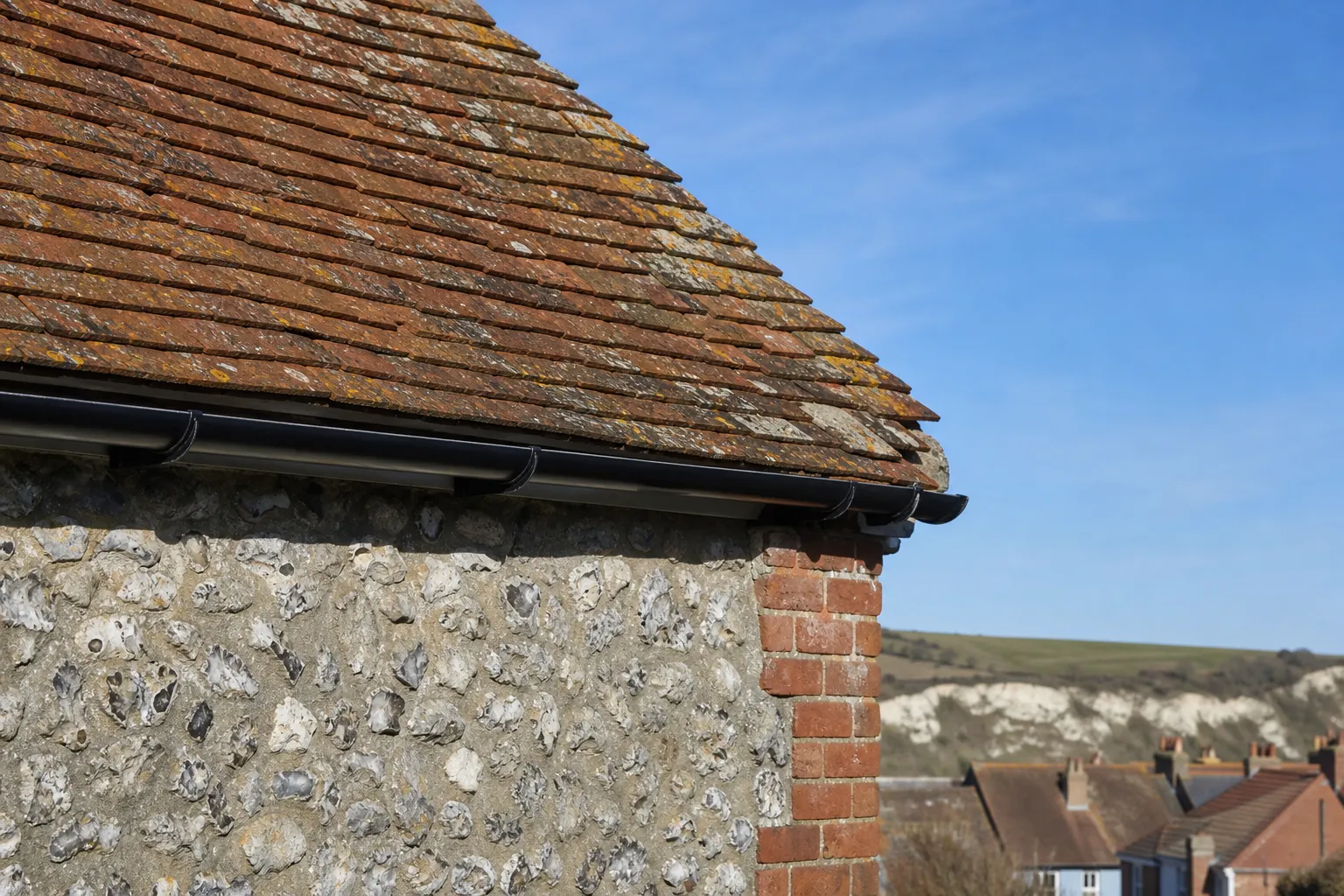
Moss, lichen and algae are different organisms, and a roof treatment has to deal with all three. Moss is a small plant with a mat of fine strands that anchor it to the surface of the tile. Algae is a thin film, green when young and darker with age, which gives the black streaks you see on many slopes. Lichen is a partnership between a fungus and an alga that forms a crust, tightly attached, in grey, orange or pale green patches.
A biocide works by being absorbed into the growth. It disrupts the living cells, and the organism stops growing, browns, and dies. The strands that anchor moss loosen, the algae film fades and the lichen crust becomes brittle. Different products reach this end by different chemical routes, and their strengths differ. Some are quick on algae and slow on lichen, which is the toughest of the three to kill. The label should say which organisms the product is made for.
The treatment acts on the living part only. It does nothing about the debris that remains, and it does nothing about the conditions that let the growth take hold: shade from trees, a damp north-facing slope, blocked gutters that keep the lower courses wet, and salt-laden sea air that leaves surfaces slow to dry.
This is why a biocide is best seen as one stage. For a roof carrying a thick layer, it usually follows the physical removal of the bulk. For a roof with a light film of algae and little else, it may be all that is required. Our guide to lichen on a roof explains why that crusty growth often needs particular patience.
Applying it: weather, timing and preparation
The best result comes from applying a treatment to a dry roof when the forecast is settled. The product has to soak into the growth and stay there long enough to work, which the label calls the dwell time. If heavy rain falls too soon, much of it is washed down the slope into the gutter before it has done its work, and the treatment is wasted.
Frost is the other enemy. A roof that is cold and frozen at night will not take up a treatment well, and the chemistry slows right down. Spring and autumn, with mild, dry spells, tend to suit best, though a long dry stretch in any season will do. Midsummer midday sun can dry the liquid before it soaks in, so a cloudy, dry day is often the better one.
Preparation matters just as much. Gutters should be cleared, so run-off has a clear route and does not pool. Doors and windows below should be shut, car and garden furniture moved, and plants covered or wetted. Where there is thick moss, taking the bulk off by hand first lets the product reach the tile and the roots. A treatment sprayed over a deep cushion mostly wets the top.
The way it is applied counts too. A roofer works across the slope steadily so that coverage is even, paying attention to the laps and shaded edges where growth is thickest, and does not allow it to run off in streams. A watering can or a garden sprayer used from a ladder gives patchy coverage. Much of what a proper application costs is the price of doing it safely.
Following the label
Dilution, coverage per litre, drying time and what to protect nearby are all set out in the manufacturer's instructions. Follow them to the letter, and keep the product container to hand so any advice can be checked.
What to expect over the weeks that follow
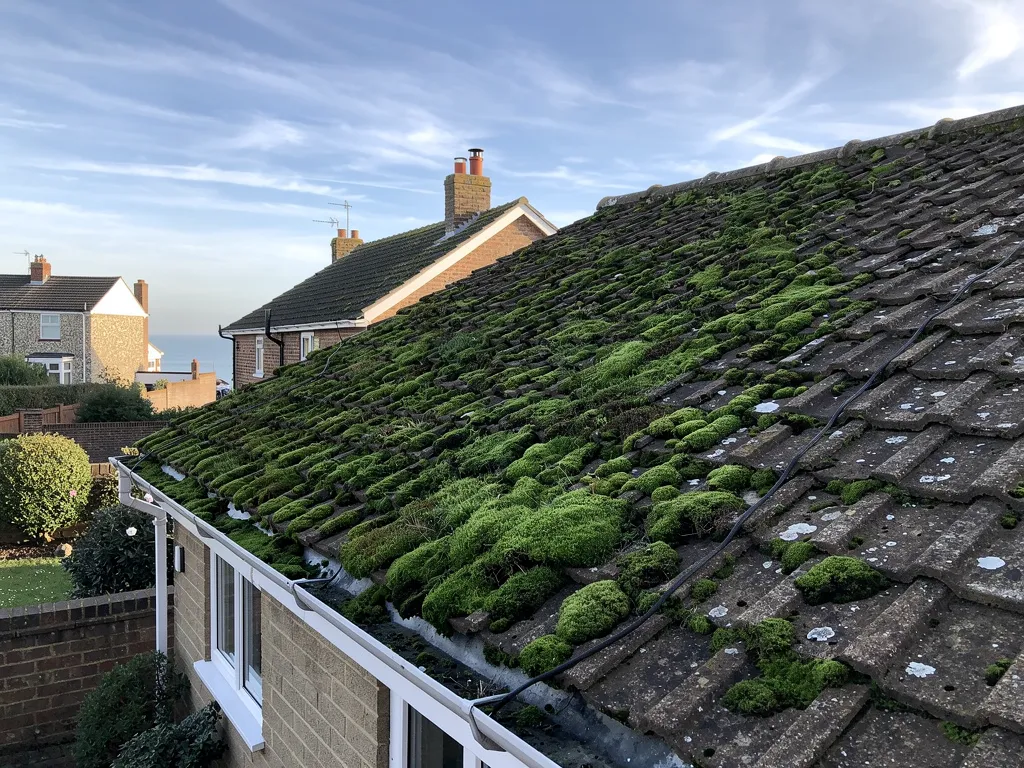
A treated roof does not look clean on the day. In fact it often looks worse for a time. The moss turns brown or black, the algae streaks may darken, and patches of dead growth sit on the tiles until they are shifted. People who expected a dazzling roof by teatime are sometimes alarmed, and a roofer should tell you beforehand what is coming.
The pattern is gradual. Within a week or two the colour of the growth begins to change. Over the next few weeks, rain, wind and the freeze and thaw of the colder months loosen the dead material, and it washes or blows off. Many roofs look clear after a couple of months. Thick moss or established lichen can take much longer, and some patches need a light brush to finish.
That slow rate is the price paid for gentleness. A biocide does not scrape or blast, so the tile face is left undisturbed and there is no force driving water under the laps. For brittle slate, ageing clay, or any covering you want to preserve, that matters a great deal. It is the reason many roofers prefer it to a jet wash.
You can help by leaving the roof alone while it works. Do not scrub it, do not walk on it, and do not be tempted to jet off the dead moss. If the debris collects in the gutters, they need clearing again once the bulk has fallen.
Judge the success at the end of the season, not after a fortnight. A well-treated roof should show clear faces, tidy lap lines and gutters that are not filling up with green. If patches remain after several months, a second light treatment or a hand brush may be needed, and a good roofer will return to deal with them.
Run-off, plants and the water below the roof
Whatever is sprayed on the roof ends up somewhere. It runs down the slope, into the gutter, down the downpipe and out into a drain or a soakaway, and some of it drips onto the garden along the way. A responsible application plans for that from the start.
Plants are the first concern. Many biocide products can harm garden plants if the run-off reaches the soil in strength, so beds beneath the eaves are usually covered or well soaked before the work. Lawns, shrubs and climbers fixed to the house are the usual casualties when nothing has been done. Water butts should be disconnected from the downpipe, so that treated water does not collect and later get used on vegetables or poured into a pond.
Ponds and wildlife need the same thought. Garden ponds, streams and ditches are damaged by chemical run-off, and so are drains that lead to surface water. Pets and children should be kept off treated paths and lawns until the product label says it is safe. A tidy job keeps all of that in mind, in the way the sprayer is used, in how the gutters are managed, and in what is done with any rinse water.
The label is the authority on what is safe and what must be protected, and the contractor should read it before the work, not after it. Questions about a particular product, including what it contains and how it must be handled, are answered by its own instructions and safety data sheet, and you are entitled to ask to see both.
If a roofer cannot tell you what is in the product, or shrugs at the question of run-off, that is a reason to think again before the work begins.

How long a treatment lasts and what shortens it
No treatment is permanent, and anyone who promises that it is should be questioned. A biocide kills the growth that is present and leaves the surface less friendly for the growth that follows. How long that holds depends on the roof and the setting far more than the product.
Shade is the greatest factor. A roof that sits beneath mature trees collects leaf litter, drips of water and a steady supply of spores, and it dries slowly. A north-facing slope gets less sun, so it stays damp for longer, and that is where green returns first. Sheltered gardens in the Downs villages and the Weald, and sea mist along the coast, keep surfaces damp for long periods and encourage algae.
The covering counts as well. A rough or porous tile gives growth more to hold on to than a smooth one, and a tile with its surface worn away, perhaps by earlier jetting, takes growth sooner. Gutters that overflow keep the lower slope wet, and valleys collect debris and moisture where moss gathers first.
Because of all this, there is no single schedule that fits every roof. Some are kept clear for several years, others need attention more often. A fresh film of green at the edges is the early signal that the treatment is wearing off, and catching it then is much easier than waiting for a thick mat to form.
Does moss really harm the roof?
The answer depends on the covering and how long the moss has been there. We look at it in our guide on whether moss damages a roof, and it is the question that decides how urgently a treatment is needed.
Deciding whether to treat the roof yourself
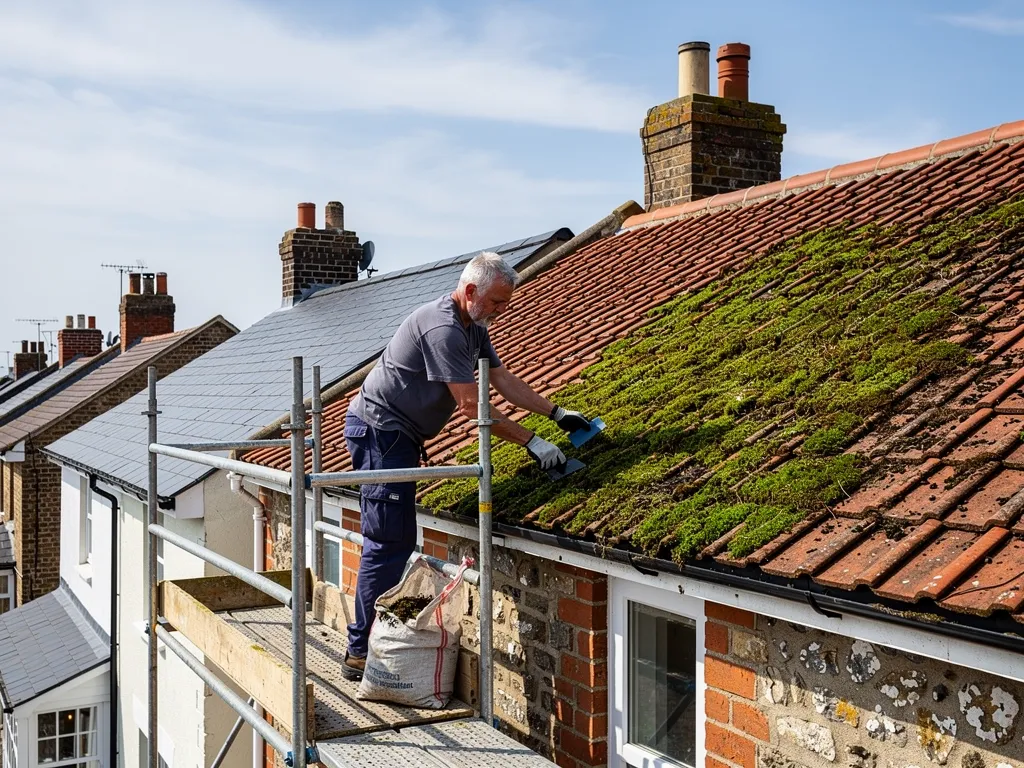
Treatments are sold over the counter, and plenty of people consider spraying their own roof. Our guide to DIY moss removal looks at that choice in detail. The central point is safety: roofs are dangerous places, and falls from ladders and roofs are a serious cause of injury. A treatment applied from the ground with a long-reach sprayer will not reach the upper courses, and climbing onto a wet or mossy roof to improve coverage is exactly the wrong thing to do.
There are practical limits as well. A garden sprayer gives uneven coverage, and without removing thick moss first, the product will not reach the tile. Run-off is harder to control when you are working from a ladder with a hand-held spray, and the mess lands on your own paths and plants.
A professional application deals with these things. Access equipment is set up properly, the thick growth is taken off first, the treatment is applied evenly, and the gutters and ground are protected. The roof is inspected as the work goes on, which means cracked tiles, loose ridges and failing pointing are found before they turn into leaks.
That inspection is what makes the biggest difference to the final decision. A roof may need a repair as well as a treatment, and the least costly moment to find that out is during the clean. Our survey produces pictures of the slopes and a written quote, and the quote names which slopes need treatment and which can be left alone. If the roof needs only a modest treatment, that is what we recommend; if it needs more, you will see why.