
Question answered
Preparing for a roofer's survey visit
The short answer
To prepare for a roofer's survey, make sure the loft hatch is clear and reachable, gather anything you know about past roof work, write down when and where the roof leaks, and take dated photographs of stains from inside. Tell the roofer about side access, parking and any neighbours' boundaries. None of it needs to be tidy; it just needs to be to hand.
A little preparation makes a survey quicker and the findings sharper. Most of it takes ten minutes: a clear route to the loft, a note of what has happened and a few photographs.
Give access to the loft
The roof space tells a surveyor more than the outside of the roof can, since it exposes the back of the covering, the timbers and any tide marks where water has run. Start by making the hatch easy to get to.
Clear the landing below it. If the hatch is in a cupboard, empty enough of it to get a ladder under the opening. Make sure the hatch lid is not painted shut or screwed down, and if the loft is boarded, show the roofer where the boards end and where the bare joists begin.
If there is a light, check that it works, and leave a torch by the hatch. Move stored boxes away from the eaves and from the areas under the stained ceilings, so the underside of the roof there can be seen. If anything in the loft is valuable or fragile, move it out the day before rather than during the visit.
A loft that cannot be entered is one of the main reasons a survey ends with "further investigation needed".
Collect the roof's history
Any paperwork helps, however old. Invoices for previous repairs, a re-roofing receipt, a home buyer's survey that mentions the roof, or an insurer's letter after a storm all say something about what has been done and when.
Write down what you remember as well. Which ceilings have marked, and when did you first see it? Has anyone been on the roof recently, for a satellite dish, a chimney repair or a solar installation? Has the loft ever been insulated, boarded or converted? Each answer narrows the search, because a leak that started the week after a new aerial went up points somewhere quite different from one that came with the first gale of autumn.
If the house has had a flat-roofed extension, a porch or a dormer added, mention it. The joints between old and new roof are common places for water to get in, and the surveyor will want to look at them closely. Our flat roof inspection guide covers what is looked at on those.
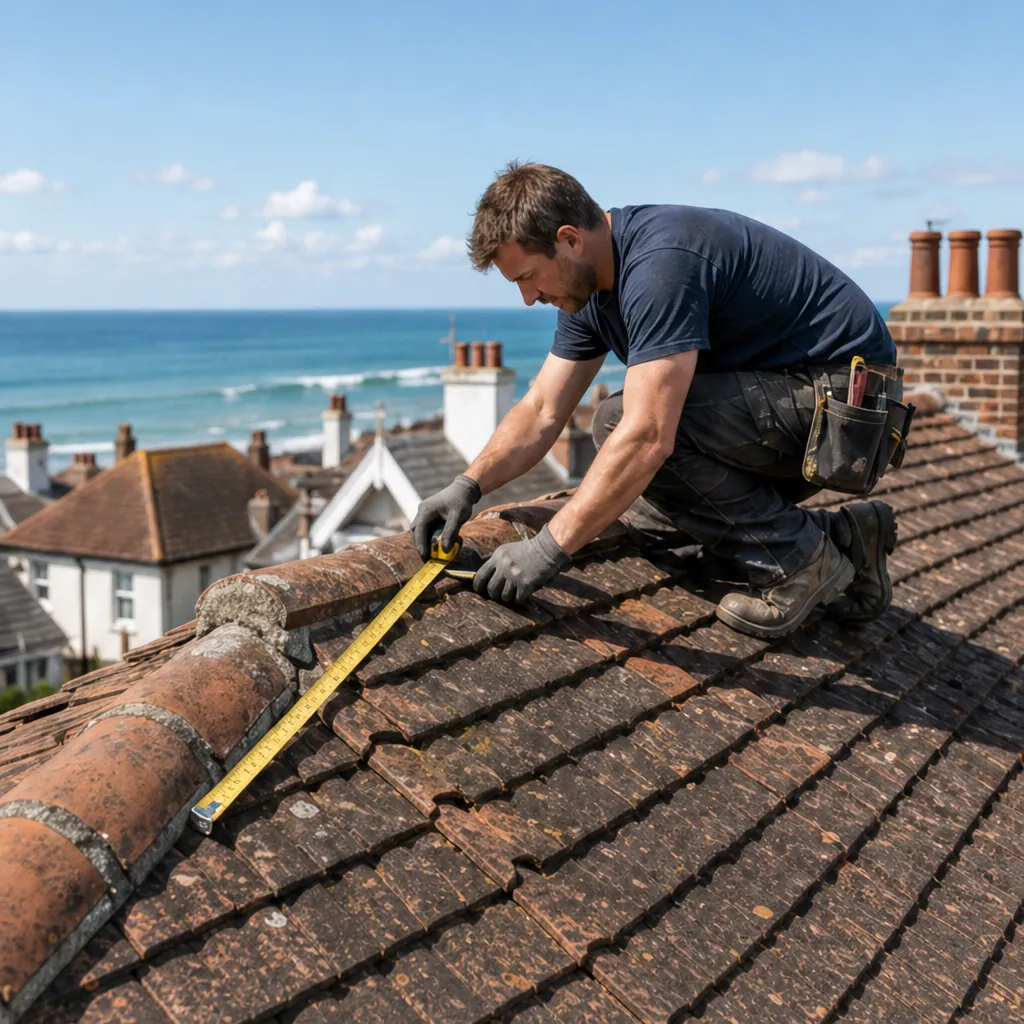
Photograph and record the symptoms
Take photographs of every stain, damp patch or flaking area, with a ruler or a pen alongside for scale. Take one wide shot to show where it sits in the room and one close one. Date them, because a mark that has grown between two photographs is useful evidence.
Record the weather when water appears. Does it come in only in heavy rain, or only when the wind blows from a particular side? Does it drip steadily or in bursts, and does it stop soon after the rain does? A leak that continues for a day or two after rain has stopped often means the water is moving slowly through insulation or timber before it reaches the ceiling.
If it is safe, check the loft during or just after rain with a torch. Do not go on the roof or use a ladder in poor weather. Water seen moving is worth more than any amount of speculation afterwards.
Condensation looks like a leak but behaves differently, with damp that follows cold spells rather than storms. Write down which you suspect.
Sort out the outside
The roofer needs to see the roof from several angles, and that can mean a ladder at the side or back of the house. Tell them if there is a locked gate, a narrow passage or a boundary shared with a neighbour. If the only way to the rear is through the house, say so in advance.
Parking matters too, especially in terraced streets near the seafront. A van that has to be parked three streets away slows everything down, and any work that follows may need a scaffold on the highway, for which a licence is applied for by the scaffold firm. It is worth finding out who owns the pavement frontage and whether a bay needs to be reserved.
Move cars, bins and garden furniture out of the way of the walls the ladder will use. Check that any dogs are secured. If a neighbour's roof adjoins yours, as with a terrace or a semi, it helps to let them know that someone will be looking at the roofline.
If the property is tenanted, give the tenant notice and make sure someone can let the roofer in.
Questions to have ready
Write your questions down before the visit, not after it. Useful ones include: what caused the fault, and how sure are you? Is this a repair, or is the covering coming to the end of its life? What happens if I leave it for a season? What will you photograph, and when will I see the pictures?
Ask for the findings in writing, illustrated with shots of your own roof, and for the quote to follow as a written document with a total price. The difference between the two is covered in why photographs from your roofer matter. Check that VAT and scaffolding are covered by the total.
If you are selling, say so at the start. A roof check ahead of a sale is a different exercise from tracing a leak, and the roof check before selling page explains how it differs. If you want to know what is happening above the insulation, see the loft insulation check.
The visit is a conversation, and the better prepared you are, the more answers you leave with. Our roof inspections and surveys page describes the visit itself.
Before the roofer arrives
Must someone be in while the roofer looks round?
It helps, particularly for access to the loft and to talk through what you have noticed. If you cannot be there, arrange for someone to let the roofer in, and leave your notes and photographs where they can be found. Tell the roofer in advance if the loft has restricted access.
Should I clear gutters or fix anything before the visit?
Leave things as they are. A blocked gutter, a stained ceiling and a slipped tile are all clues, and tidying them first can hide the cause. Do clear anything that stops safe access, but keep your hands off the roof itself.
Tell us about your roof
Describe what is happening and we will call you back to arrange a visit.
- Photographs of what we find
- A written quote with one total price
- Or call 01903 299063
10-year workmanship guarantee, in writing.