A slate roof can look settled for decades and then begin to drop slates in the first hard gale. The slates themselves are rarely the problem. They are hard, thin pieces of rock that have usually outlived the fixings holding them. Each is hung by nails driven through two holes near its head, and once those nails weaken the slate slides down a little and leaves a gap where rain can get in.
The repair depends on the fault, and the faults are not all the same. A single slipped slate is a small job. Nail sickness, where the nails in a whole slope are failing, is a different problem with a different answer. Then there are the parts of the roof that are not slate at all: the ridge, hips, valleys and the lead around chimneys, which tend to let go before the slates do.
This guide goes through them in turn, with what the repair involves, what to leave alone and where a series of repairs adds up to a case for re-slating. It is written for homeowners, landlords and anyone who has been told they have a slate problem and wants to understand it.
Slipped slates and what holds them
A slate roof is a series of overlapping courses. Each slate is hung from the batten by two nails, and its tail is held down by the slates above. When a nail corrodes or snaps, nothing stops the slate sliding down until the nail heads catch the one below. You will see it from the garden as a slate sitting lower than its neighbours, with a dark gap showing at the top edge.
It is more serious than it looks. A slipped slate leaves the nail holes of the courses above partly uncovered, and rain driven up the roof in a gale can run into the gap and onto the underlay, or the battens, or the ceiling if there is no underlay at all. Left, the slipped slate tends to take its neighbours down with it.
How a slipped slate is repaired
The repair is a small job done from a ladder or a roof ladder. The slater slides a tool called a slate ripper up beneath the slate, hooks the old nails and cuts them, and the damaged slate comes out. A new or reclaimed slate of the same size slides into the gap and is held with a tingle, a thin strip secured to the batten and folded up around the tail. The slate is then dressed so it sits in line with the courses.
Done carefully, it leaves no trace. Done in a hurry, it leaves a visible tingle strip or a slate that sits proud. Our page on slipped slates goes into the causes and how to tell one repair from many.
Nail sickness, and when it spreads
Nail sickness is the trade name for what happens when the fixings across a roof deteriorate together. The nails rust, snap or work loose, and slates begin to slip over a wide area. It is common on older slate roofs, because the nails were put in when the roof was built and have been in damp air ever since. Salt air does the roof no favours, and the slate maker's specification, not habit, says which nail a given product needs.
One slipped slate is a repair. Several, spread across different slopes and courses, is nail sickness, and it changes the question. Replacing slates one at a time tackles the symptom while the cause carries on in the next row. On a roof where the nails are failing everywhere, each patch costs a callout and a visit, and the number of visits goes up each year.
How we tell the difference
At the survey, we look at where the slipped slates are, how many there are, and whether they are clustered or spread out. We lift a sample slate or two to look at the nails on the back, and look at the underside from the loft if there is access. Nails rusted through or snapped at the head tell us the fixings have run their course.
If failure is local, a repair with tingles is sensible. If it is general, the honest advice is usually to re-slate, saving the good slates and laying them afresh on new battens. Our guide to re-slating shows what that involves, and we give you the evidence in photographs before you decide.
Cracked, chipped and delaminating slates
Slates break in several ways. A crack across the slate, usually from someone or something stepping on it, lets water run straight through. A chipped corner may be harmless if it sits under the lap and does not expose the batten. A slate that is delaminating, which means its layers are peeling or flaking apart, is failing slowly and is likely to be one of many on the same roof.
Walking on a slate roof is a common cause of damage. Slate is hard but brittle, and a boot in the middle of a slope cracks slates that look sound. So we keep our weight spread on ladders and boards rather than walking the slates, and we ask you not to climb up to look. The thing you notice from the ground may be the damage done by an inspection.
Repairing a cracked slate
A cracked slate is replaced in the same way as a slipped one: the broken slate is removed, a slate of matching size and colour is slid in and a tingle holds it. A temporary patch with a sealant is not a repair, because it hides the gap and does nothing for the fixing behind it.
For delaminating slate, the question is one of extent. A few can be replaced. Widespread delamination means the slate is reaching the end of its life, and the sensible choice is to look at new slate. We explain this with samples, and our page on delaminating slates covers the causes. For old roofs, matching is part of the job, and we describe how it works in matching old slates.
Tingles, clips and the small fixings
A tingle is the repair fixing of the slate trade. It is a short strip fixed to the batten, bent up and over the tail of the replacement slate, and it holds a slate where the original nail holes are no longer usable. Because it is exposed, it should be of a type that will not rust or stain, and the slater should fix it so it is tight to the slate. Our page on tingles explains the types.
The point worth understanding is that a tingle holds a slate, but does not make the roof sound. Where there are a few tingles, they are a normal part of an older roof's life. Where a roof has dozens, it is a sign of how much of the original fixing is gone, and a reminder to ask what else is going on.
Why quality of fixing matters on this coast
Gales test the repair as well as the roof. A tingle that is loose or bent badly lets the tail lift in the wind, and the slate may be gone by the next storm. We fix each so the tail is held down firmly, then check the courses either side. The fixing is specified to the slate maker's guidance, and the maker's data sheet takes priority.
Cupa Pizarras puts the line for hooks at 25 degrees of pitch, below which it says to avoid them, and quotes 20 degrees as the floor for a 500 mm natural slate in moderate exposure. On a shallow slope, the headlap, which is the depth by which each slate is covered by the courses above, matters more. If your roof is shallow and sheds slates repeatedly, the cause may be that the setting out is wrong, not that the nails are tired, and that is a case where repairing again is the wrong answer.
Ridges, hips, valleys and lead
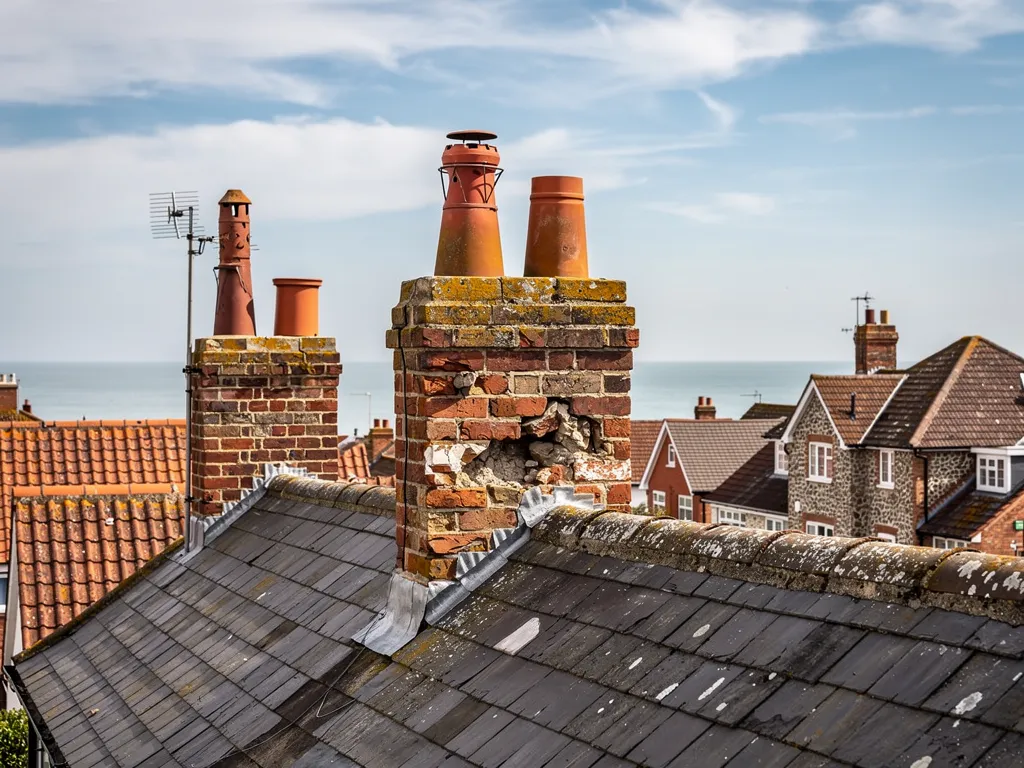
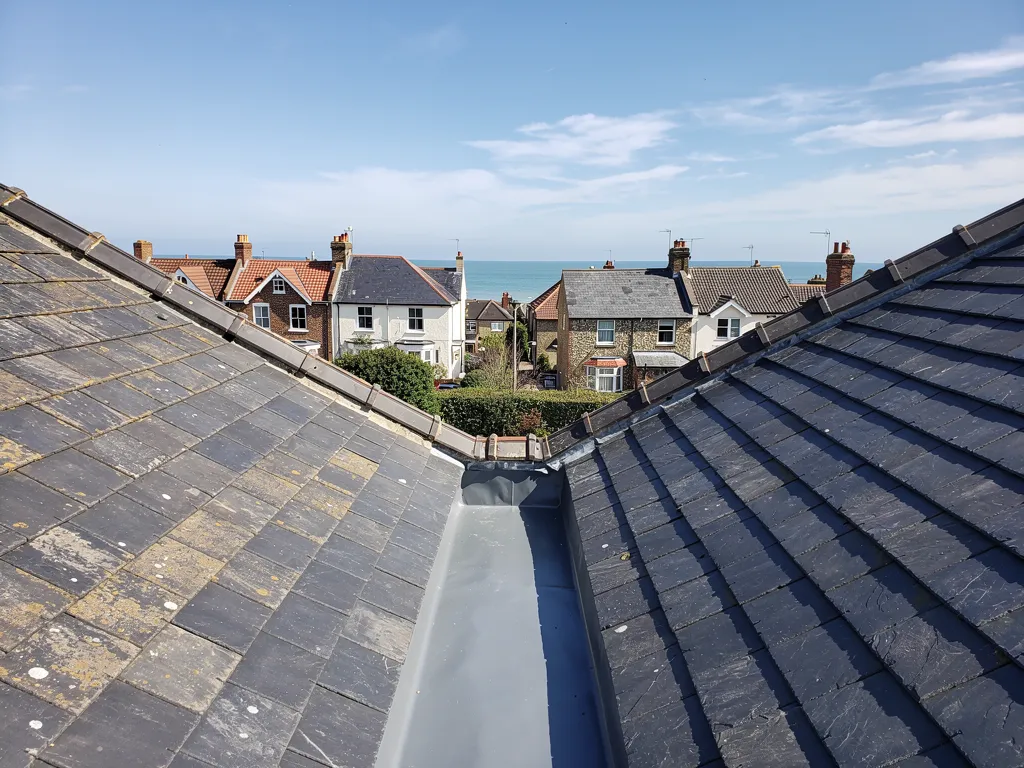
On many slate roofs the first leak does not come through the slates at all. It comes from the details: the ridge, the hips, the valleys and the lead around chimneys, the parts of the roof built from something other than slate.
The ridge is the capping along the top, and hips are the sloping outer corners. On slate they are often capped in clay or stone, bedded in mortar that cracks and loosens over time. Ridge and hip capping has been mechanically fixed, not just bedded, since BS 5534 was revised in 2014, so a repair there adds clips or screws to the mortar. Dry-fix systems, covered by BS 8612:2018, are another option, and our page on dry ridge on slate covers whether they suit your roof.
Valleys, flashings and soakers
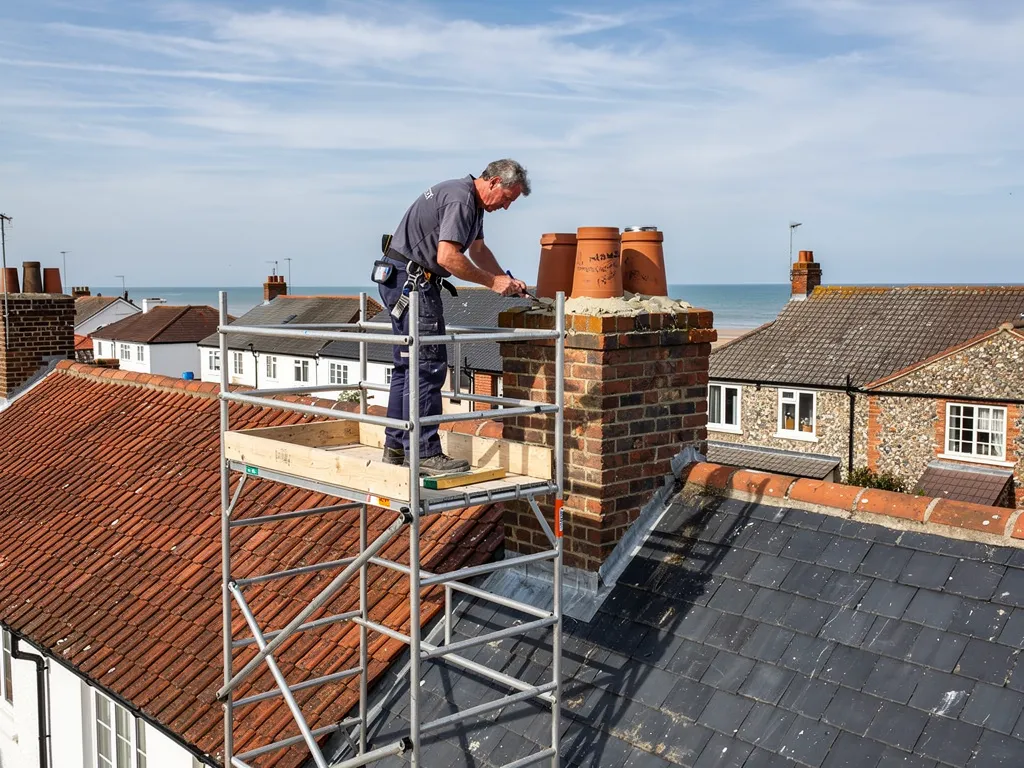
A valley is the inside corner between two slopes, normally lined in lead, and it drains both of them, so a split there can soak the timbers below. Flashings are lead shaped over the junction of roof with wall or stack. Soakers are little folded squares of lead tucked beneath each course along a wall. Leadworx names code 4 as the standard for general flashing, with code 3 kept for soakers.
Lead lifts, splits and works out of the mortar joint it is wedged into. A repair may be a local patch or a replacement length, depending on what the survey finds. MyJobQuote (22/09/26) lists £150 to £250 as a typical UK range for patching chimney lead, and £350 to £460 to replace it all, scaffold excluded.
These are the repairs that most often need a second look when a leak returns. A slate that looks fine may not be the way in at all, so the water is followed back before anything is priced.
Repair or re-slate, and what repairs cost
The real test is whether the repairs are curing the roof or only buying time. A handful of slipped slates on a roof with sound nails is a repair. A slope that needs attention again every winter has failing fixings, and a re-slate will use the money better. We tell you which applies, and why, with photographs.
On cost, the national guides give ranges and not prices for your roof. MyBuilder (updated 21/08/2026) quotes £150 to £1,500 as the typical UK range for roof repair, split into minor at £100 to £300, moderate at £500 to £1,000 and major at £2,500 or more. Checkatrade (June 2026) gives natural slate repair at £150 to £220 per m², exclusive of VAT. Ridge re-bedding or replacement is put at £300 to £600 by MyBuilder, and a chimney scaffold at £400 to £900.
What moves the price
The number and position of the faults, the height and access, whether scaffolding is needed, and what the survey finds beneath all change the total. A slate high on a chimney slope costs more than one at eaves height.
For a listed house, or one in a conservation area, check the position first. Repairs in matching materials are normally fine, but a change of material can need consent, and a few local Article 4 directions reach roofs. Our notes on slate in conservation areas and Victorian slate roofs cover the details.
The written quote arrives after we have surveyed, gives one total, and reflects pricing that is good and fair. Slate that has been disturbed deserves a second look after the first hard blow of weather, and a photograph sent to us is enough to start that conversation. Our slate roofing page shows the wider work.