The honest answer to "can spray foam insulation be removed?" is yes, and the answer to "how difficult is it?" is that it is slow, skilled and varied. Foam that was applied thinly onto clean modern underlay behaves very differently from foam that was sprayed thickly onto old timber and the back of the tiles. The same word covers jobs that differ a great deal in time, mess and risk.
What stays constant is the sequence. A sound removal starts by finding out what is there, takes the foam off in a way that spares the roof, looks properly at the timber that has been hidden, repairs what needs repairing and only then puts insulation back. Skip the second-to-last step, and you may reinsulate a roof that is rotting. Skip the last, and you may recreate the condensation that caused trouble in the first place.
This page sets out those stages in plain terms, so you know what a careful contractor should be doing on your roof and what to expect to see in the photographs. It sits within our wider spray foam insulation removal service, and it draws on the RICS consumer guide of March 2023 and on Energy Saving Trust advice for the points where they apply.
Assessing the foam before anyone touches it
Removal begins with looking, not scraping. The assessment answers four questions: what type of foam is it, how thick and how firmly stuck to the surface, what condition are the timbers and covering in, and what access is there. The type matters because the two main kinds behave differently when you work on them, a difference our guide to open-cell and closed-cell spray foam explains.
We start in the loft and at the eaves, where the edges of the foam are visible, and look for signs that something is wrong behind it: stained or soft timber at the ends of rafters, rust on nail points, dark patches or a musty smell. We check the covering from outside, since cracked or slipped tiles are a common reason for water to be in the roof void in the first place. Where there is a hatch or a cut-out, we note how the foam has adhered to the underlay and the battens.
The RICS consumer guide cautions that taking foam out can harm the structure underneath, so the assessment also judges how the removal should be done. A roof with sound timbers and a loose, thin layer is a different job from one with thick foam stuck hard to old rafters. We photograph every area we can reach, and the pictures reach you alongside the written quote.
What the assessment can and cannot tell you
It cannot see through the foam. It can show how the roof behaves at its edges, and it can tell you how likely it is that the hidden timbers are in trouble. Final knowledge comes during removal, which is why a sensible quote leaves room for what is found.
Preparing the house and the access
Foam removal creates a lot of debris, and the preparation decides how much of it ends up in the house. Before any work starts, belongings are cleared from the loft and the rooms below, floors and stairs are covered, and the loft hatch route is protected. Dust sheets and sealed bags keep fragments out of living spaces, and electrical items in the loft, such as cables and tank fittings, are noted and kept out of the way.
Access shapes the whole job. A loft with a full-size hatch, boards on the joists and room to kneel is quicker and cheaper to work in than a cramped one with a small hatch or a roof with a shallow pitch. Where the room in the roof has been finished with plasterboard over the foam, the lining may have to come off in places to reach the foam behind. We tell you which, in advance, from the survey.
Outside, the covering may need attention. If the tiles or slates have to be lifted to reach the foam from above, scaffolding goes up first, because working on a roof edge without it puts people and the covering at risk. Scaffolding on the pavement or road can need a highway licence as well, which the erecting firm arranges with the local highway authority.
Why removal is slow
It rarely goes quickly because the foam is stuck down. Each section is released carefully so the timbers, underlay and battens beneath are not torn, and that takes time. A fast job is a warning sign, not a bonus, since speed on a foamed roof usually means the timber behind it is being damaged or left unchecked.
Taking the foam off, section by section
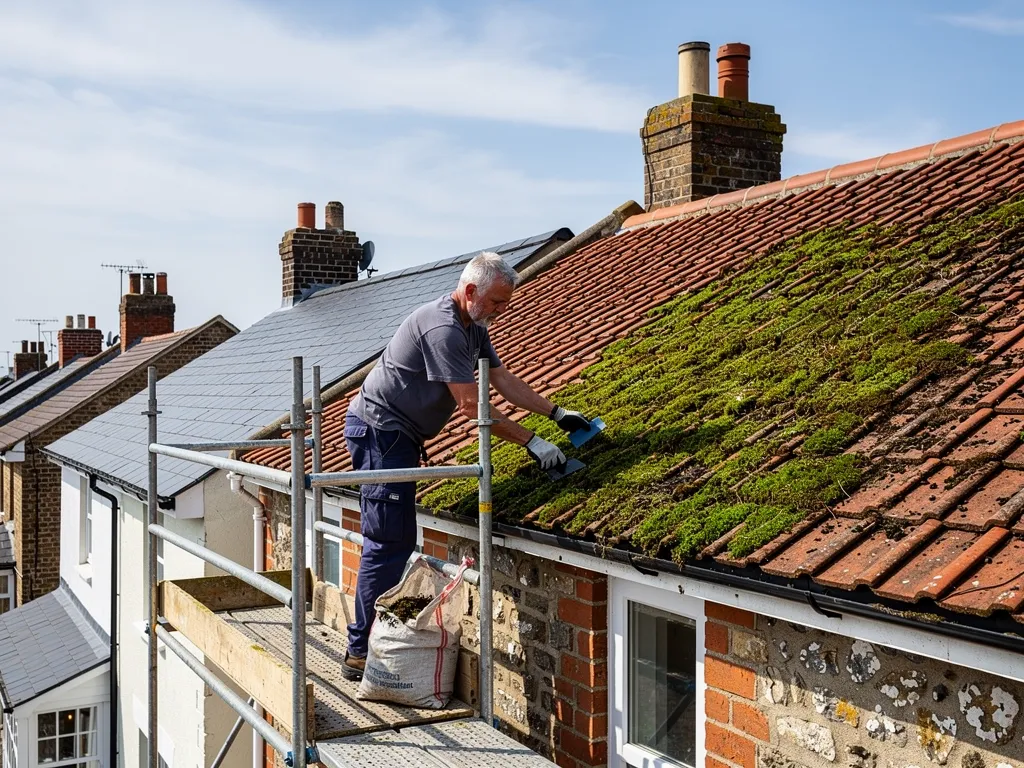
The removal itself is careful, mostly hand work. The aim is to separate the foam from the roof without taking the roof with it. How that is done depends on the foam and the surface. Thin or soft foam may peel and scrape away in sections, while firmer foam tends to be cut or shaved back in layers until the surface beneath shows. The timbers are exposed bay by bay, so each one can be inspected before the next is started.
Offcuts go into bags as they come away and leave the house during the work, never left to pile up in the loft. A clear working area also helps the person doing the work to see what the foam was hiding. When the surface is clean, we can see the condition of the rafters, the battens, the underlay and the underside of the covering, and that is the first moment the real state of the roof is known.
Why it is not a job to try yourself
Anyone can pull a handful of foam off a rafter end, but doing a whole roof is a different matter. The work is awkward and dusty, it is done in a confined space, and the damage that clumsy methods cause may only show up years later as a leak or rot. Our short answer on removing spray foam yourself goes into the practical limits.
Leftover traces are a judgment call. On smooth surfaces, clean removal is realistic. On rough, aged or fibrous timber, a thin residue may be left to avoid cutting into the wood, and a sensible contractor will say so and photograph it rather than promise a perfect finish. Our page on whether all of the foam gets removed covers that point directly.
Checking the timbers and repairing what the foam hid
With the foam gone, the roof can finally be inspected as a roof. We look along each rafter, the wall plate and the ends where timber meets masonry, since damp collects there. Staining, softness, flaking or a dark, crumbling texture all prompt a closer check, and a probe tells us how deep any decay goes. Battens and underlay are examined in the same way, and the covering is checked from underneath for light, cracks and signs of long-term leaks.
The outcome decides what happens next. Sound timber needs nothing beyond a clean. Surface-damp timber may be left to dry before anything goes over it. Timber that has lost strength is a repair job: a section is cut out and replaced or strengthened, and a structural fault would be pointed out so the right person can advise. We show you the pictures of each area before and after, so the decision is one you can see.
This stage is also where problems that the foam disguised come to light. A slipped tile, a failed flashing or a split valley may have been letting water in for years. Fixing those is part of closing the job properly, because putting new insulation under an unrepaired leak simply starts the cycle again. Our pages on spray foam roof damage describe the faults we most often meet.
Cost, in scale
MyBuilder (updated 21/08/2026) gives typical UK figures of £20 to £50 per square metre for removal, around £1,500 on average, £100 to £200 for assessment and £150 to £400 for disposal. Timber repairs are extra and are only known after the foam comes off. The quote itself is one total, set after we have seen the roof.
A new membrane, then insulation that can breathe
Once the structure is sound and dry, the roof needs a proper build-up again. That usually starts with the layer under the covering: if the old underlay has been damaged or soaked, it is replaced, with a breathable membrane that lets moisture pass through while keeping rain out. Then comes insulation, chosen to suit the roof and the way you use the space, laid so that air can still move where it needs to.
Ventilation is the point most often missed. BS 5250, as summarised by Marley, gives continuous eaves ventilation for a cold roof using a high-resistance underlay: 25mm along the eaves for pitches of 15° or less and 10mm for pitches above 15°, with an extra continuous 5mm at high level for roofs over 35°, for any roof spanning more than 10m and for monopitch or lean-to designs. With a lower-resistance underlay, a ceiling that is properly sealed allows much smaller gaps, provided the third-party certification requirements are met. Pitch, span and underlay type settle the figure for a given roof, so it is worked out on site, not guessed.
The building is also tested against the rules that apply. Re-insulating can touch the Building Regulations, and where the work is notifiable we handle the notification and talk you through it. Our pages on spray foam and condensation and insulating after spray foam look at what to use and why.
Finishing and clearing
When the build-up is back, we compare the finished work with the photographs from the start, then sweep up and carry the waste off site. You receive the before and after record, which is worth keeping with the deeds, since a future buyer's surveyor or lender may ask for it.
So how difficult is it, really?
Difficulty is hard to put a number on, because it hangs on four things: how thick the foam is, how hard it grips the surface, how healthy the timbers are and how easy it is to get at them. A small, thin patch on a straightforward pitched roof with a decent hatch is a manageable job. A fully sprayed roof with finished rooms underneath, tight access and suspect timber is a long one, with repairs likely to follow.
Foam type adds a further variable. On roofs that already leak, the Energy Saving Trust puts the danger of hiding the problem as much smaller with open-cell foam, which hints at why the two types call for different judgment during the work. Our guide to the differences covers it, and the RICS guide's warning about damage during removal applies to both.
If you are weighing it up, there are three practical steps. First, get an assessment with photographs before deciding anything. Second, ask for a written quote that follows that survey, with the scaffold and VAT position stated. Third, ask what happens to the timbers once the foam is off, and who decides if repairs are needed. A contractor who can answer all three has probably done the work before. A price offered over the phone, without anyone seeing the roof, rests on guesswork about all of them.
It also helps to decide in advance what you want the roof to be afterwards: the same insulation level, a different material, or a cold roof ventilated in the traditional way. Saying so at the survey stage keeps the quote and the plan aligned.
You can also read what RICS says about spray foam insulation before you speak to anyone, which helps you judge their answers.