
Most owners ask this question after a surveyor, a lender or a neighbour has mentioned spray foam in a worried tone. The honest position sits between the headlines and the sales leaflets. Foam is not poison to timber, and a roof that was sound when it was sprayed may be fine for years. But foam does change what a roof can do with water, and it makes the wood very hard to look at afterwards.
A normal pitched roof deals with moisture in two ways. The covering keeps rain out, and the timbers behind it dry out through air movement and a little warmth from the house. Spray foam, stuck straight onto the underside of the roof, interrupts the second of those. If the covering has a weakness, or the house is damp, or the foam went onto timber that was not dry, there is nowhere for the water to go.
Below we set out what the RICS says, why the rafters are hard to inspect under foam, where the moisture comes from, which signs matter, and how we open up a roof to see the timber. The aim is to help you decide what to do next, not to push removal if your roof does not need it.
What the RICS says about dampness under foam
In March 2023 the RICS issued consumer advice on spray foam, and its main concern is moisture. The guide warns that badly installed insulation may cause dampness, with uncontrolled condensation given as the example. It also says the calculations and condensation risk checks behind an installation must be done by a qualified professional. For a roof, that means somebody should have worked out where condensation would form, and what the timbers would do about it, before any foam went on.
The same guide makes a point many owners miss. Removal carries its own risk, because taking foam off could potentially damage the existing structure. That cuts both ways. It is a reason not to rush into a scraping job with a borrowed tool, and it is equally a reason not to ignore a doubtful installation because stripping looks difficult.
Why the guide matters for rot
Timber decay needs sustained dampness. A rafter that dries after each wet spell can last for a very long time, while one held damp against a skin of foam has no way to dry. Foam does not feed fungus. What it can do is remove the airflow and the warmth that used to carry moisture out of the wood. So the useful question for your roof is never just whether foam is present. It is whether moisture has a way in, a way out and a place where it can collect.
That is also why a blanket statement either way is unreliable. A loft with a sound covering and a well-judged installation may show no problem at all. Another, sprayed over an old leak, may hold damage that nobody has seen. Only an inspection tells the two apart.
How foam hides the timbers it touches
In an ordinary loft you can put a torch on a rafter, read the grain, and spot a dark tide mark or a soft patch. Under foam you see a pale or yellow skin, shaped over every timber, nail point and gap. The rafters, the battens that carry the tiles and the underlay between them are all coated and stuck together. The roof looks tidy, and that tidiness is the problem.
Foam hides three kinds of evidence. It covers the stains an old leak leaves on the underlay and the timber. It stops you feeling a rafter for softness, because the wood is sealed behind a layer that does not give. And it masks the cracked or slipped tiles you would otherwise see as pinpricks of daylight from inside. A leak that was slow before the foam went on can go on slowly for years behind it.
Spraying over a problem
The Energy Saving Trust warns about one practice in particular. The Trust has seen firms propose curing a damaged or leaking roof by coating its underside with foam while the fault itself stays unrepaired, and it advises against that. Open-cell foam, it says, carries a much smaller version of that risk. If your roof was leaking, or had missing tiles, when the foam was applied, that is worth telling whoever inspects it. You can read more about how the two types differ in our guide to open-cell and closed-cell foam.
A moisture meter helps, but a reading taken through a thick skin of foam is only an indication. A surface reading that looks acceptable does not prove the timber behind it is dry, so a meter alone does not settle the matter.
Where the trapped moisture comes from
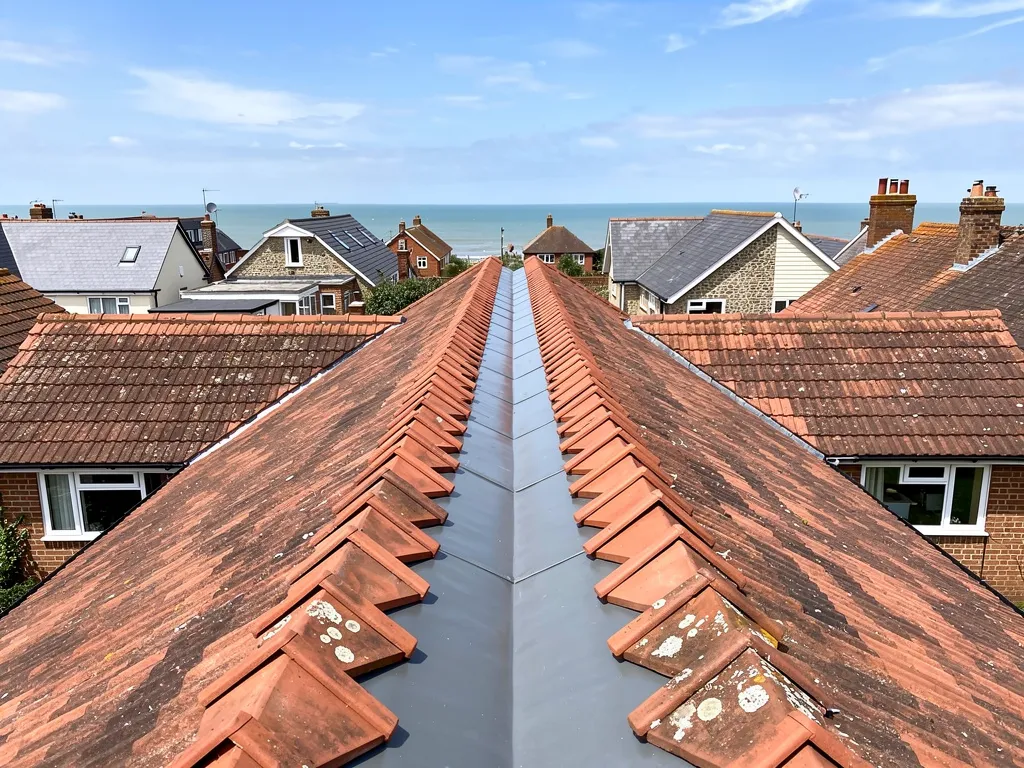
Moisture reaches roof timber from three directions, and foam can make each one worse. The first is rain getting past the covering: a split lead valley, a flashing that has lifted from a chimney, a slipped tile or a cracked ridge. On a bare roof, a small leak runs down the underlay and shows as a stain. Under foam, the water is held against the wood, and it can soak in for a long time before a stain reaches the ceiling.
The second is condensation. Steam from cooking, washing and ordinary breathing drifts up towards the roof, and wherever it meets a cold surface it leaves water behind. The RICS names uncontrolled condensation as one hazard of poor installation. If foam is thin in places, or has gaps around pipes, hatches and the wall plate, the timber behind those gaps is the coldest and wettest part of the roof.
The third is moisture that was already in the wood. Timber sprayed while damp, perhaps after a wet winter or an earlier leak, is sealed with that water inside it.
Ventilation that foam can switch off
Many pitched roofs were built as cold roofs, with air passing through at the eaves. Marley's reading of BS 5250 asks for a continuous 10mm eaves gap on pitches over 15° under a high-resistance underlay, and 25mm on pitches of 15° or less. Foam sprayed across the eaves, or hard against the underlay, can shut those paths. The timbers then lose the airflow the roof was designed around, and airflow at the eaves gets a close look on any foamed roof.
Warning signs from the landing and the garden
You cannot see the rafters, so you look for what they cause. Inside, the clues are a musty smell on the landing or in a bedroom below the roof, ceiling stains that return after being painted, damp patches on chimney breasts, and mould on walls where the roof meets the top of the wall. A loft hatch that releases a stale, earthy smell when opened is worth taking seriously. So is any visible fungal growth around the hatch frame, or foam that has pulled away from the timber and left a gap.
Outside, stand back and look at the roof. Slipped, cracked or missing tiles, lifted ridge tiles, a gutter that overflows onto the fascia and sagging along a rafter line are all things we check. None of them proves anything alone, because roofs fail in many ways for reasons unrelated to foam. But a roof with one or two of these faults and a layer of foam beneath it needs a proper look, because the leak and the foam interact.
Sagging, springing and soft boards
Where timber has been wet for a long time, the roof may sag between the ridge and the eaves, or a section may feel soft if you press a pole against the underside of the ceiling below it. These are late signs. If you see them, treat them as a reason to arrange a survey soon rather than wait for the next wet winter.
Do not climb into the loft to poke at the foam or cut samples. Foam fragments are awkward to handle, the boards may not be safe to walk on, and you could pierce the underlay behind the foam. Take photographs from the hatch with a good torch, and note when the smell or stains are worse. Those notes help whoever inspects the roof.

Opening up the roof to see the timber
A proper timber check starts with the history. We ask when the foam was sprayed, who did it, whether the roof was repaired first, and whether anything has leaked since. Then we study the covering from outside, go through the loft carrying a torch and a damp meter, and set the readings beside what the tiles and flashings tell us. Pictures from your own roof arrive with the quote.
Where the readings are doubtful, the only sure way to see the wood is to remove a small area of foam. That means cutting back a section, usually at the lower edge of the slope near the eaves and again beneath any suspect tiles, and taking a close look at the feet of the rafters, the timber sitting on the wall and the underlay. We look for darkened wood, soft patches that a probe sinks into, a powdery or cubed texture, and any white or yellow growth. A trial opening also shows how firmly the foam grips, which tells us how hard full removal would be.
What it costs and how long it takes
MyBuilder (updated 21/08/2026) gives typical UK figures of £100 to £200 for an assessment of spray foam, £20 to £50 per square metre for removal and £150 to £400 for disposal, with an average removal job at around £1,500. The size of the roof, how we reach it, the foam type and what lies behind it all move the price, so the quote you receive is one written total, issued after the survey.
Leave it, part-strip it or take it all out
Once the timber has been seen, the choice usually falls into one of three routes. If the wood is dry and sound, the covering is in good order and the ventilation is acceptable, leaving the foam in place can be a reasonable decision. You then keep an eye on the roof and tell any future buyer or lender what is there. The RICS is clear that foam can colour a surveyor's view of what a house is worth, so a question about resale remains even when the timbers are healthy.
If the damage is local, a part-strip may be enough: remove foam from the affected slope or bay, repair the covering and the timbers, and restore ventilation. The repair might be a few new rafter feet, a spliced section or a replaced batten, depending on what the inspection shows. A decayed structural member is not something to patch with filler, because the repair has to carry load again, and the joint between old and new wood needs proper support from the wall plate or a sound neighbouring timber.
If the damage is widespread, or the foam cannot be inspected or was applied unevenly, full removal and a fresh start is the cleaner option. Then the question moves to what goes back in. That means choosing a covering-friendly, breathable insulation and restoring the airflow along the eaves, with the loft left open to inspection from then on.
Other things to line up
Think about the money side early. Lenders and equity release providers have their own views, and our guide to spray foam and equity release sets out what was reported. If you plan to sell, see selling a house with spray foam. For the full picture of the work we do, start at the spray foam removal page.