You made a claim after a storm, expecting the policy to respond, and the letter that came back says the roof failed through wear and tear. It feels like a verdict on the whole house. It is better understood as one insurer's view of one cause, and that view can be tested.
Home policies usually exclude damage that builds up slowly, and a roof is exactly the sort of thing that ages in the background. Tiles lose their grip, mortar crumbles, flashings fatigue and underlay perishes without anyone seeing it. When a gale then finishes the job, the insurer and the owner may look at the same bare patch and name different causes. Sometimes the insurer is right. Sometimes the storm really did the damage and an old roof simply gave it an easier target.
What follows sets out how the exclusion is applied, how to read the refusal, what the Financial Ombudsman Service asks, what kind of evidence helps, and the dates that matter if you complain. We are roofers, and the decisions belong to your insurer and the Ombudsman, but a survey of the roof can supply facts for them to weigh. For the repair side, see our emergency roof repairs page.
Why insurers reach for the gradual damage exclusion
A buildings policy is written to cover sudden events, such as a storm, a fire or a fallen tree. It is not written to pay for the slow decline of any building, and so the wording usually carves out maintenance and ageing. The Financial Ombudsman Service points out that exclusions commonly cover loss that develops over time.
On roofs this exclusion does a lot of work, because roofs fail in two ways that can look alike. In the first, a sudden force breaks sound material: a gust lifts well-fixed tiles, or a branch cracks a slate. In the second, material that was already tired lets go under an ordinary push. Both leave tiles on the lawn and a wet ceiling, so the outcome tells you little about the cause.
What the insurer is looking for
Insurers commonly use a storm definition tied to wind speed. Which? reported in November 2025 that insurers frequently set a minimum gust speed before they accept a storm, and its example of a wear-and-tear loss was rain getting in through a roof that had been poorly looked after. The same report, citing Financial Conduct Authority figures, said that only 32% of storm-related claims made in 2024 resulted in a payout.
So an insurer will often check three things: whether a qualifying storm occurred on the date given, whether the damage pattern is typical of a storm, and whether the roof showed signs of age before it. A refusal usually rests on one of the last two.
None of this means a refusal is wrong. It means the insurer has chosen an explanation, and you are entitled to see it set out, which the next section looks at.
Reading the refusal letter closely
Before you do anything else, read the letter slowly with the policy booklet beside it. Insurers tend to quote a clause and a conclusion, and the gap between the two is where a challenge starts.
Note which exclusion is being relied on. Wear and tear, gradual deterioration, lack of maintenance and faulty workmanship are different grounds with different consequences, and a letter that blurs them is worth querying. Note the date the insurer treated as the date of loss, and whether it matches the storm you reported. Note whether anyone visited. A loss adjuster is a specialist the insurer appoints to assess a claim, and a report from one is often the evidence behind the refusal. You can ask for a copy.
Questions to put in writing
You are entitled to ask reasonable questions, and a short email gets a written reply you can keep. Ask which part of the roof the insurer considers worn, and what it saw that led it to that conclusion. Ask whether photographs were taken, and request copies. Ask what evidence it relied on for the weather on the date given. Ask which policy wording it says applies, by clause number.
Keep the tone factual. A calm list of questions shows you are working from the evidence, and the answers either support the refusal or expose a weakness.
Do not throw away anything related to the claim. Keep the letter, the envelope, the emails and your own notes, and write down the dates of any phone calls. Where no final written response has reached you yet, say so, because the complaints timeline depends on that document and we return to it below.
The questions the Ombudsman asks about a storm
If a dispute goes as far as the Financial Ombudsman Service, it does not simply accept the insurer's label. Its published approach to storm damage boils down to three tests. Did a storm really take place on the date given? Does the damage look like the kind a storm produces? And was the weather the main cause, or might other factors have produced the same result anyway?
The service describes a storm as usually involving violent winds, often with rain, hail or snow. It also puts the burden on the insurer, who must show that the exclusion really fits. That is worth remembering, because it shifts attention from whether your roof was perfect to whether the insurer can show the exclusion truly fits.
What the third question means for old roofs
The third question is the one that matters most for an older roof. An ageing covering is not an automatic bar. The issue is whether the storm did most of the harm here, or whether the roof would have failed in much the same way in ordinary weather.
A roof can be old and still be sound. Tiles that were properly fixed and are only lightly worn can resist a good deal of wind, and if a gust strips a run of them, the weather has a strong claim to be the main cause. A roof where many tiles had slipped and the mortar had gone years ago points the other way. The facts of the particular roof decide it.
The Ombudsman looks at evidence, not at how a case is presented. Dates, photographs, a roofer's written findings and the weather on the day are the material it works from. Read the Ombudsman's page on gradual damage to see how it frames the issue.
Evidence that separates a storm failure from age
A roofer can read a failed roof in ways that are hard to do from a letter. The aim is not to argue the claim but to record what the roof shows, in plain words and with photographs, so that the cause can be judged on facts.
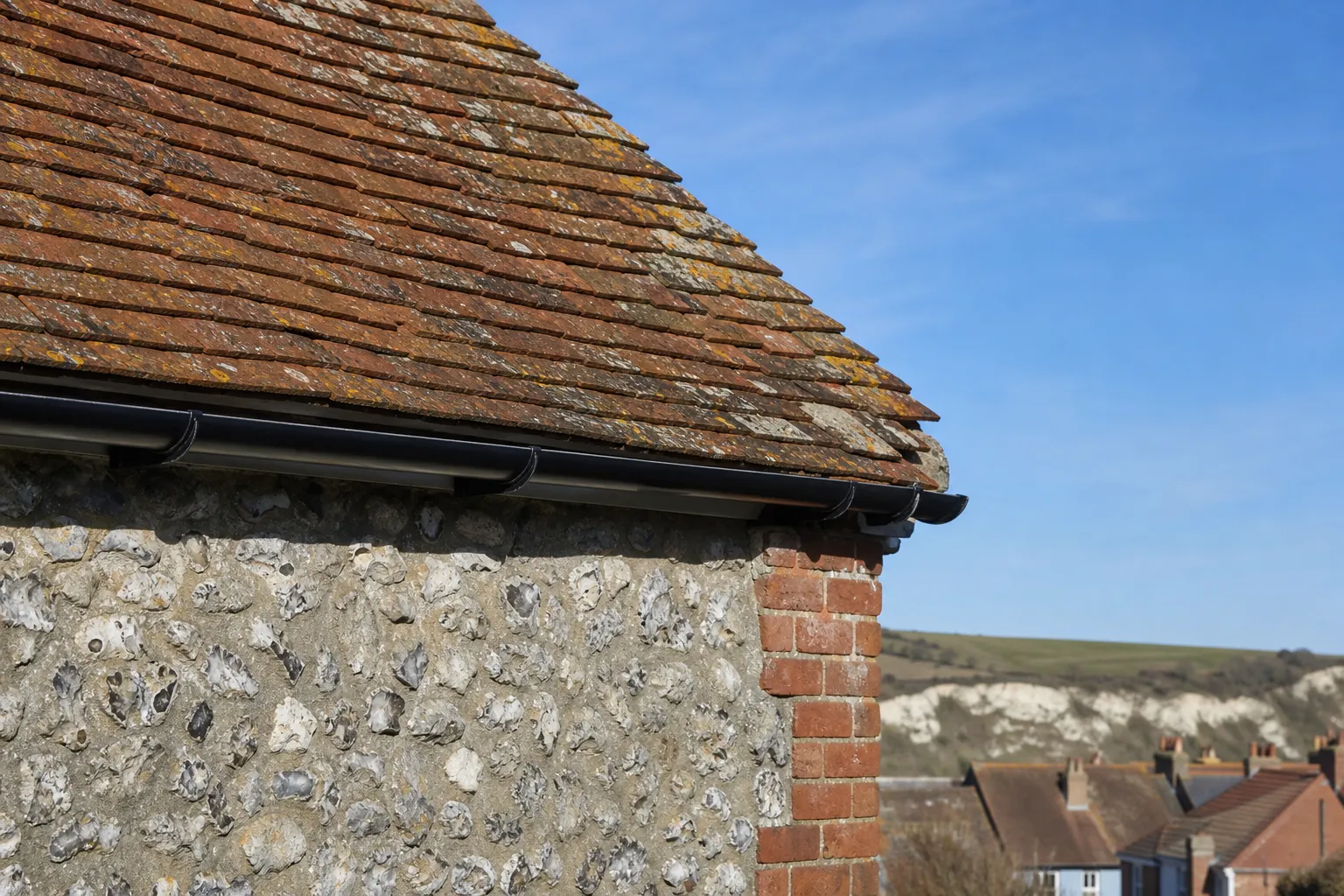
We look first at the breaks. A fresh break shows clean, bright faces and no moss, and the broken pieces often lie where the wind put them. An old crack is dull, often with lichen or dirt in the line. We check whether the tiles that moved were fixed to the standard expected. Since the 2014 revision of BS 5534, the capping along a ridge or hip has to be secured mechanically as well as bedded, so a ridge that was bedded and never clipped tells a particular story. We note where the damage sits, because wind damage tends to cluster on exposed edges, ridges and the windward slope, while age-related failure is more scattered.
What to gather yourself
Collect anything that shows the state of the roof before the storm. Estate agent or survey photographs from a house purchase, older pictures of the garden with the roof in the background, invoices for earlier repairs or gutter clearance, and any maintenance notes all count. Together they show the roof was maintained, which speaks directly to the insurer's suspicion of neglect.
Add your own storm-day record: dated photographs, the time you noticed the damage and a note of the weather. Our guide to checking your roof after a storm shows how to take those safely.
A written roofer's report is one piece of evidence, not a ruling. The insurer, and in the end the Ombudsman, decides what weight to give it.
Complaining to the insurer, then to the Ombudsman
The route is set out in a fixed order, and it helps to follow it exactly. The first step is to complain to the insurer itself, in writing, and to say clearly that you are making a formal complaint about the refusal. Give the claim number, the date of the decision and the reasons you disagree. Attach the evidence you have gathered rather than promising to send it later.
The insurer then has time to investigate and to send what is called a final response. The Ombudsman's guidance is that you can take the complaint to it if eight weeks pass with no final response, or if the final response leaves you unhappy. The service is free and designed to be used without a lawyer.
The six-month limit
This is the date to protect. The Ombudsman allows 6 months, counted from the day printed on the final response, for bringing a complaint to it. Count from the date printed on the letter, not the day it arrived, and note it in your calendar the day you receive it. The service explains how time limits work on its own website, and that page is the authority if your situation is unusual.
A complaint can still fail. The Ombudsman may agree with the insurer, and nobody can tell you in advance that it will not. What the process gives you is an independent look at the reasons, by people who are used to weighing storm claims against ageing roofs.
The outcome rests with the insurer and, if it comes to that, the Ombudsman. A consumer organisation or adviser can help you prepare your case, and our part is to describe what the roof shows.
Repairing the roof while the dispute runs
A roof that has lost tiles cannot wait for a complaint to finish. Rain is the real deadline, and further water damage inside the house is likely to be treated as your responsibility if the repair was left. Make the roof safe, and keep a clear record of what was done and why.
Before any work starts, photograph the damage thoroughly and keep samples of the broken material if you can. A roofer can lift a tile and place it aside without destroying the evidence, and can note on paper what was found beneath. Ask for the report to be dated and to describe the condition of the fixings, the underlay and the timbers as well as the visible fault. Our page on a tree that has fallen on the roof deals with a case where the cause is rarely disputed, which is a useful contrast.
Make the roof safe, then decide the repair
We make a leaking roof safe before anything else, then trace the cause and suggest the smallest job that puts it right. If a repair will hold, that is what we put forward, and if the covering is past its useful life, we tell you that instead. The survey brings photographs of your roof and a written quote,.
The best protection for any future claim is a roof that is looked after and a record that shows it. Our guide to preparing your roof for storm season sets out the checks, and a dated photograph of each one adds to the file you may one day need.