Fresh lead is a shiny, silvery metal. Within days of going on a roof it begins to change colour, and for a while the change is not attractive. A chalky white film spreads across the sheet, and the first proper rain carries some of it off in streaks that dry on whatever lies below. A new chimney flashing can leave pale tracks down the brickwork, and a new dormer cheek can mark the tiles under it.
None of this means the lead is faulty. It is the early stage of the natural process that eventually gives old lead its calm grey surface. Roofers have long managed that early stage with a patination oil, a thin treatment brushed or wiped onto the clean metal before the weather gets to it. It is a small job done once, and it can save an owner a cosmetic problem that is awkward to remove from brick and stone.
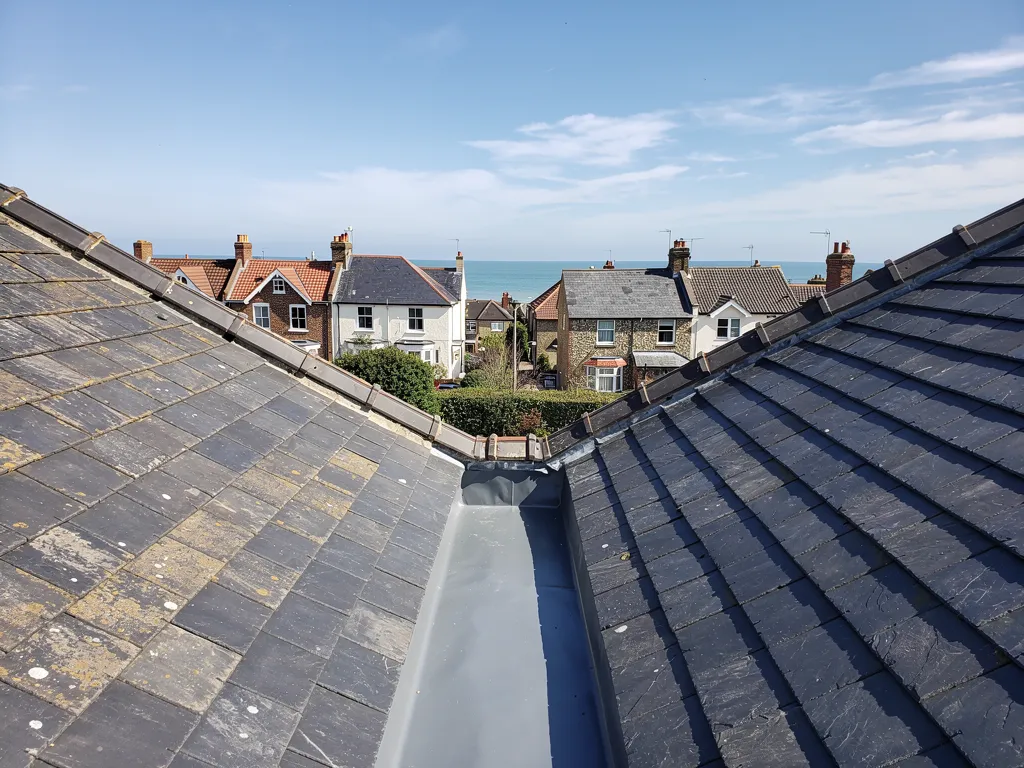
This guide describes what happens to new lead, why white staining forms, what the oil does and does not do, and how to deal with marks that have already appeared. It belongs with our wider lead roofing advice and is written for owners who are comparing quotes and want to know what a good lead job includes.
What happens to new lead in its first weeks
Lead is a soft metal that reacts with the air around it. As soon as a clean sheet is exposed, its surface begins to combine with oxygen, then with carbon dioxide and moisture, forming a thin layer of lead compounds. In dry conditions that layer comes up slowly and stays dull and even. When damp and carbon dioxide reach the metal together, the layer forms faster and can turn bright white and powdery, like a dusting of flour.
That white film is the real subject of this page. It is a surface coating of lead carbonate, and it is soluble enough to wash off in rain. The result is the problem owners see: pale streaks and splashes on the materials beneath the lead. Over time the process settles. The surface layer becomes stable, the colour deepens to a soft grey, and the lead stops shedding white. That finished surface is the patina, and it is the reason old lead roofs look so settled.
Why the early stage is the awkward one
Between a bright new sheet and a stable grey one there is a messy middle. How long it lasts depends on weather, shelter and the position of the sheet. A roof that is wetted often and dried slowly, such as one beside a shaded wall, can go through the white stage more dramatically than one in open sun and wind. Sheltered positions that stay damp, and surfaces that trap a film of water, are the likeliest to shed the most white.
This is why a roofer treats the lead at installation, while the metal is clean and dry, instead of leaving the weather to start the process unaided.
Why white streaks end up on brick, slate and stone
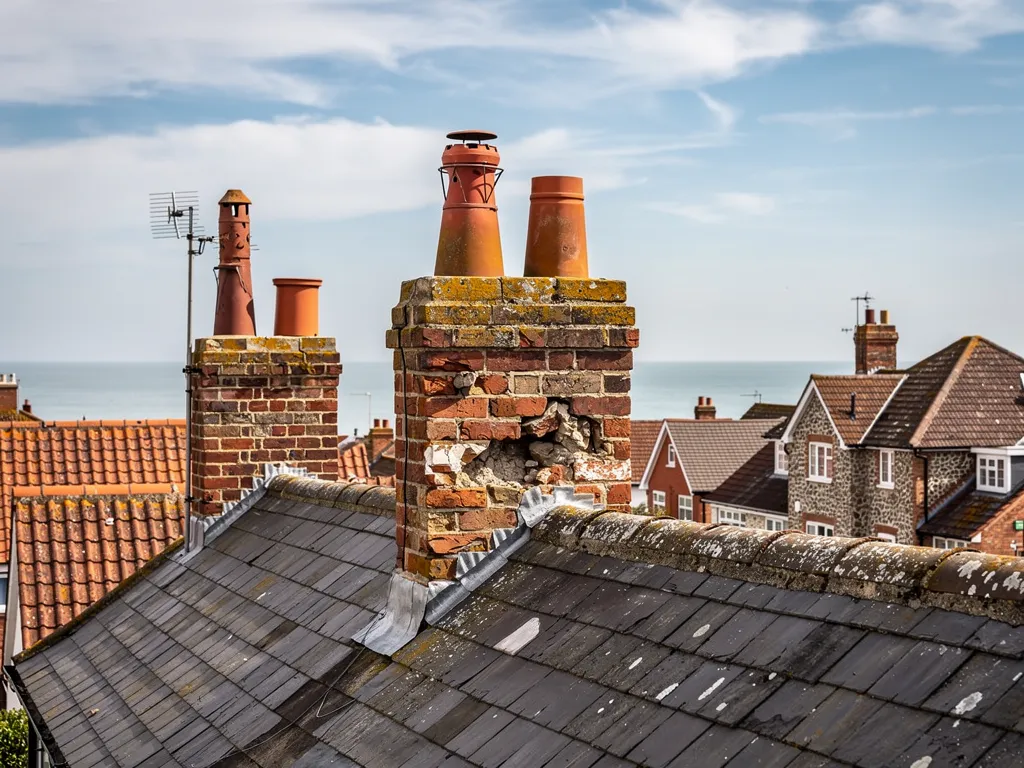
Where the streaks land depends on where the water goes. Rain falls on the lead, dissolves a little of the white film and runs off at the lowest edge. Everything below that edge is in the firing line. A flashing set into a chimney sends the run-off down the stack. A lead apron below a dormer window sends it across the tiles. A lead-lined gutter sends it along the fascia board and down the wall below. A lead flat roof drains over its edge onto whatever is beneath.
The materials that suffer most are the porous ones. Soft red brick, stone and unglazed clay tiles soak up the dissolved lead compound, and when the water evaporates the white stays in the surface. On slate and glazed tiles the film is more likely to sit on top and wash away over a few storms. Rough render, cement and old pointing hold it too. The result is a pattern of vertical bands that follows the lines of the run-off, often most obvious on a sunny day when the wet surface dries.
Lead near the chimney stack
Chimneys are the commonest place to meet the problem, because a stack carries several lead items at once: the back gutter, the step flashings and the apron. We hold these in place with lead wedges pressed into the mortar joints, and our note on lead flashing wedges explains how the fixing works. The point here is that every one of those pieces drains over brickwork, so every one of them is treated before the scaffold comes down.
Treating the full set matters. A single untreated piece among treated ones is enough to leave a visible trail.
What patination oil does, and what it does not do
Patination oil is a thin protective coating, supplied for use on lead, that is applied to the surface once the sheet is fixed. It is not a paint or a sealant, and it does not change the lead itself. Its job is to separate the metal from the damp air during the early stage, so the surface weathers slowly and evenly instead of in a rush. The oil gives new lead a dull, even grey look from day one, which also helps it blend with an older roof.
Because the chalky film forms more gently, less white is available to be washed off in the first rains, and the streaking that would have marked the brickwork is reduced. As the coating wears away, the lead below has already begun its steady change, and the natural patina takes over without the dramatic white phase.
Limits worth knowing
The oil is a cosmetic and protective step, so its limits deserve a plain statement. It does not make lead last longer, and it does not stop a split in a badly detailed flashing. Lifespan comes from the thickness of the sheet, how it is laid and how it is fixed. Our guide to lead codes explains the thickness side, and a thicker code does not by itself stain less.
Nor is the treatment a cure for white marks that already exist. It works best on clean, new metal, applied before the weather has started the process. Different suppliers offer different products, and each comes with its own instructions on coverage and drying, so a careful roofer follows the label for the oil on the job. If your quote mentions patination, you now know why it is there, and if it does not, it is a reasonable thing to ask about.
How a roofer applies it
Applying patination oil is quick work, but it only helps if the order of events is right. The lead has to be clean, dry and free of grease and dust, since any fingerprints, wax from the workshop or fine dirt will show through as patches. The oil is then brushed or wiped on in a thin, even coat, and the work stops at any edge that will sit under another piece of lead or inside a wall.
Timing is the other half. The treatment is applied as soon as the lead is fixed and finished, before it has been out in the rain, so that a surface that has already started to whiten is not sealed in. For this reason it is part of the day's work at the end of the job, not an extra visit months afterwards. A forecast of heavy rain affects the plan, as wet metal cannot be treated and a fresh coat should not be washed off before it has set.
Protecting what lies below
A tidy application also protects the surroundings. Dust sheets or boards under the work keep drips off render, paving and plants, and a slow, careful hand keeps oil off the brick it is meant to protect. After the job we look at the junctions where the lead meets other materials and make sure the finished surface is uniform.
- clean and dry the sheet first;
- apply a thin, even coat with a brush or cloth;
- cover every piece, including flashings and soakers that drain over brickwork;
- keep drips off walls and ground;
- follow the supplier's drying instructions.
Done this way, the treatment adds little time to a lead job and leaves the roof looking finished when the scaffold comes down.
Dealing with marks that have already formed
If white streaks have already appeared, the first rule is patience. Some of the film is loose and will rinse away in later storms, especially on glazed or dense surfaces. Wait a season before concluding the marks are permanent, and do nothing aggressive in the meantime.
On brick, stone and render, avoid hard scrubbing, wire brushes and strong chemicals. They can damage the face of the material and drive the stain deeper, leaving a mark that is worse than the one you started with. A small test with plain water and a soft brush, on a hidden corner, is the safest start. If that does not shift the film, ask a specialist cleaner who handles masonry, particularly where the building is old or the stone is soft.
Stopping the source
Cleaning the wall without dealing with the lead only works until the next rain. If the lead is still shedding white, the stain returns. Where the metal is a few seasons old and still active, treating the sheet may calm it. Where a new piece has been added to an old roof, an unmatched bright patch can stand out for a time, and patination on that piece helps it blend.
On a listed building or in a conservation area, take extra care. Any cleaning of historic masonry, and any change to the lead itself, should be discussed with the planning team first, and our guide to lead on listed buildings and churches sets out when consent is needed. Do not confuse these marks with those on coastal metalwork either. White bloom on zinc near the sea has a different cause, covered in zinc roofing near the sea.
What to ask about when you compare lead quotes
Patination is a small item on a lead job, and its presence says something about how the whole job is run. A roofer who plans for run-off is usually thinking about the whole sequence: the code of lead, the fixings, the laps and the finish. When you compare quotes for leadwork, ask what code is proposed for each part, how the joints are made, and whether the new lead is treated against staining, and what happens if a stain shows up after the first rains. Different answers to those questions explain why two prices for the same chimney can differ.
The price of a lead job turns on access, the length of flashing, the code, the condition of the joints and mortar, and whether anything beyond the lead needs repair. Our lead roofing cost guide works through the figures that third-party guides publish. MyJobQuote (22/09/26) gives a typical UK range of £350 to £460 for replacing leadwork on a chimney, or £700 to £920 with scaffolding.
What we do at the survey and after
At the survey we photograph the existing lead, the brickwork below it and any staining already in place, and we show you those pictures with the written quote. Our quote gives a single total, and whatever you compare it with should be checked for VAT and scaffold. We aim for the least work that stops the leak, treat new lead against run-off within the job, and write down which lead code and finish we are fitting. Staining is a detail owners often overlook until the scaffold is gone. A finished lead roof should look settled, which is what the oil is for.