Zinc has a quiet grey look that suits a clean modern extension, the cheeks of a new dormer or the curved roof of a garden room. It weighs less than lead, it builds its own protective skin as it ages, and makers quote lifespans that run to a century. For anyone living on the Sussex coast, the question is whether sea air changes the picture. This page sits in our lead roofing section because zinc often meets lead on mixed roofs.
The answer is that the coast changes the upkeep more than the material. Salt settles on every surface it reaches. Where a shower washes the roof, little happens. Where rain cannot reach, a pale film can build. The maker VMZinc has published guidance that ranks buildings in three bands according to how far they stand from the water, and that is the most useful tool a coastal owner has when deciding whether zinc is a sensible choice.
Below, we set out the bands, show where the film tends to gather on an ordinary house, and describe the detailing and the routine we would plan for a Worthing roof. We also cover the cases where another covering is the better answer, because the right metal depends on the building and the owner, not on fashion.
How sea air treats a metal roof
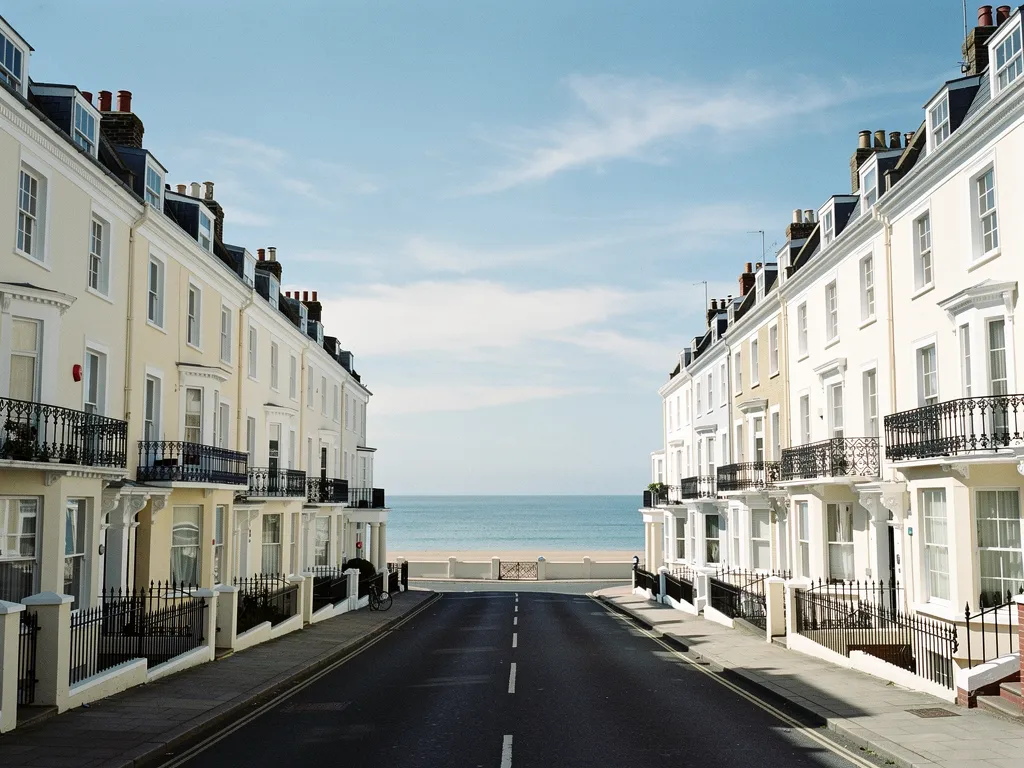
Fine salt rides in on sea air and settles on roofs, windows, car bodywork and garden furniture alike. On a metal roof, what follows depends on the surface and on whether weather washes it. HomeBuilding's guide to zinc roofs notes that the salt in marine air makes staining, and corrosion of certain metals, a possibility. It also observes that salt collects on the eaves boards and on fascias, where rainfall never gets to wash it away. A roof near the Worthing seafront, with its long runs of boxed eaves, has plenty of such places.
That last observation is the one to hold on to. A slope facing open sky gets rinsed by every shower. The parts a shower misses are different: the underside of a deep overhang, the soffit board beneath the gutter line, the face of a wall tucked behind a porch roof. Salt gathers on those, nothing removes it, and within a few seasons it shows as a pale bloom.
Why this page is about zinc
Among roofing metals, zinc is the one whose maker publishes distance-based coastal guidance, which is why we have built this page around it. VMZinc is content to stand behind its product at coastal sites under its usual warranty terms. It also acknowledges that salty air leaves a mark on the surface. Both things hold together: the metal lasts, and the finish can discolour.
None of that rules zinc out on the Sussex coast. It simply turns three questions into the agenda for a survey: how far is the roof from the water, which of its faces will the weather never wash, and who will rinse them?
The three distance bands and how to place your house
VMZinc sorts the shoreline environment into three bands, measured from the coast to the building.
| Band | Distance from the coast | Position |
|---|---|---|
| Sea front | Up to 1 km | The strictest of the three |
| Sea area | 1 km to 3 km | Second band |
| Low maritime influence | 3 km to 20 km | Third band |
Source: VMZinc FAQ, fetched 20 October 2026.
These are the maker's bands for its own metal. They are not a rating of any town, and they are separate from the driving-rain categories used to design tile and slate roofs. What an owner can do is measure. Open a map, find the nearest point on the shoreline, and read off the straight-line distance to your house. A seafront flat sits in the first band, a village house under the Downs lies further out, and a good deal of the coastal plain falls between. If your house lies close to a boundary between two bands, treat it as the stricter one when you plan the upkeep.
What the bands change
The band alters what we would recommend for the finish. VMZinc states that for pre-weathered products, permanent staining from salt is still likely within a kilometre of the sea. That matters to anyone choosing a dark, even finish for a house near the beach, because the colour may not stay even, and a mottled roof is hard to put right once it has set in. It is far better to hear this before the order than after the scaffold has come down. Further out, the risk eases. We record the measured distance in the survey notes and in the written quote, so the finish is chosen on a measurement and not on a guess. You can also put your address to the zinc maker and ask for its view on the product you are considering before an order is placed.
Where salt bloom gathers on an ordinary house
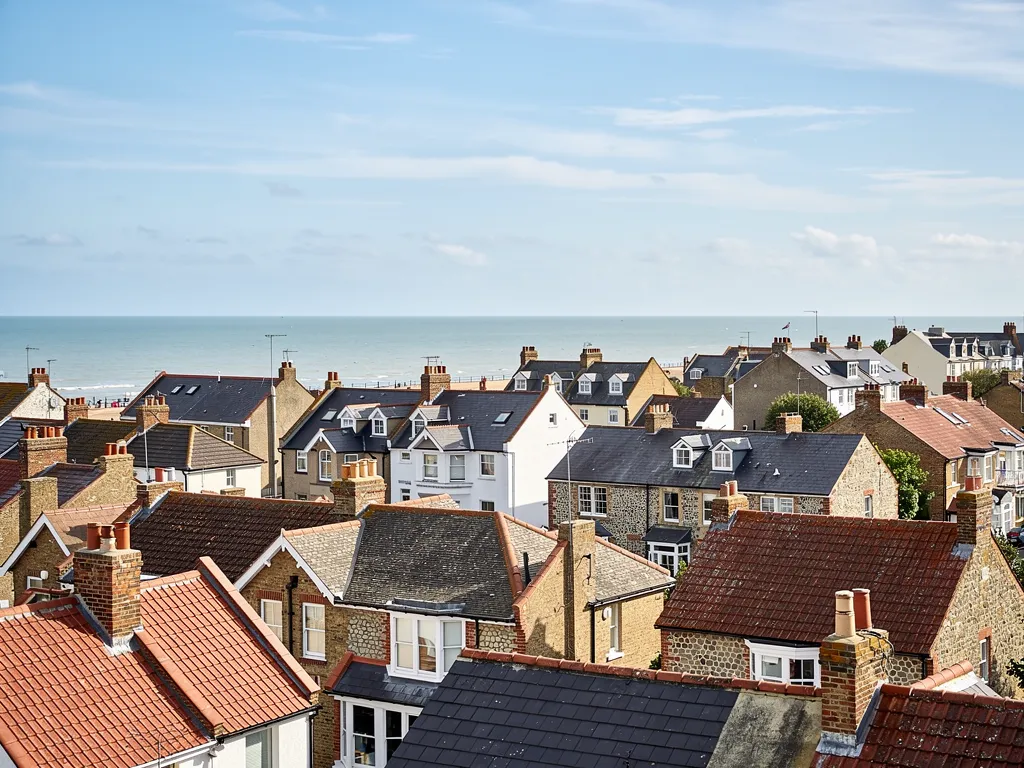
On a home, the bloom turns up in predictable places, and they are not always the roof slope. The first is the underside of the eaves, where a boxed soffit shelters the metal from the weather and the metal edge of the roof above it gets no direct rinse. The second is the face of a dormer cheek or extension wall under a deep overhang. The third is any pocket behind a bay roof or porch, where wind carries salt in but rain does not follow. VMZinc says the white deposits form mainly where rain does not wash the surface, which describes all three.
This is a different process from the pale carbonate that streaks new lead, which our guide to lead patination oil: why new lead is treated explains. The two blooms look similar from the garden, but the causes and cures differ, so do not assume a remedy for one will work on the other.
What the maker advises
The advice is practical and cheap. A plain-water rinse keeps the build-up down, and VMZinc suggests two rinses a year as a minimum. The sheltered faces and undersides are the targets, because the open slopes look after themselves.
If the routine sounds like more upkeep than you want, mention it at the survey. A metal that wants a rinse every spring and autumn suits an owner who can reach the roof safely or will book someone in. On a flat roof with no safe way up, a different covering may suit better, and our flat roofing page sets out the alternatives. Scrubbing hard or using strong cleaners risks marking the surface, so follow the maker's own cleaning advice for the product on your roof.
Detailing a zinc roof for the Sussex coast
Detailing decides how well a coastal zinc job ages, and most of it comes down to water. The aim is to leave as much of the metal as possible open to rain. Deep overhangs, boxed-in soffits and sheltered returns trap salt, so a design with shallow eaves and exposed faces stays cleaner than one with deep shadow. Where a sheltered surface cannot be avoided, it should at least be reachable with a hose from a ladder or tower.
Drainage follows the same logic. A gutter holding standing water keeps salt in contact with the metal, so falls, outlets and downpipes are set out to clear quickly. Flashings where zinc meets brick, a chimney or a window should throw water outward and leave no pocket for damp. The maker's technical sheets give the fixing method, the seam type and the compatible accessories for each product, and we follow them for the specific product on your roof, since a manufacturer's warranty depends on it. That warranty belongs to the maker and is not a lifespan promise.
Where zinc meets other materials
On a modern extension, zinc often sits beside brick, render, glass and sometimes lead. That is ordinary practice, but the junctions are where a careful roofer spends the time, because each material expands and weathers at its own rate. If the same building has lead flashings or lead cheeks, the way the two metals meet is settled at survey, with photographs of the existing roof in front of us.
Small lead repairs beside a zinc roof are a different job from the zinc itself. Our note on DIY lead flashing covers what an owner can reasonably try and where a roofer should take over.
Lifespan, lead as a comparison and the price
Published lifespans for zinc are long, with the usual caveat that they are typical ranges. VMZinc puts a zinc roof beyond 100 years and points to an environmental product declaration that gives 100 years. HomeBuilding, quoting a contractor, offers between 60 and 100 years. Compare that with MyJobQuote (22/09/26), which says lead flashing can last over 80 years, and over 100 years for higher codes. The two metals sit in the same league, and neither number is a promise about a particular roof.
The price of a zinc roof depends on the area, the pitch and form of the roof, the height and access, the seam system chosen and the state of the deck beneath, and only the survey turns those into a figure. For comparison, on the lead side, MyBuilder (updated 21/08/2026) gives £150 to £200+ per m² as its typical UK figure for lead on a flat roof. Our lead roofing cost guide goes through the lead side in more detail.
How a zinc quote reaches you
We survey first, photograph the roof and its sheltered faces, and then write one total price. Check that any quote you are weighing includes VAT and any scaffold, because zinc work on a tall extension usually needs access equipment. Ask too what rinsing routine the installer assumes, since that is part of the job's true cost over the years. If a simpler covering would do the job, we tell you plainly, and what we fit is chosen to suit the exposure. How long the metal itself lasts is a separate matter and rests on upkeep, so keep the gutters clear and look at the seams after each winter.
Protected buildings and when zinc is the wrong answer
Zinc is a modern material in most Sussex settings, so it needs more thought on an old building than on a new one. On a listed building, replacing lead with zinc is a change of material, and a change of material is the kind of work that can need listed building consent. Our guide to lead on listed buildings and churches explains how like-for-like is judged and who decides. Conservation areas and the South Downs National Park add planning questions of their own, so put the plan to the council before you order metal.
There are practical reasons to decide against zinc, too. A roof with no safe access for twice-yearly rinsing, a sheltered site where salt will gather and never wash off, or a heritage setting where the original lead should stay are all cases where we would suggest keeping to lead or choosing another covering. The right job, not the biggest, is the aim. If repairing the existing metal solves the leak, that is what we would recommend, with photographs of the defect, so the reasoning is visible to you.
What to bring to the survey
A short list makes the visit quicker:
- a map pin showing the nearest point on the shoreline;
- any photographs of past white bloom on soffits, fascias or metalwork;
- the maker or product name if zinc is already on the building;
- any listing or conservation area notice that applies to the property.
With those in hand we can judge whether the band, the detailing and the upkeep routine make sense together, and show you the evidence on your own roof before any price is set.