
Question answered
Can you fit lead flashing yourself?
The short answer
You can buy lead and the tools, but fitting flashing properly is a skilled trade. The sheet has to be cut, shaped and dressed to the roof, fixed so it can still move, and tucked into the wall so water cannot get behind it. Most failed flashings fail at those details. Work at height, handling lead and the cost of getting it wrong add further reasons to use a roofer.
Lead and the tools are easy to buy, and a flashing looks simple from the ground. The difficulty is in the details that only show when the first storm arrives.
Why a simple strip of lead is not simple
Flashing is the lead that stops a roof leaking where it butts a wall or chimney. From the ground it looks like a tidy grey line. Close up it is a set of shapes, each cut to suit the tile, the wall and the fall of the roof.
Lead is dressed with wooden tools, not pressed flat. The fitter works it into corners without thinning it, folds it so the overlaps shed water and avoids creases that crack with movement. A bend that looks neat in a workshop can be the point where a split starts a few winters later.
Getting that right takes practice on real roofs, and the first attempts are usually the ones that fail. If you are weighing it up, bear in mind that joining lead by welding, a flame technique, takes the skill further still.
The details that decide whether it holds
The top edge goes into a raked joint in the brickwork and is pinned with small lead wedges before the joint is pointed. Skip the wedges and the lead relies on the filling, which fails first; see what lead wedges are. Cut the joint too shallow and the lead pulls out.
The lead also needs room to move. Fixing it tight everywhere makes it crack as it expands and contracts. Sheets have to lap by enough to shed water, and the weight of the sheet has to suit the job. Where the roof meets a parapet or a hidden gutter the details become more involved, as in lead parapet gutters.
None of these shows up in the first week. Each shows itself as a stain on a ceiling after a storm, long after the work felt finished.
Working at height and handling lead
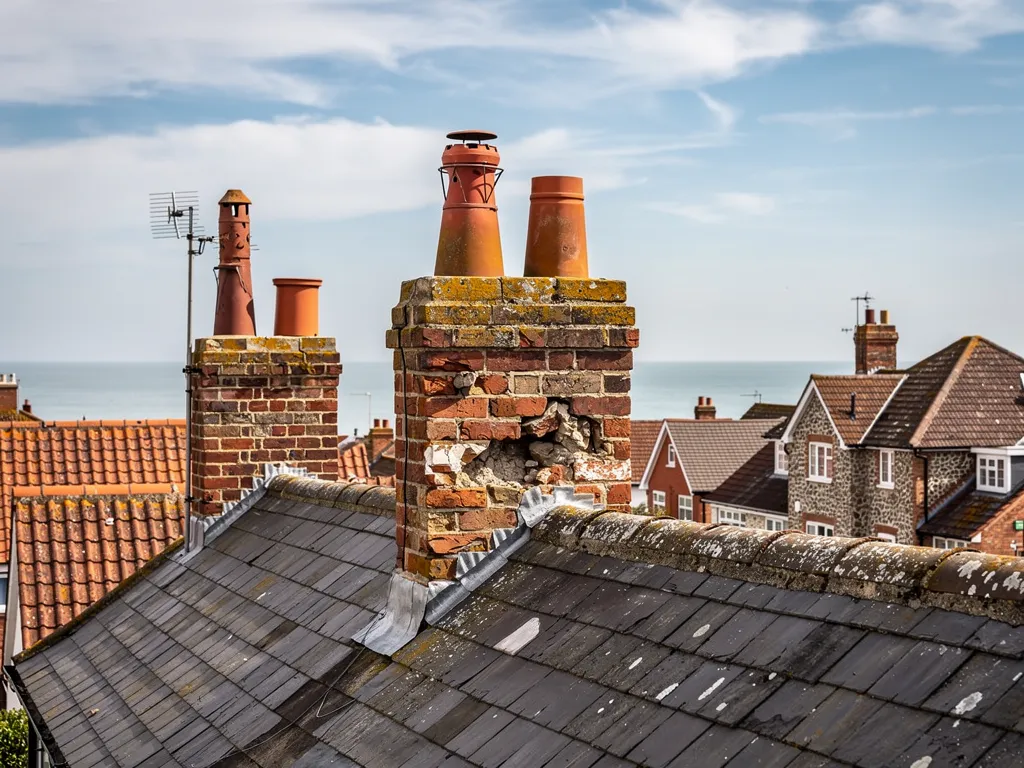
Flashings run along the margins of the roof, around chimneys and up gable walls, which are the places where a fall is most likely and most serious. A ladder against gutters, a slippery slate or a loose tile underfoot makes the job riskier than it looks, and a chimney stack is rarely reachable from a ladder at all.
A scaffold that stands over the footway needs a licence from the highway authority: West Sussex County Council for Worthing and the surrounding area, Brighton and Hove City Council in the city. The scaffold firm makes the application. That adds time and cost before the first tile is lifted.
Lead itself is toxic if swallowed or breathed as dust. Cutting and dressing produce fine particles, so protective gloves and a mask are sensible, and anyone handling it should wash before eating or smoking. These are everyday habits on a roofing job, and easy to forget at home.
Where do-it-yourself flashing tends to go wrong
The common faults are not exotic. Sealant is smeared over a lifted edge in place of a proper joint. The wrong weight of lead is used, for example a thin sheet where code 4 or code 5 belongs; a lighter code is made for soakers and not for exposed flashing. Soakers are left out, or a plain strip is stuck down with mortar.
Mortar-filled cracks and sealant beads are the other giveaway, since they usually mean a joint has been papered over rather than rebuilt. Each of these can hold for a season and then leak in a gale. By that point the cause is hidden under the new work, and tracing it costs more than the original repair would have.
Different metals bring different pitfalls. If you are tempted by an alternative, zinc roofing near the coast has the extra considerations for sea air.
What you can usefully do yourself
Quite a lot of the groundwork is safely yours. Walk round the house and photograph the flashings from the ground, using the zoom on your phone. Note stains indoors and on which wall they appear, and when, because leaks that only show in gales point to a joint, not a hole.
Check the loft with a lamp while it is raining or just after, and keep off the roof. Keep the gutters near a chimney or wall clear, within reach from the ground.
Then ask a roofer to trace it. For a sense of scale, Checkatrade gives typical UK figures of £50 to £70 per metre for code 5 lead flashing and £80 to £120 per metre for stepped flashing, all before VAT. Our photographs of your own flashings come with a written quote showing a single total price, and a roof that is actively leaking is made safe ahead of the repair. Our lead roofing pages show the other lead details.
Fitting flashing yourself: two more questions
Is self-adhesive flashing tape a safe substitute for dressed lead?
It can seal a gap for a while, but it is a patch and not a flashing. Tape cannot be wedged into a joint, tends to peel in sun and wind, and hides the fault underneath. A proper repair is usually lead, fixed and pointed.
What could I get wrong that I would only notice after a storm?
A missing wedge, a joint cut too shallow or a lap that is too short. All three look fine on a dry day and fail when rain is blown sideways against the wall, which is why a flashing needs to be right from the first.
Tell us about your roof
Describe what is happening and we will call you back to arrange a visit.
- Photographs of what we find
- A written quote with one total price
- Or call 01903 299063
10-year workmanship guarantee, in writing.