
Question answered
Can you walk on roof tiles?
The short answer
You should not walk on roof tiles. Clay, concrete and slate are made to shed water, not to bear a point load, and one footstep can crack a tile that then leaks. Roofers use crawl boards, roof ladders and edge protection to spread weight and stay safe. To have your roof checked, look from the ground or ask a roofer to inspect it.
A tile may take your weight once without breaking, but you should not rely on it. Roofs are built to keep water out, not to carry a person, and falls from height cause serious injuries.
Why tiles crack underfoot
A tile is strong when loaded the way it was designed to be: lying in its bed, overlapped by the course above, with the weight carried down through the battens. A boot lands on one small patch, often over the unsupported part of the tile between battens, and the tile flexes. Clay and concrete are brittle, and slate splits along its layers.
The damage is often invisible from above. A hairline fracture, or a snapped corner under the overlap, lets rain in at the next storm, and you only find out from a stain on the ceiling. Older tiles that have weathered or gone porous crack more easily, and ones that were repaired before are more fragile still.
A rotten batten adds a further trap: the tile looks fine, but nothing sound lies beneath it. The vertical equivalent, with its own fragility, is covered in tile hanging repairs.
The danger to you on the slope
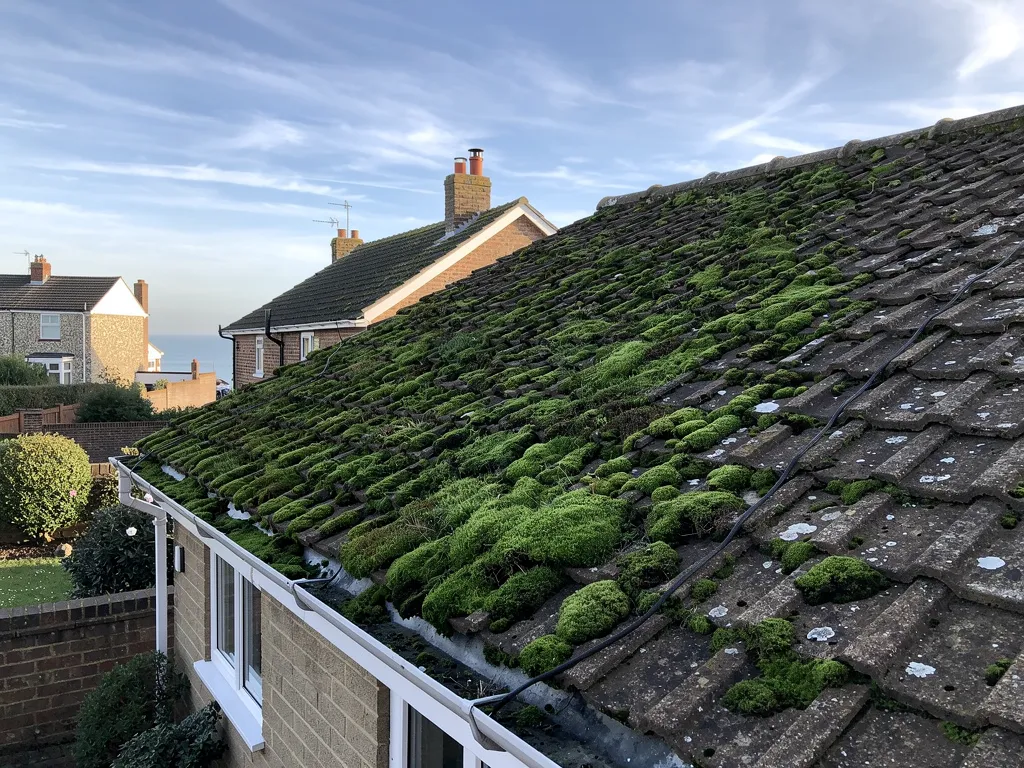
The bigger worry is the fall itself, which is rarely survivable without injury. Roofs are slippery. Moss and algae, morning dew, frost, salt film and wind-blown dust all reduce grip. Tiles shift, a ridge tile can come away in the hand and a slate can slide. Pitch makes it worse: the steeper the slope, the faster a slip turns into a fall.
Even from a ladder, the working edge at the gutter is a hard place to step off. Gutters are not made to carry weight, and a fascia can be rotten behind its paint.
For that reason we do not suggest anyone attempts repairs at height themselves. Climbing up to refix a slipped tile, clear a valley or smear sealant on a flashing is among the commonest ways people get hurt. Nothing on this page should be read as encouragement to try. The work belongs with trained people who have the right equipment.
How roofers stay safe up there
Professionals spread their weight and limit the drop. A crawl board is a long plank with cross battens that rests over the battens or rafters, sharing a person's weight across several tiles. A roof ladder lies flat on the slope and hooks over the ridge, giving a stable path. Scaffold with edge protection at the eaves gives a safe working platform on larger jobs and stops a fall at the gutter line.
Where tiles are old, brittle or loose, they plan the route in advance, step only where the roof is supported and sometimes lift tiles ahead of them. They carry spares and mend as they go.
Scaffold is often the largest single item in a pitched job, so ask each roofer whether theirs is included in the price. The steepness of a slope decides how much help the equipment has to give, a theme taken up in changing the pitch of a roof.
Checking your roof without climbing
A lot can be learned from the ground. Walk round the house in good light and look for slipped or missing tiles, broken ridge tiles, mats of moss, a sagging line and anything hanging from the eaves. Binoculars help, and so does a phone camera's zoom. Inside, a torch will show chinks of daylight and damp patches, as long as you keep to the joists or a boarded area.
A roofer goes further, using a drone or a ladder. MyBuilder puts a standard roof inspection at £150 to £250 and a drone survey at £200 to £400, as typical UK ranges updated in August 2026.
Our surveys produce photographs of your own roof, so what we see is what you see, and the written quote that follows gives one price for the job. If something looks wrong, such as a ridge that dips, read roof spread before you do anything else.
When work has to happen, and who does it
If water is coming in, the safest course is to limit the damage from inside, with a bucket and towels, and ask a roofer to make the roof safe. Never climb up after dark, or in wind and rain. A storm is when a roof is least safe, and a make-safe should be left to people with the kit. We prioritise leaks and storm damage.
For smaller jobs, ask any roofer how they will work at height: what protection they use and how the scaffold is arranged. The answer should be specific.
The structure matters too. Pitched roofs differ in construction, and what is safe on one is not on another, as pitched roof construction shows. Our wider tile and slate services are on the pitched roofing page.
Roof access: further questions
Is it safe to stand on the ridge of a slate roof?
No. A ridge is not a path. Ridge tiles are bedded and fixed to resist weather, not weight, and a person astride one can dislodge it. Slate is also fragile and slippery. Any inspection of a slate roof is best done from the ground or by a roofer with the right equipment.
Will a tile cracked by a footstep always leak?
Not always, and not at once. A crack under the overlap may hold in light rain and fail in a storm, or when frost opens it. Because you cannot judge from below, any tile that has been stood on should be inspected, and replaced if it is broken.
Tell us about your roof
Describe what is happening and we will call you back to arrange a visit.
- Photographs of what we find
- A written quote with one total price
- Or call 01903 299063
10-year workmanship guarantee, in writing.