
Question answered
Can dry verge be fitted to an old roof?
The short answer
Dry verge can be fitted to many older roofs. It replaces the mortar at the gable edge with a cap or trim screwed or clipped to the roof, so it suits tiled roofs with sound battens and a tidy edge. It is a poor fit on hand-made or irregular tiles, rotten battens or a decayed undercloak, all of which need repair first.
Dry verge can often be retrofitted to an older roof, but it depends on the tiles, the battens and the condition of the edge. The survey decides, not the age of the house.
The edge a dry verge replaces
At a gable, the last tiles of a pitched roof overhang the wall slightly and are bedded in mortar on a strip beneath called the undercloak, usually a course of slate, tile or board that closes the gap to the brickwork. That edge faces the weather from the side and from below, and the mortar tends to crack and drop out long before the tiles wear.
A dry verge system takes the mortar away. A cap or trim is fixed mechanically, normally with screws and clips into the battens or a purpose-made fixing, often with a closer to seal against the wall. Nothing is left to crumble. Our page on dry verge systems describes the parts, and verge repairs covers the bedded alternative.
Why old verges fail in the first place
Before choosing a system it helps to know why the existing verge is failing. Sometimes the mortar simply aged and cracked in the wind. Often the cause is deeper: water running down the face of the gable wall, a failed undercloak, or movement in the roof timbers that has pulled the edge tiles away from the bed.
If the cause is not put right, a new cap will just sit on the same problem. On a seaside house the verge also meets the gale side-on, and a tile that was only held by a bed of mortar can lift as soon as the bond weakens. A survey from the loft and the roof edge shows which of these is at work, and the photographs let you see it for yourself before agreeing to any work.
Tile compatibility comes first
A dry verge kit is designed around a specific tile profile and width. Interlocking concrete tiles and many modern clay tiles are consistent in size, and the trim is shaped to suit. Older roofs are less predictable. Hand-made clay plain tiles vary from one to the next, and a roof laid a century ago may have uneven courses, bowed battens or tiles that are no longer made.
A fixer checks whether the edge tile matches what the kit expects, whether a part-width tile is needed, and whether the cap will lie flat. Where the original tile has been discontinued, the answer may be a different system, or a repair with a matching reclaimed tile first.
Dry-fixed verge systems are tested to BS 8612:2018, and manufacturers list which tiles each one is intended for. A careful fixer reads that before ordering, not after the scaffold is up.
Fitting it to a worn gable, step by step
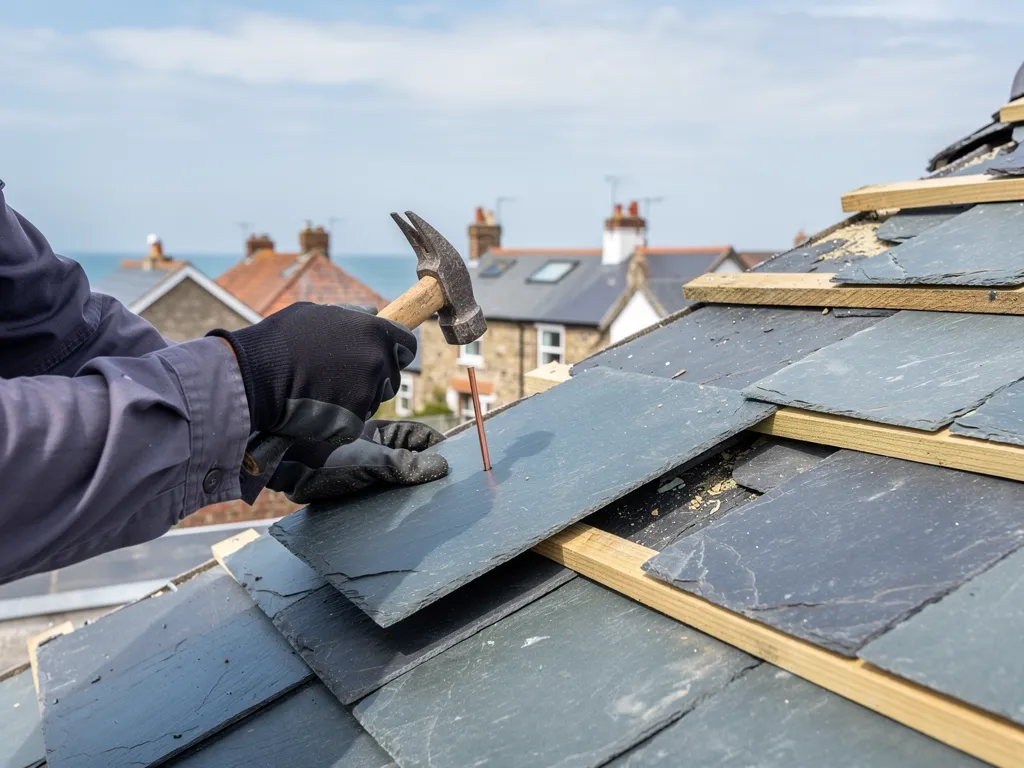
The work follows a set order. The old verge tiles and mortar come off, and the battens and undercloak are inspected. Rotten timber is cut out and replaced, and a new undercloak goes in where the old one has failed. The cap fixing is then set out along the edge, with the closer or seal against the wall.
Once the line is true, the verge tiles are laid and each cap is screwed or clipped down, with the joints overlapped as the maker directs. Because nothing depends on mortar setting, the work can carry on in conditions that would stop a bedded verge. The last job is a walk along the finished edge, a check of the gutters for debris and a set of photographs for the file.
Battens, undercloak and the wall line
Screws are only as good as the timber they bite into. On an old roof the battens at the gable may be rotten, split or too narrow, and the rafter beside them may have been damp for years. If a fixing has no sound wood to hold, the cap will lift in a gale. So the edge is opened up and the timbers are checked before anything dry goes on.
The undercloak matters just as much. If it is cracked, missing or choked with old mortar, it is renewed, because it carries water away from the wall. A stain on the wall of a gable bedroom often starts here. Our page on verge undercloak shows what we look for.
On an exposed coastal edge, a mechanical fix at the perimeter is good practice. Marley notes that BS 5534 expects perimeter tiles to be fixed twice, and a dry verge puts that idea into the hardware.
Protected buildings and what to ask a roofer
On a listed building or in a conservation area, changing the look of the verge may need permission, because a mortared verge is part of the character of an old gable. Ask the council's planners first, or the South Downs National Park Authority if the house is within the Park. Unmatched materials on a listed building can require listed building consent.
If the roof is not protected, the questions to ask any roofer are practical. What is the cap fixed to, and with what? What happens to rotten battens and the undercloak? Will the colour match the tile? How long will the work take? The first of those matters most when a gale comes.
For timings, see how long a ridge repair takes, and for roofs in slate see dry ridge on slate. Cover for storm damage is discussed in ridge tile insurance, and the whole range is on ridge tile repairs.
Retrofitting dry verge: two more questions
Is a dry verge noisier than a mortar one?
A well-fitted dry verge is quiet. Rattling usually points to a loose cap or a missing fixing, and our page on dry verge noise goes through the causes. A mortar verge is silent but can crack and fall out.
Can the caps blow off a dry verge in a gale?
They can if they are fixed to weak timber or without the right fixings. A cap screwed to sound battens and fitted to the maker's instructions is held mechanically, which is the whole point. The blown caps page covers the failures.
Tell us about your roof
Describe what is happening and we will call you back to arrange a visit.
- Photographs of what we find
- A written quote with one total price
- Or call 01903 299063
10-year workmanship guarantee, in writing.