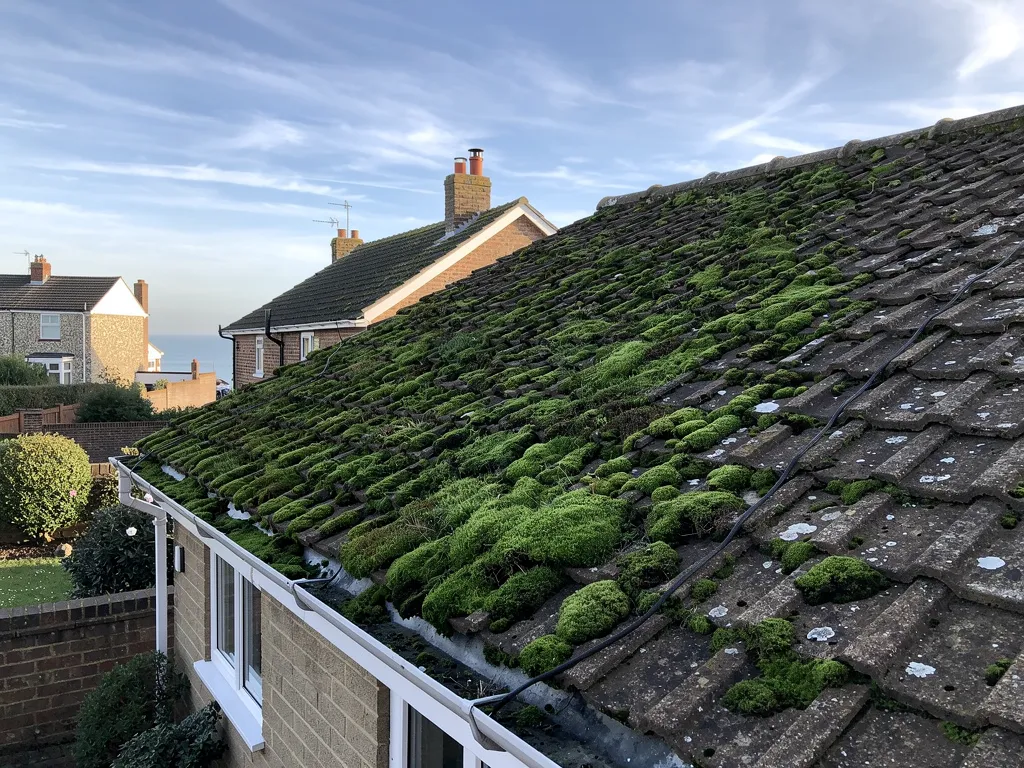
A gutter looks like a simple channel, but it is the last stage of the roof's drainage. Everything the roof sheds goes through it: rain, but also grit from the tiles, seeds, leaf litter, bird droppings and the moss itself. A mat of moss on the slope above sheds fragments in every shower, and wind and rain carry them down to the eaves. The gutter catches the lot.
A little of this is normal. The trouble starts when the gutter holds what it catches. Moss is spongy and takes in water, so a clump at the outlet acts as a plug. Water backs up behind it, finds the lowest point on the gutter's front edge, and pours over, or it rises over the back edge, down behind the fascia, and runs into the wall.
This guide, part of our roof cleaning and moss removal set, explains how the blockage builds, the damage it can cause around the house, what clearing it properly involves and why the roof and the gutters should be dealt with in a single visit.
How moss gets into the gutter and stays there
There are three routes in. The first is simply gravity: moss on the bottom rows of a tiled slope loosens in rain and frost, slides down and drops into the gutter. The second is spores. Moss and lichen release them in huge numbers, and spores land wherever there is damp debris, so a gutter with a little silt in it becomes a seedbed of its own. The third is a roof that has just been cleaned badly. Moss scraped off a slope and left to wash down will end up in the channel, and a gutter can be filled to the brim within a week of an over-eager job on the tiles above.
Once there, the growth thrives. A gutter holds water between showers, gets little direct sun on its back edge and is full of the nutrients that debris breaks down into. Moss, algae and even small plants such as grass and seedlings take hold. Roots work into the joints of an old cast iron gutter and a modern plastic one alike, and into the corners where one length meets the next.
The pattern is predictable. The worst gutters are those under a north-facing slope, beneath overhanging trees and on the slope that takes the most weather. Where a roof drains into a short valley gutter or a hopper head, a blockage forms faster, because the flow is concentrated.
The outlet and the downpipe are the weak points. A gutter is wide and forgiving, but the outlet is a narrow hole, and the downpipe below it is narrower still. A fist-sized mat is enough to stop it. You may notice that water pours over the front of the gutter at one spot in heavy rain, or that the gutter holds water long after the rain has stopped. Both are signs the outlet is part-blocked.
What an overflowing gutter does to the house
Water that cannot go down the pipe has to go somewhere. Often it spills over the front lip and runs down the wall, leaving green staining, a damp band at ground level and a splashed path. Brickwork and render that stay wet are slow to dry, and in winter the water can freeze and flake the face.
The worse case is a gutter that overflows at the back. Water runs behind it, soaks the fascia board and the rafter ends under the first course of tiles, and on a house with a weak eaves detail finds its way into the wall or the loft. Timber that stays wet rots, and by the time a soft fascia or a stained soffit shows, the damage is already some way along. MyBuilder puts fascia and soffit replacement at around £150 per metre and a gutter replacement at £30 to £70 per metre, so a blockage left for years can turn a cleaning job into a rebuild.
Weight is another factor. A gutter full of wet moss and silt is heavy, and the brackets that carry it can bend or pull out of a fascia that has already gone soft. The gutter then sags, holds more water, and the cycle repeats. Brett Martin advises brackets spaced no more than 900mm apart, and a gutter with a sag between two of them has lost its fall.
Makers of plastic and metal systems generally want a very slight tilt to the outlet, in the region of 1:600 to 1:350 depending on the system, so there is little margin. A sag of a few millimetres is enough to leave a pool, and a pool is where moss starts again.
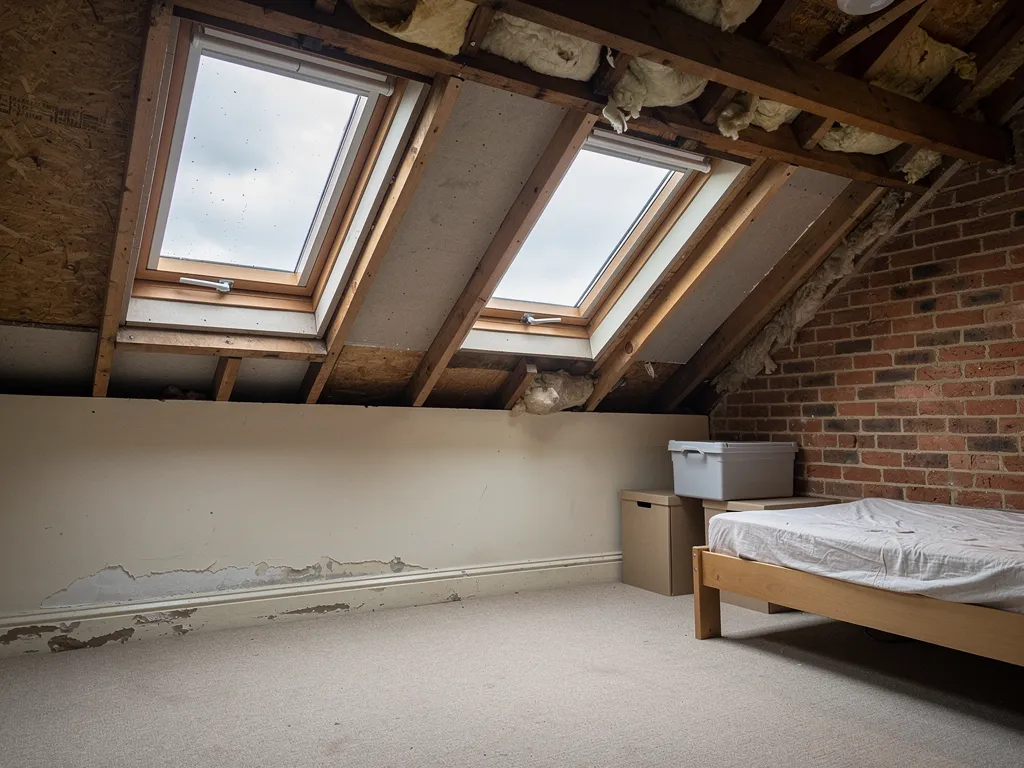
Overflow from a blocked gutter is also behind some damp patches that get blamed on the roof. We check the eaves from the loft and from outside before deciding which it is.
Clearing the channel and the downpipe
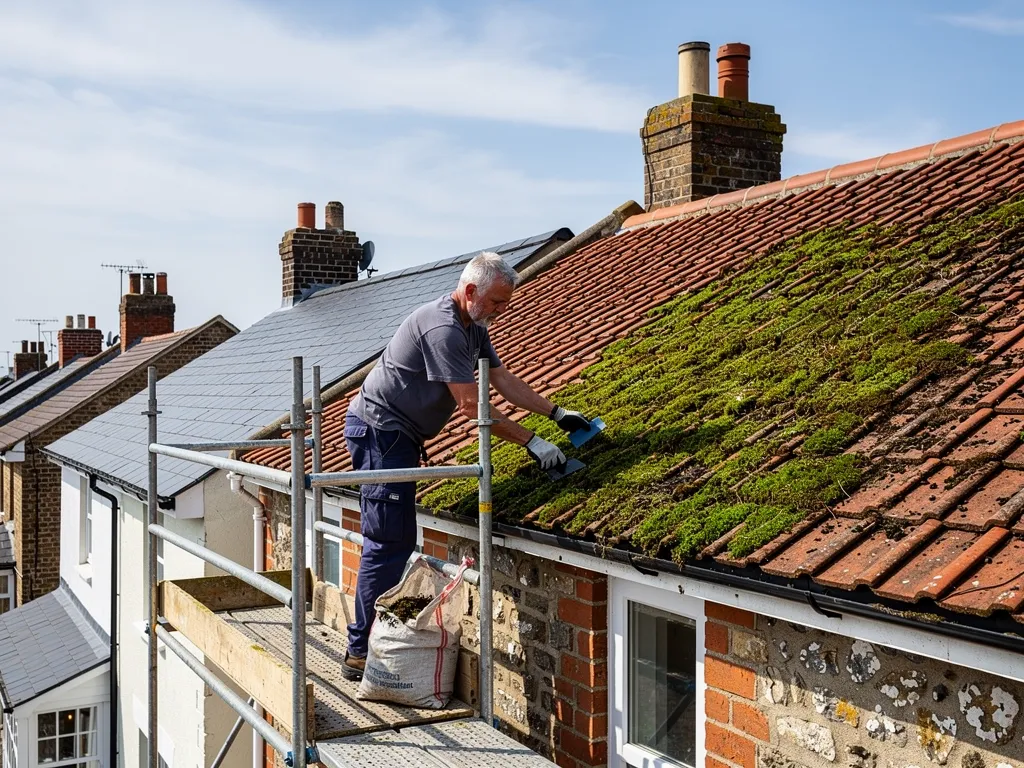
A proper gutter clean is more than a scoop. We start by taking out the loose material by hand or with a scoop and a small trowel, working from the end furthest from the outlet towards it, so that the debris moves with the flow and is not pushed into the pipe. It goes into a bag or a bucket and comes down with us. Dropping it on the ground and leaving it is not a clean.
Then the channel is brushed and rinsed. A hose run along it shows where water still pools, because it settles at the low spots, and shows whether the outlet is passing freely. If the water drains slowly, the downpipe is the next thing to check. A blockage there needs rodding or flushing from the top, and sometimes dismantling a bend at the shoe. We look at the pipe joints and the brackets as we go, because moisture shows at a bad joint.
We also check the details that fail quietly. End caps and stop ends leak at their seals. Corners and unions need to be sound. Brackets should be firm in the fascia. A gutter that has dropped will not drain, however clean it is, and the fix is to reset it to the right fall, not to keep clearing it.
Cast iron, plastic and aluminium
Old cast iron gutters on Victorian and Edwardian terraces are heavier and bolted at the joints, so they are cleaned with patience and without hard scraping that would strip the paint. Plastic gutters are lighter and scratch more easily, and are cleaned by hand. Aluminium is handled much as plastic is. All three can be cleared properly; the difference is in the tools.
Why the roof and the gutters are cleaned in one visit
If you clean the gutters and leave the roof, the next rain brings more moss down from the slope above, and the gutter is half full again within weeks. If you clean the roof and skip the gutters, the debris that comes off lands in a channel nobody has emptied. Either way, you have paid for half a job.
The order matters, and it is the reverse of what many people expect. On a combined clean we work from the top down. The ridge and slopes come first, then the loose growth and debris fall into the gutters, which are cleared last, once everything that is going to land in them has landed. The downpipes are flushed at the end, so the whole run is confirmed clear before we leave. A roof cleaned from the bottom up spreads the mess onto surfaces already finished.
A combined visit saves access as well as time. The ladders, towers or scaffolding needed to reach the eaves are in place for both jobs, and our guide to what roof cleaning costs shows how large a share of a modest clean access can be. Doing both together means paying for it once.
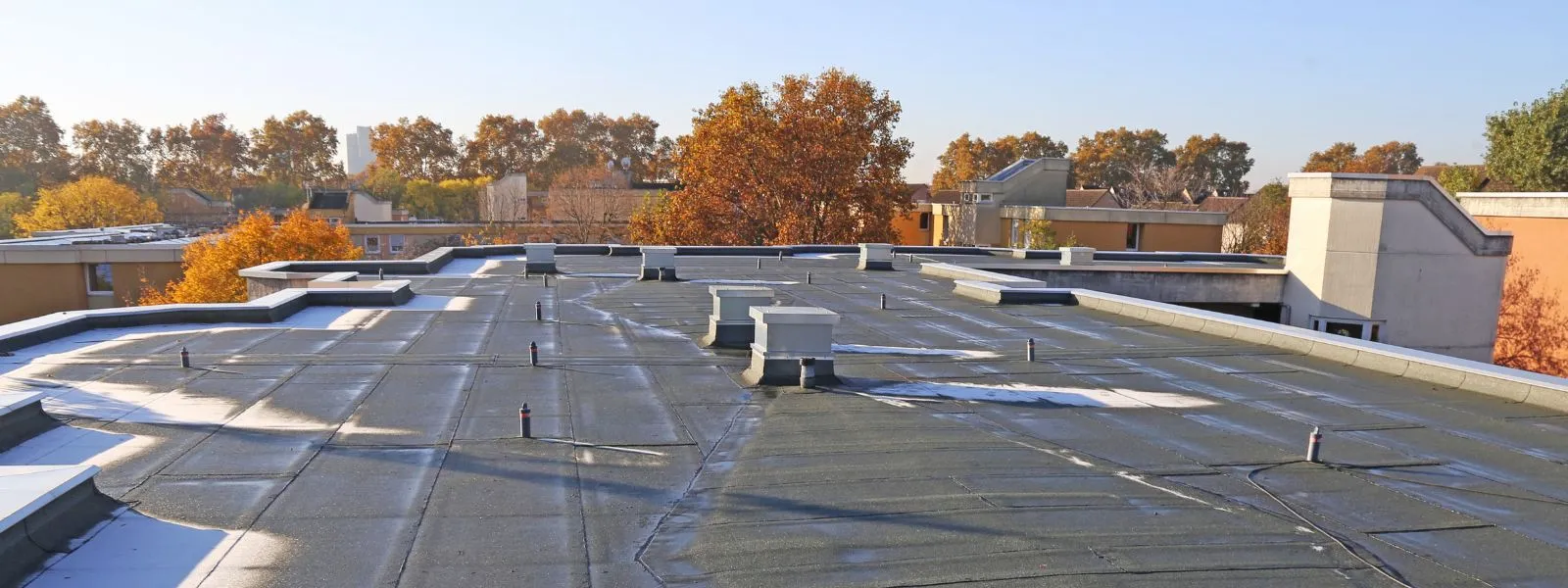
It also catches faults early. With the moss gone, we can see the state of the first course of tiles, the felt at the eaves and the fascia behind the gutter. If a tile has slipped, or a lead tray at a chimney has opened, you see it in photographs at once and not after the next storm. Where the roof is flat, the same principle applies, and cleaning a flat roof covers its outlets and rainwater route.
Black streaks, guards and the things that help
Not every dark mark on the gutter's face is moss. Black streaks on tiles and on the front of a plastic gutter are often algae, and our guide to black streaks on a roof explains the difference and why it matters for treatment. Algae sits on the surface and will not block anything, though it shows that the surface stays damp.
Gutter guards and brush inserts are sold as a cure for blocked gutters. Some help on a house with a single overhanging tree, where leaves are the main problem. They are less use against moss and silt, which pass through a mesh or settle on top of it and then root. A guard can also hide a blockage, so the gutter fills out of sight, and it adds a job when the gutter has to be cleaned: the guard must be lifted first. We tell you if a guard is likely to help on your house, and we do not fit one for the sake of it.
Better results come from the basic things. Keep the roof free of moss, so less falls in. Cut back overhanging branches. Check the fall and the brackets. Make sure the outlets are the right size for the area they drain, since a roof extended without altering the guttering can overload a small outlet.
After a clean, a light treatment on the roof slows regrowth, which means fewer fragments reach the gutters, and the routine for that sits in keeping a roof clean after it has been cleaned.
Gutters that are cracked, split at the joints or past repair should be replaced, not cleaned over and over. Cleaning a failing run only postpones the bill, and a replacement run is laid to the correct fall with sound brackets, so it should drain properly from the first shower and hides the leaks at the joints behind a fresh coat of cleanliness. We will tell you when we find them.
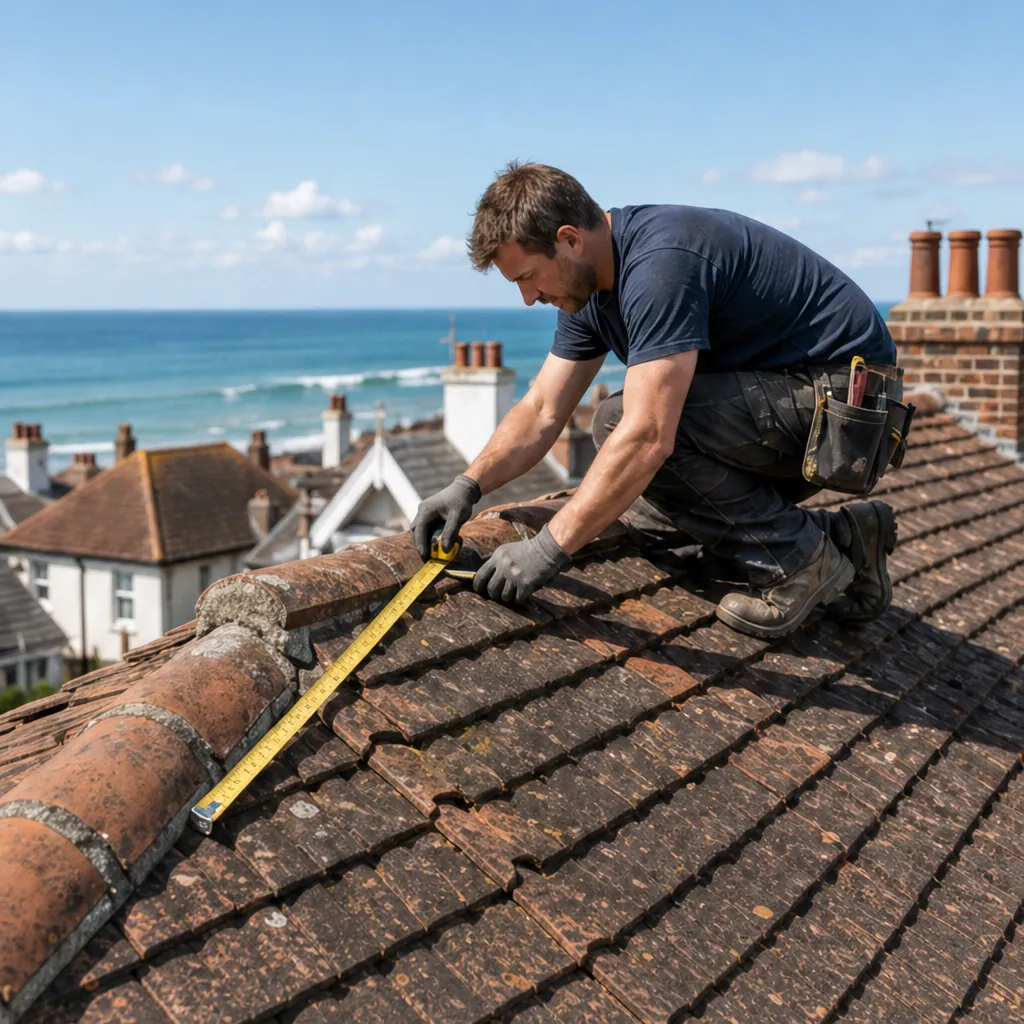
What to look for and what it costs
You can spot most gutter problems from the ground. Look for water spilling over the front in rain, green or black streaking down the wall below the gutter, plants growing out of the channel, a sagging run, drips from a joint and damp stains on the wall near a downpipe. Binoculars help. A look from an upstairs window at the back of the gutter can show a lot more.
Do not climb a ladder against a plastic gutter, which was never designed to carry weight. Leave it to someone with a stand-off bracket or a tower.
Gutter clearing is often bundled into a roof clean. MyBuilder's roof cleaning guide (updated 21/08/2026) says a roof clean typically starts from around £300. That is a national figure and not a Watertight price, and it will not include a gutter replacement, which MyBuilder prices separately at £30 to £70 per metre. The difference between a clean and a replacement is the condition of the gutter, and the survey shows which you need.
The things that move the price are the length of gutter, the height of the eaves, the number of downpipes, how choked the run is and whether any repairs are needed. Ask whether the figure you are given already contains VAT and any scaffolding.
The survey comes first. You then get one price in writing for the whole job, with photographs of your own gutters attached. Waste leaves with us and the site is left tidy.