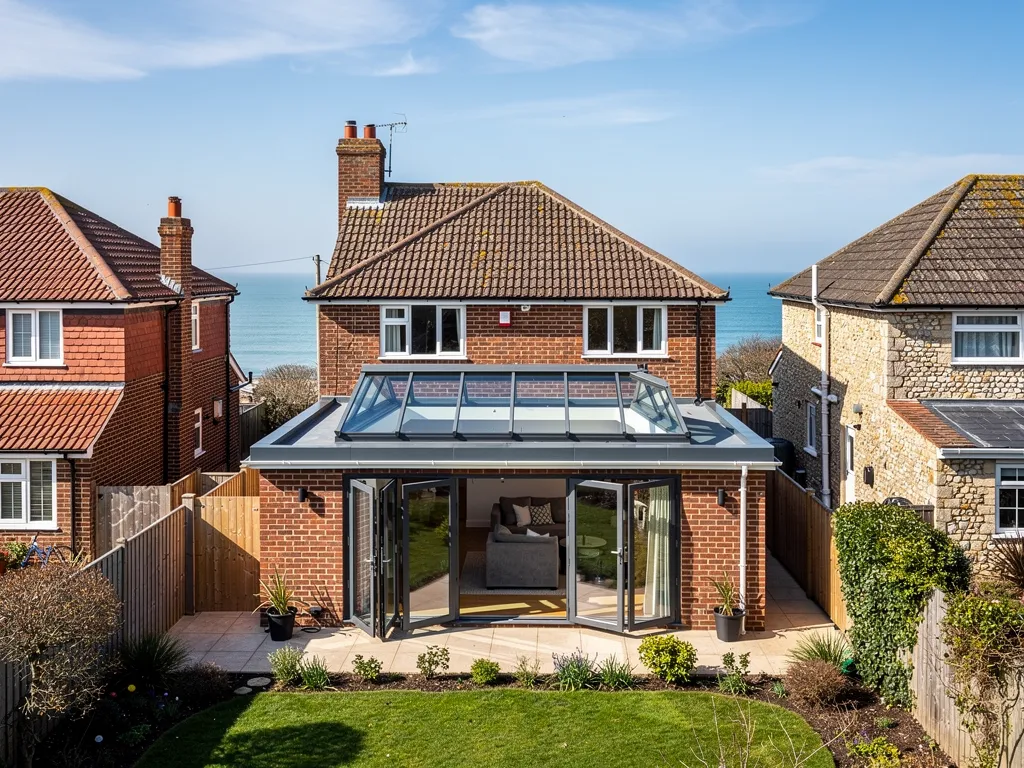
A pitched roof sheds water quickly, and moss mostly settles on the shaded, damp slopes. A flat roof is different. Water leaves it slowly, grit and leaf litter settle in the same corners, and a thin film of algae or moss can build up in a few seasons over the extension, garage or porch it covers. Along the Worthing seafront and across the post-war bungalow estates, flat roofs over kitchens, dining rooms and garages are everywhere.
The covering underneath decides almost everything about the cleaning. Mineral felt, rubber sheet, fibreglass, plastic membrane and metal are all called flat roofing, and they do not react the same way to a stiff brush, a pressure washer or a bottle of treatment. What suits one can cut, blister or dull another. A roof that has been treated like a tiled slope may look cleaner for a month and leak by spring.
This guide, part of our roof cleaning and moss removal series, takes it in the order we work: why growth appears, how to tell what you have, how each surface is cleaned, what to look for once it is clear, and what it costs.
Why moss and algae settle on flat roofs
Moss needs damp, some shade and a surface to grip. A flat roof offers all three where the water stays. A fall that is too shallow, a low spot in the deck, a blocked outlet or a gutter that sits proud of the edge will each leave a pond after rain, and the growth follows the pond.
The fall is the number to know about. IKO, citing the 2018 edition of BS 6229 (since revised), gives 1:80 as the finished minimum fall and advises designing to 1:40 so that building tolerances and deflection do not use it up. A roof built close to the minimum has no margin, and a deck that has sagged a little with age can drop below it. Standing water is the usual sign.
Debris is the second cause. Leaves, seeds and wind-blown grit lodge against upstands, in corners and around outlets, and break down into a thin soil. Seeds root in it. Shade from a neighbouring wall or tree keeps the film wet for longer. On a coastal house, salt and sand in the air add to the mix, and a bare membrane left alone can turn green or black well before there is any real damage.
Growth itself rarely harms a good membrane in the short run. What it does is keep the surface damp, hold weight on a deck that may already be weak and hide the first signs of a split. That is why we take it off and look, not just treat it.
Algae and the black film
The dark staining you often see on felt is algae, not moss. It is mostly cosmetic, but it holds moisture and speeds up the weathering of the surface. It comes off with the same gentle washing, and a treatment slows it returning.
Telling felt, rubber, fibreglass and metal apart
Before anything is cleaned, identify the surface. You can usually tell from the ground or from a window, and a quick look at the edges confirms it.
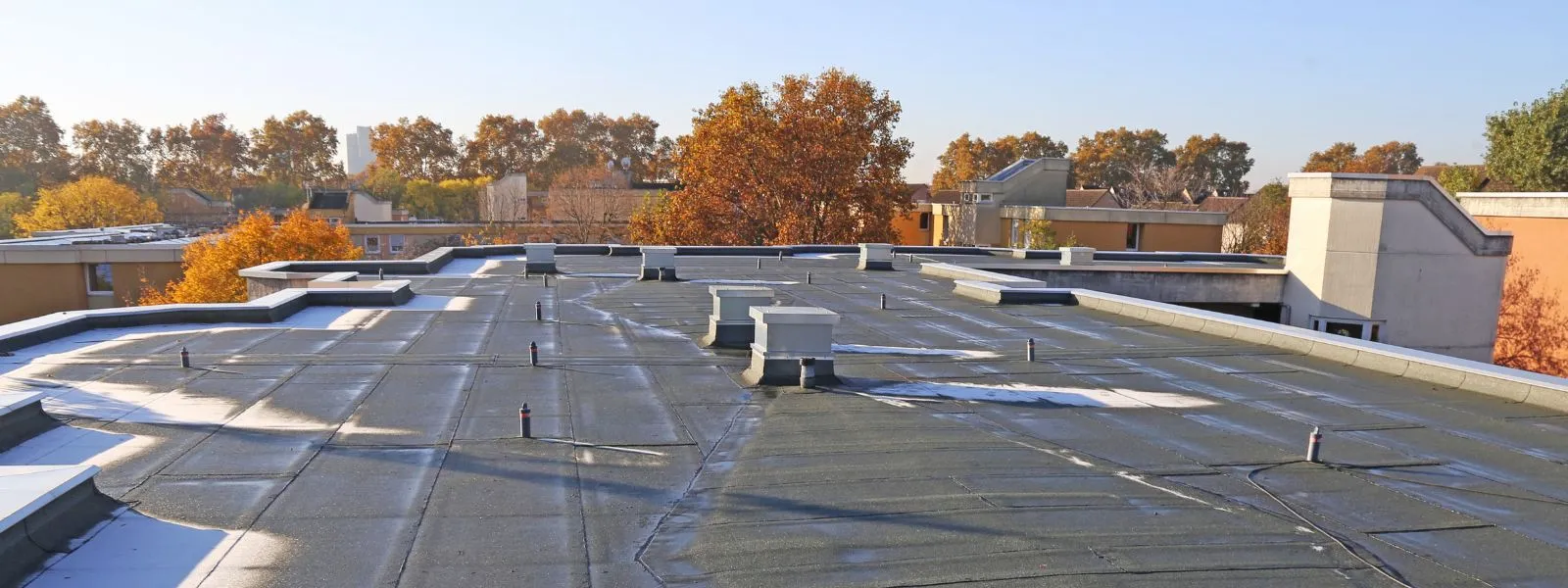
Mineral felt, often called torch-on felt, is a bitumen sheet with a gritty cap, in grey, green or black. It has visible laps, and the surface sheds granules. Less puts a good felt job at 10 to 20 years, and sources disagree on how far a well-maintained one can go.
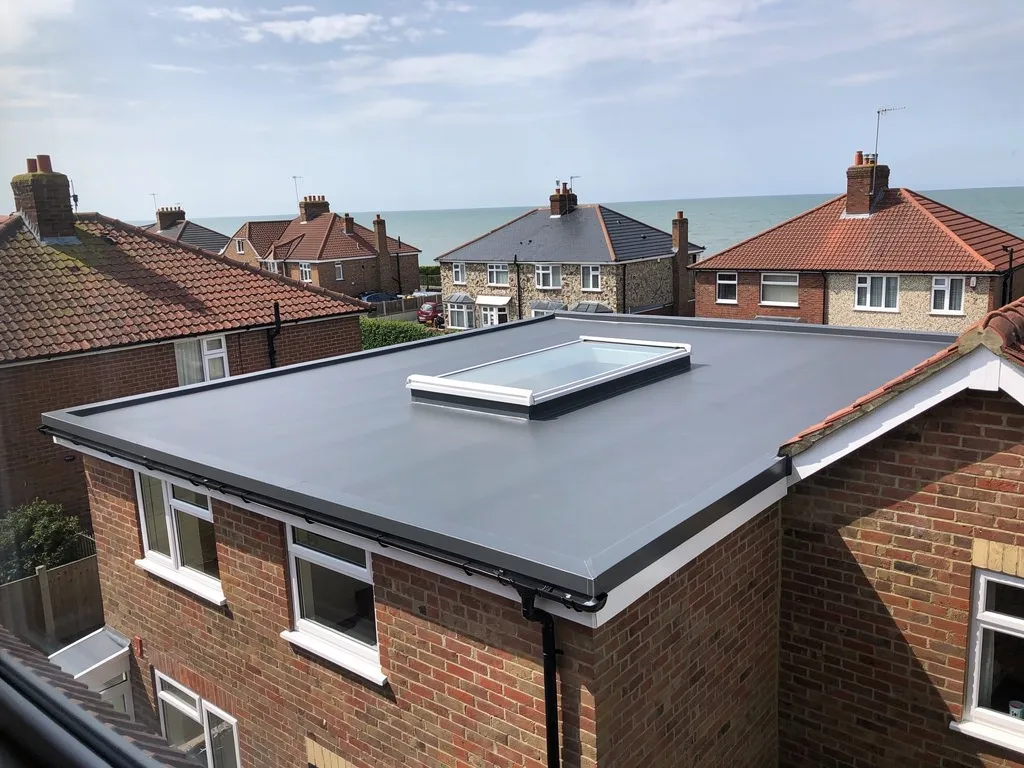
EPDM is a smooth, black rubber sheet, often laid as one piece with few seams. GreenSpec lists a service life of 20 to 30 years for it, and other sources put it higher.
GRP, glass-reinforced plastic, is a hard, glossy resin finish with a jointless look and a fibreglass weave beneath. Less gives 25 to 40 years.
Single-ply PVC and similar sheets are welded at the seams and come in grey and other colours. Lead and zinc are metals, with joints that are rolled or folded. Lead can last for 50 to 100 years on a flat roof according to Less, and the manufacturer VM Zinc says zinc can last more than 100 years.
Ranges like these are typical, not promises. Exposure, workmanship and upkeep all change the result.
If the surface is corrugated cement sheet, translucent sheet or polycarbonate, stop. Older corrugated cement roofing on garages and outbuildings may contain asbestos, and neither it nor a brittle plastic sheet should be brushed, scraped or stood on. Read our guide to cleaning a roof that may contain asbestos first.
If you cannot tell what you have, send us a photograph, and we will say what it is before anyone plans a clean.
Cleaning each surface without damaging it
The principle for every membrane is the same: soft tools, low pressure, plenty of water and no solvents that the manufacturer has not approved.
On felt, we sweep loose debris, lift moss by hand and brush the surface with a soft broom, then rinse. Metal blades and stiff wire brushes tear the cap sheet and strip granules, so they stay in the van. Where the surface is already blistered or splitting, brushing can open it further, and we stop and show you what is there.
EPDM tolerates washing and a soft brush well. It does not tolerate petrol-based cleaners, strong solvents or sharp tools, which can swell or cut the rubber. Mild detergent and clean water do the job, and the seams and edge trims are checked as the film comes off.
GRP has a resin top coat that is often a different colour from the glass beneath. A soft brush and water are right. Abrasive pads, harsh scouring and a heavy jet will dull or wear through the top coat, and the weave shows through.
Single-ply PVC takes a soft brush and a mild cleaner. Check the manufacturer's guidance before using any chemical treatment on it.
Lead and zinc are brushed lightly and rinsed. The zinc manufacturer VM Zinc advises rinsing with fresh water at least every six months to limit salt build-up, since white deposits gather in spots the rain never reaches, and a coastal roof collects more of them. Its guidance adds that pre-weathered zinc within 1 km of the sea is still likely to stain permanently.
MyBuilder's roof-cleaning guide gives £5 to £10 per m² for manual scraping, which sits oddly with a membrane, where scraping is the wrong technique.
Drainage, ponding and the outlets
Once the surface is clear, the water route is the next job. A flat roof drains to an outlet, a gutter or a hopper at the lowest edge, and if that route is blocked the roof cannot clean itself however well it is washed.
We clear the outlet and check the grid or cage over it, because a handful of leaf mould is enough to hold back a pond. We look along the edge trim for a gap where wind-driven rain gets under, and at the junction with the house wall, where the membrane turns up and is sealed by a flashing, the strip of lead or flexible sheet that closes the joint. A split in that upstand is a more common source of a ceiling stain than the main surface.
Ponding that stays for more than a day or two after rain is a build problem, and no amount of cleaning will cure it. It may be a sagging deck, a dip around an old outlet, or a layer of felt laid over an earlier layer. When the pond sits on a joint it speeds up the fatigue of the seam. We note the position and depth, photograph it, and set out the options: a re-levelling layer, a new outlet, or recovering the roof.
Gutters on the same extension are part of the same drainage run. Debris from the roof ends up there, and our guide to moss blocking gutters and downpipes describes how a cleaned roof can overflow into a blocked gutter if the two are not done together.
If the water already comes through, our flat roofing page explains repair and replacement.
What cleaning reveals under the growth
A mat of moss is a good hiding place. When it comes off, you can see what the membrane has been through.
On felt we look for blistering, where trapped moisture has lifted the cap sheet, for splits along laps and for cracks at the upstands. Granule loss shows as a bare, shiny patch, which is the bitumen losing its protection from sun. On EPDM we check the seams and the corner details, where the rubber is folded and glued and where most failures start. On GRP, fine cracks in the top coat appear around fixings and at the edge trim. On metal, we look at the joints and for any pinholes.
None of these is always a reason to replace the roof. A short split in a felt lap can be repaired, a pinhole in a seam can be patched, and a blistered corner can be cut out and made good. What we want is to match the repair to the actual fault, which is the approach we follow on every roof, and to say clearly when the covering is near the end of its useful life.
Close-up pictures of the problem area sit beside the written quote. If the answer is that a clean and a small repair will do, that is the answer we give. If the answer is that the roof needs recovering, we say that and show why.
Fragile surfaces call for care at this stage. A flat roof is not always safe to stand on, and we use boards to spread our weight over a membrane we cannot be sure of. If you want to inspect your own roof, look from a window or an upper floor, and do not go out on it.
Cost, and what a sensible quote includes
MyBuilder's roof cleaning guide (updated 21/08/2026) gives a typical UK range of £300 to £600 for cleaning a flat roof. That is a national figure, not a Watertight price, and it covers the plain case of an accessible roof of ordinary size.
What moves a flat roof clean is access, area, the membrane, the amount of growth and whether there are repairs to be done as well. A rear extension reached from a ground-floor ladder is quick. A flat roof over a first-floor addition may need a tower or scaffolding, and MyBuilder puts scaffolding at roughly £850 to £1,200 for a standard two-storey house. If a quote leaves out scaffolding or VAT, it is not comparable with one that includes them, so ask both questions.
A good quote names the membrane, the method and what happens to the debris. It says whether the outlets and gutters are cleared and treated as part of the job, and whether a treatment follows. The waste is taken away with us and nothing is left behind.
Our price for the work arrives in writing as one total, with photographs of the roof attached, after we have looked at it in person. Ask to see photographs of the membrane after the clean, since a washed surface shows cracks, blisters and open seams that moss had hidden.
For what happens afterwards, keeping a roof clean after it has been cleaned covers the routine that stops the film coming back. If the house also has a historic pitched section, cleaning a historic or listed roof explains the gentler approach. And for the tiled slopes next to a flat roof, the notes on cleaning concrete tiles cover how that material differs.