
Question answered
How long does it take to clean a roof?
The short answer
A roof clean usually takes one working day for a modest house, and longer when the roof is large, steep, fragile or thick with moss. The hands-on work is the quick part: removing growth, clearing the gutters and tidying the site. A biocide treatment then keeps working for weeks afterwards, so the roof carries on looking cleaner once the crew has left.
For an ordinary house the work on the roof itself is usually a single working day. What stretches it is the roof, the forecast and the thickness of the growth, not the cleaning method.
What fills the working day
Cleaning a roof is a sequence, and the order matters. Access comes first, whether that is a tower, a cherry picker or a roof ladder with proper edge protection. Then the thick growth is raked and brushed away by hand, working down the slope so that debris travels towards the gutter rather than under the laps. Only after that does any washing or treatment go on.
Gutters are emptied along the way, because moss and grit end up in them. At the close, paths, drive and borders are swept and the waste is carted off. On a two-storey semi with plain access, that whole sequence commonly fits into one working day, and a bungalow with an easy pitch can be quicker.
The length of the day is set mainly by how much growth there is and how safely the crew can reach it, which is why the survey of your roof comes before any promise about time.
Size, pitch and access change the answer
A long terrace roof, a hipped bungalow with four slopes and a large detached house are three different jobs, even though each is called a roof clean. More slope means more scraping, and a steep pitch slows everyone down because the crew has to work more carefully and reposition more often.
Access matters as much as area. A roof behind a narrow side passage, above a conservatory or beside a neighbour's boundary may need a different set-up, and that takes time before any cleaning begins.
Material plays a part too. Brittle old tiles and natural slate are worked gently, so they take longer than sound, modern concrete tiles. Our notes on cleaning concrete tiles show what a sturdier surface allows, and the older end of the range is always the slowest.
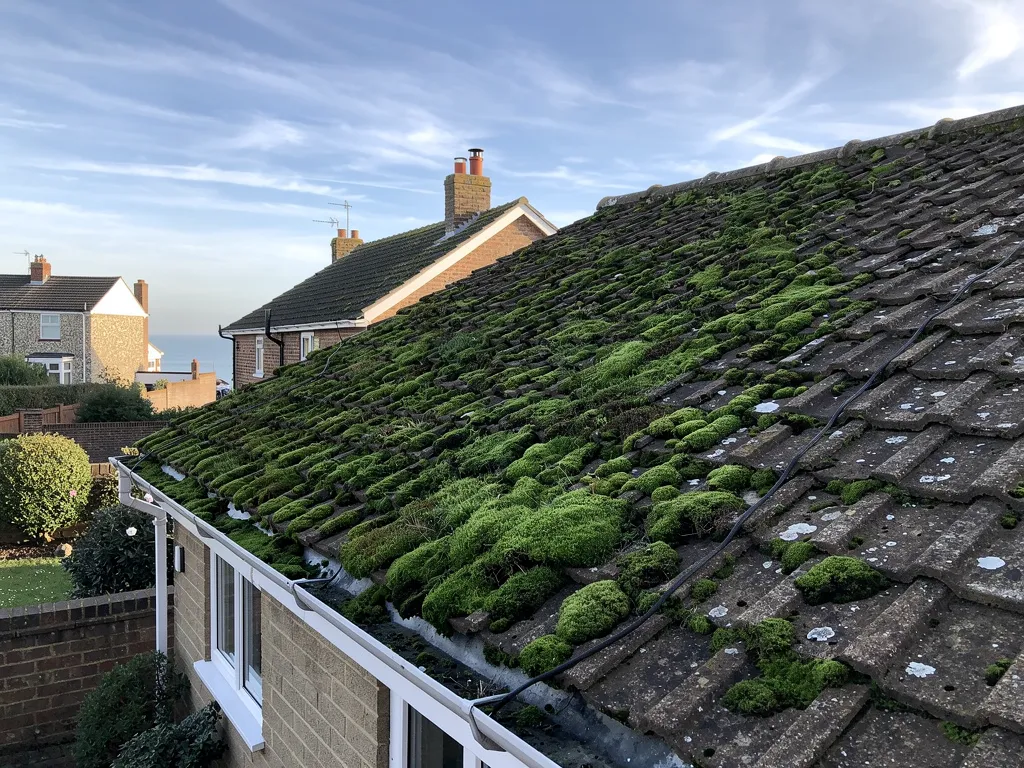
Heavy moss, dark staining and shaded slopes
Moss that has built up for years forms a thick, wet mat that keeps the roof damp. It comes away in clumps, and underneath there is often finer growth rooted in the surface of the tile. That extra pass adds time compared with a roof that only carries a light green film.
Dark staining is a different matter. It is a surface growth that does not scrape off, so it is dealt with by treatment and rinsing rather than by effort alone. You can read about the cause in black streaks on the roof.
Slopes facing away from the sun keep their moisture longest and tend to grow the most. If your house has a shaded side, expect that slope to take a larger share of the day. The reasons are covered in why north-facing slopes grow moss.
Weather moves the date, not the method
Wet or windy conditions are the usual cause of delay. Soaked tiles and slates are slippery, and a strong wind makes ladders, towers and loose debris dangerous. On this coast a gusty day off the Channel is reason enough to rebook, and a sensible crew will not push on regardless.
Frost matters as well. A treatment needs to go on and settle without being rinsed straight off by rain, so the forecast is read for the days after the clean, not just the day itself.
It follows that a job needing one working day on the roof may be booked a little apart from the survey visit. Leave some room in the diary, and expect the date to be confirmed once the weather looks settled rather than fixed weeks in advance. Delays for weather are routine on an exposed south coast roof and no cause for worry.
After the clean: when the roof finishes changing
When the crew drives away, the roof is cleaner but not yet at its best. A biocide kills what remains in the surface, and the dead growth then loosens and rinses away with the next rain. Many roofs look better several weeks later than they do on the evening of the clean.
That is why the time a clean takes and the time it takes to look its best are different questions. One is a day on site, the other a matter of weeks and a few showers.
Moss does return, slowly, if the roof stays shaded and damp. A short look each year, from the ground or the loft hatch, keeps the next clean small, and a check early each autumn rarely turns up more than a light touch. Our roof cleaning and moss removal hub covers how often cleaning pays, and the written quote, a single total, comes once we have surveyed your roof.
Timing a roof clean
Do I need to stay in while the roof is cleaned?
Not all day, but it helps to be reachable. Someone usually needs to confirm access to the side and rear, move cars and garden furniture, and agree where waste can be stacked. Keep windows closed during the clean, and the crew will tell you before leaving what has been done.
Can very heavy moss still be cleared in one visit?
Often yes, because scraping and clearing can be finished in a single visit. Very thick growth or fragile tiles may need a short second visit, with the treatment left to work between. The survey photographs show how much growth there is, so the written quote can set out what is planned.
Tell us about your roof
Describe what is happening and we will call you back to arrange a visit.
- Photographs of what we find
- A written quote with one total price
- Or call 01903 299063
10-year workmanship guarantee, in writing.