
Question answered
Why does moss grow on the north side of the roof?
The short answer
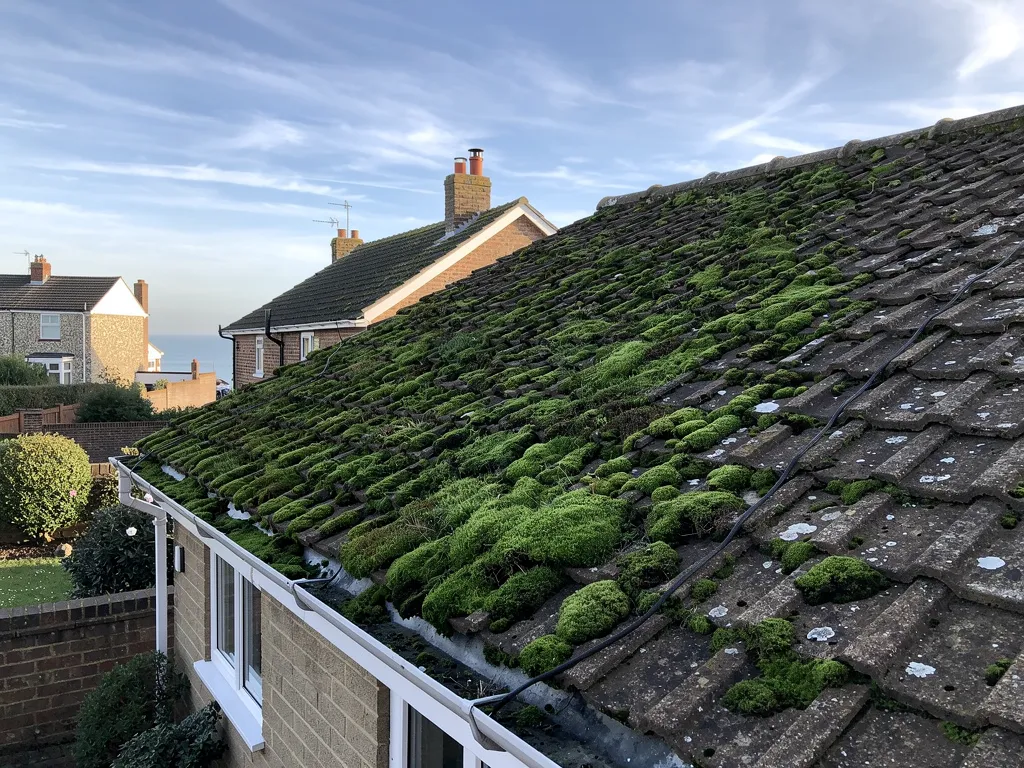
Moss grows on the north side of a roof because that slope gets the least direct sunshine, so rain and dew dry slowly and the tiles stay damp. Moss and algae need moisture and low light, not warmth. Trees, tall neighbouring buildings and low pitches make it worse, and the same conditions explain why it returns quickly after cleaning.
The north-facing slope gets the least direct sun, so it stays wet longest. Moss needs only damp and shade, and that side of the roof gives it both for much of the year.
The slope the sun barely reaches
In England the sun stays in the southern half of the sky, so a north-facing slope sits in the shade of its own house for most of the day. It gets daylight but little direct warmth. After rain, the south side dries within hours while the north side may stay wet into the next shower.
Moss does not mind the lack of sun. Algae and lichen behave in a similar way, which is why the north slope often goes dark as well as green. It has no true roots and takes in water through its leaves, so it thrives on a surface that is damp and dim. Frost and cold do not hurt it, and it grows slowly through the winter when other plants are dormant.
That is the whole mechanism, and it applies to any house. When you see a green patch on one side only and a bare roof on the other, aspect is usually the reason, and the pattern repeats along a whole street of similar roofs. Walk down your road and you will see the same thing on neighbours with the same orientation.
Other things that add to the damp
Aspect is rarely the only factor. Trees and hedges on the north side deepen the shade and drop leaves that rot on the tiles. A tall neighbouring house or extension can cast the same shadow even where there is no tree.
The pitch plays a part too. A low slope drains slowly and holds water in the surface texture, while a steep one sheds it more quickly. Rough, weathered concrete tiles give the moss a better grip than a smooth clay surface, which is one reason older roofs are often greener. The tile type matters for cleaning too, as our page on cleaning concrete tiles explains.
Gutters play a part as well. If they overflow or hold standing water along the eaves, the bottom courses stay wet whatever direction they face.
Is north-facing moss a problem or just a look?
A thin green film on sound tiles is mostly cosmetic. A deep cushion is another story. It holds water against the tile, collects at the lower edges and in valleys, and can lift tiles and block gutters. On slate it can hide faults and sit in the laps, as we cover in cleaning a slate roof.
Because the north side is the slowest to dry, damage tends to start there first. If you have a leak that appeared on that slope, look at the gutters and valleys before you blame the tiles. The moss may be the visible sign, and not the underlying fault.
Whether it needs treating comes down to thickness and position, not simply colour. Look from the ground and judge whether it is spreading, and whether any of it sits in a channel where water needs to run. A valley or the lower edge above the gutter matters far more than a patch in the middle of a slope.
What helps on a shaded slope
Letting in more light is the most lasting fix. Cut back overhanging branches, thin dense hedges and, where it is practical, keep gutters clear so water does not stand. Check that the loft is ventilated, because damp air that cannot escape keeps the underside of the tiles wet.
Cleaning clears the existing growth, and a treatment afterwards slows what follows. Our page on how long a roof clean takes shows what to expect on the day. Do not expect a north slope to stay clear for as long as a sunny one.
That can be disappointing, but it is the nature of the slope. Planning for a little extra attention there is more realistic than expecting a one-off fix, and it costs less than letting the growth build up. A short brush-down from firm ground, once the weather allows, keeps the worst of it from taking hold between professional visits.
Keeping the north side in check
Look at it from the ground once a year, ideally in good light and after leaf fall. If the growth is thin, a gentle clean and a treatment may be enough. If it is thick and spreading, plan for a professional visit, with a survey first. Our roof cleaning and moss removal page describes that process.
Remember that regrowth is likely to be quicker here. We explain the timescales in how long before moss grows back. Our survey pictures show the state of the slope, so you can see the problem without a ladder.
If the north side is also the side with the gutter that overflows, deal with that first, since a dry fascia and clear outlet remove part of the damp for free. Avoid the temptation to climb up and scrub it yourself. A wet north slope is the slipperiest part of the roof, and it is the worst place to stand.
Shade and moss
Why is only one side of my roof green?
Almost always because that side is shaded and stays wet longer. Check for trees, tall buildings and overflowing gutters on that side, as they add to the effect.
Do I need to clean the south side too?
Only if it shows growth. A sunny slope often stays clear much longer, so there is no need to treat both sides at the same rate. Judge each slope by what you can see.
Tell us about your roof
Describe what is happening and we will call you back to arrange a visit.
- Photographs of what we find
- A written quote with one total price
- Or call 01903 299063
10-year workmanship guarantee, in writing.