
Question answered
My roof only leaks in heavy rain: what is going on?
The short answer
Your roof leaks only in heavy rain because some part of it is working at its limit. Gentle rain runs off, but a gale pushes water uphill and sideways under the laps, past lifted flashings and cracked verges, while a part-blocked valley or gutter overflows back under the tiles. A slope laid below its covering's minimum pitch behaves the same way. Each copes with drizzle and gives way in a storm.
A roof that stays dry through showers but drips in a storm has a weakness that only shows under pressure. The fault is real, it has a cause, and it can be found.
Driven rain climbs uphill under the laps
Tiles and slates keep water out by overlap. Each course covers the one below by a set distance, the headlap, and in calm rain the water simply runs down the surface and drops off at the eaves. A gale changes that. Wind pushes the water up the slope and across it, and once it is moving uphill it can creep past the overlap onto the underlay beneath, or blow in through the side joints of single-lap tiles.
Designers are expected to allow for exposure. Marley describes four UK categories of exposure to driving rain, drawn from BS 8104 and Building Research Establishment Report 262, and says that on slopes longer than 6 metres, or on sites rated severe, the tile maker should confirm the product suits the job.
A roof facing open sea weather, or a bungalow on a rise with nothing to shelter it, shows any lack of margin in the first hard storm. The same roof can then stay dry for months of ordinary rain, which is what makes this kind of leak so puzzling.
A shallow pitch leaves the tiles less margin
The flatter the slope, the slower the water drains and the easier it is for wind to drive it backwards. For that reason each covering is sold with a minimum pitch. Marley gives 35° for its concrete plain tile, then 12.5° and 25° for its interlocking concrete tiles, depending on the profile. For natural slate, BS 5534 gives 20° at moderate exposure with a 115 mm headlap. The product's own data sheet is always the final word.
Trouble comes when a covering goes on below its limit. A porch or lean-to tiled at whatever angle the wall height allowed is a common example; so is a low roof re-covered in a different tile that needs a steeper slope. These can stay dry through years of normal weather and leak only when rain is forced in hard.
Wind also lifts. Marley notes that on pitches under 30°, suction on the windward slope can pull hard enough to rock a loose tile and open a gap for the next squall to find.
Valleys and gutters that cannot clear a downpour
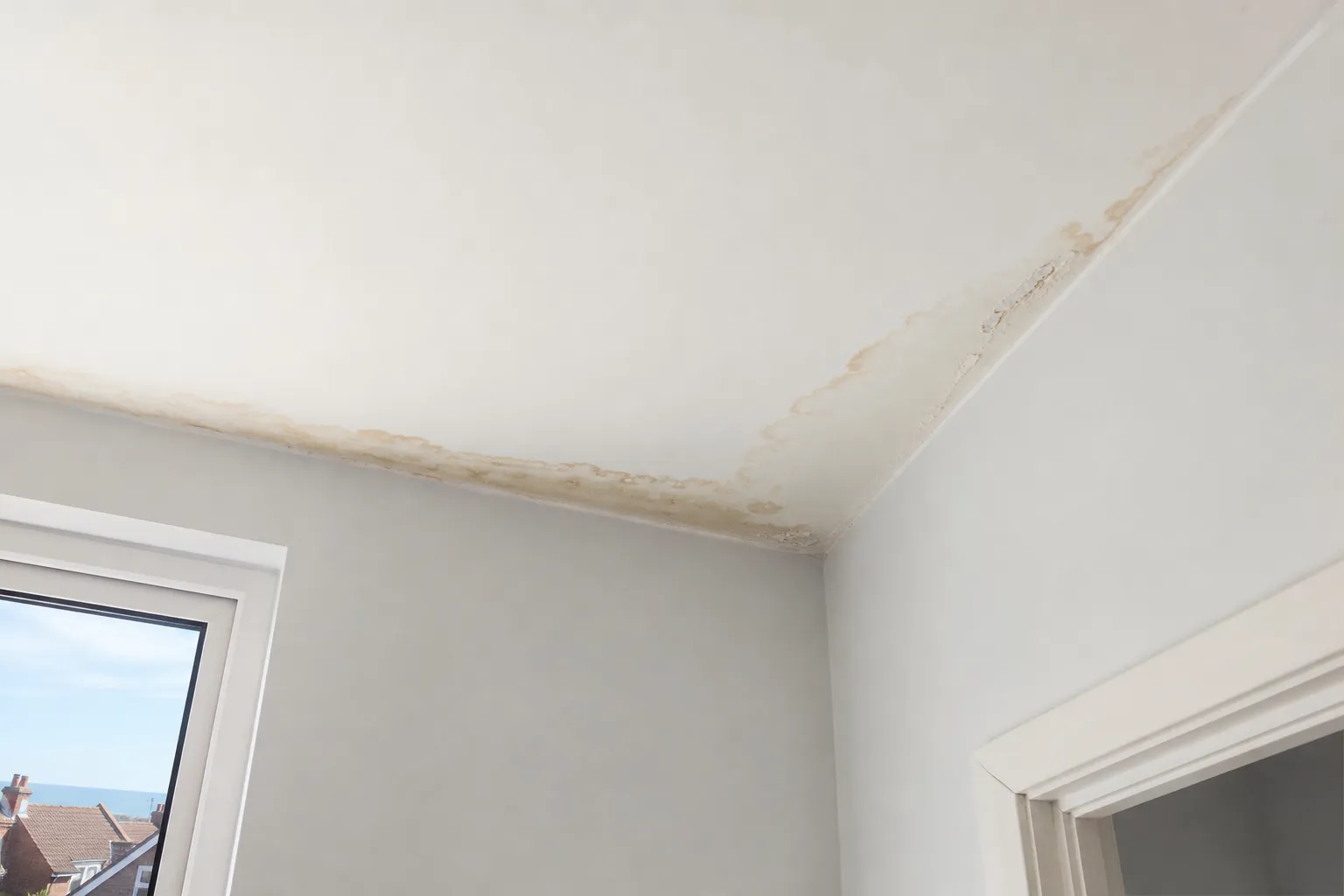
The valley, where two slopes meet in a channel, gathers the run-off from both. In drizzle even a narrow or part-choked valley copes. In a cloudburst the flow can rise above the edges of the lead or the liner and spill sideways under the tiles on either side, so the ceiling only marks when the rain is at its heaviest. Moss, leaves and broken tile in the channel make it worse. There is more on this in why a blocked valley leaks.
Gutters fail in the same way. A gutter with a blocked outlet, a sagging bracket or too little fall drains a shower without trouble but overflows in a storm, often at the back where water can run behind the fascia, into the top of the wall or onto the eaves timbers. Box gutters behind parapets, hidden from the street, are a frequent source; see parapet wall leaks. Clearing debris is sometimes the whole fix, but a gutter that runs full in every downpour may simply be too small for the roof.
Weak joints at walls, chimneys and gable edges
Lead flashings seal the line where a roof meets brickwork. If the lead lifts, splits or drags out of its chase in the wall, ordinary rain still runs off it, but rain blown sideways gets behind it and down the inside of the wall. Cement fillets, the mortar beads some houses have in place of lead, crack with age and open the same kind of gap. Our page on leaks where the roof meets a wall covers these in detail.
Verges, the roof edges at the gable ends, take the full force of a crosswind. Many were bedded in mortar alone, and once the pointing loosens, rain can be driven straight under the end tiles. Marley's account of BS 5534 says perimeter tiles had to be fixed twice, and BS 8612:2018 now sets the test specification for dry verge, hip and ridge systems. A mechanically fixed verge holds its line in conditions that would strip loose mortar.
What to note, and how the fault is traced
Write down the storm dates, how many hours the rain lasted and which wall took the weather, along with when the drip started. Where it is safe to do so, go into the loft with a torch during or just after heavy rain, because that is the one time you may see water actually moving. Stay off the roof and off ladders in bad weather.
We trace the fault from the inside first, following tide marks and wet timber up the slope, then match that to the outside: the valley, the flashing, the verge or the pitch of the slope above. Marks on the timbers stay visible for days, so a dry-weather visit still finds a good deal. You get photographs from your own roof, and our written price, one total, follows the survey. Active water ingress means making the roof safe first. The full range of repairs is on our roof repairs page.
Storm-only leaks: two more questions
Will my insurer treat a leak that only appears in storms as storm damage?
Not automatically. The Financial Ombudsman Service weighs up three things: was there a storm on that date, is the damage typical of storms, and did the storm cause it or might it have happened regardless. It also notes that policies often exclude gradual damage. Speak to your insurer before any permanent work.
Will sealant stop a leak that only shows in heavy rain?
Sometimes for a while, but it rarely lasts. Sealant smeared over a lifted flashing or a cracked fillet can trap water behind it and hides the joint from the next person who looks. The lasting fix is to dress the lead back properly, renew it, or rebuild the joint.
Tell us about your roof
Describe what is happening and we will call you back to arrange a visit.
- Photographs of what we find
- A written quote with one total price
- Or call 01903 299063
10-year workmanship guarantee, in writing.