
Question answered
Parapet wall leaking: causes and repairs
The short answer
A leaking parapet wall is usually caused by one of three faults: open joints or cracks in the coping stones on top, a blocked or poorly drained parapet gutter behind the wall, or lead flashings and linings that have split or lifted. Water then soaks the brickwork and tracks into the ceiling below. Repair means finding which of the three is at fault and renewing that part.
A parapet is the short wall standing proud of the roof edge, and it gives rain three ways in: down through the top, behind the lead, and from an overflowing gutter hidden behind it.
What a parapet is and why it is exposed
A parapet runs up above the line where the roof stops, along a gable, a terrace front or round a flat roof. You see it on Victorian and Edwardian terraces, on seafront blocks and on shops with flat roofs behind a brick front. Unlike an ordinary wall, it is wet on both faces and on top, with no roof overhang to throw rain clear.
The roof behind it often slopes toward the wall into a parapet gutter, a lined channel that carries water to an outlet. This is a box gutter by another name, hidden from the street, so trouble tends to appear indoors first: a stain on the top-floor ceiling or damp patches climbing an internal wall. On a sea front, salt, gales and driving rain all work on a wall with nowhere to shed the water.
Terraced rows share one parapet line, so a failed section in one house can send water into the next. Speak to the neighbours early.
Copings: the cap on the wall
A coping is the cap of stone, concrete, brick or clay that covers the top of the wall. It should overhang both sides slightly, with a drip groove underneath, and sit on a damp-proof layer so rain cannot soak down. Over the years the mortar joints between sections crack and open. Frost then widens them each winter, and a single gap can let water straight into the core of the wall.
Some copings were laid without a membrane below, or have lost it. Others simply lack the overhang, so rain runs down the face and stains the brick. Wet brickwork shows crumbling mortar, flaking faces, white salt marks or green growth along the top courses.
The repair depends on the damage. Loose or cracked sections are lifted, a new membrane is laid, and they are rebedded and pointed. If the coping is past saving, new stone or precast sections can be fitted with the proper overhang. Sealing a failed coping with mastic is rarely a lasting answer.
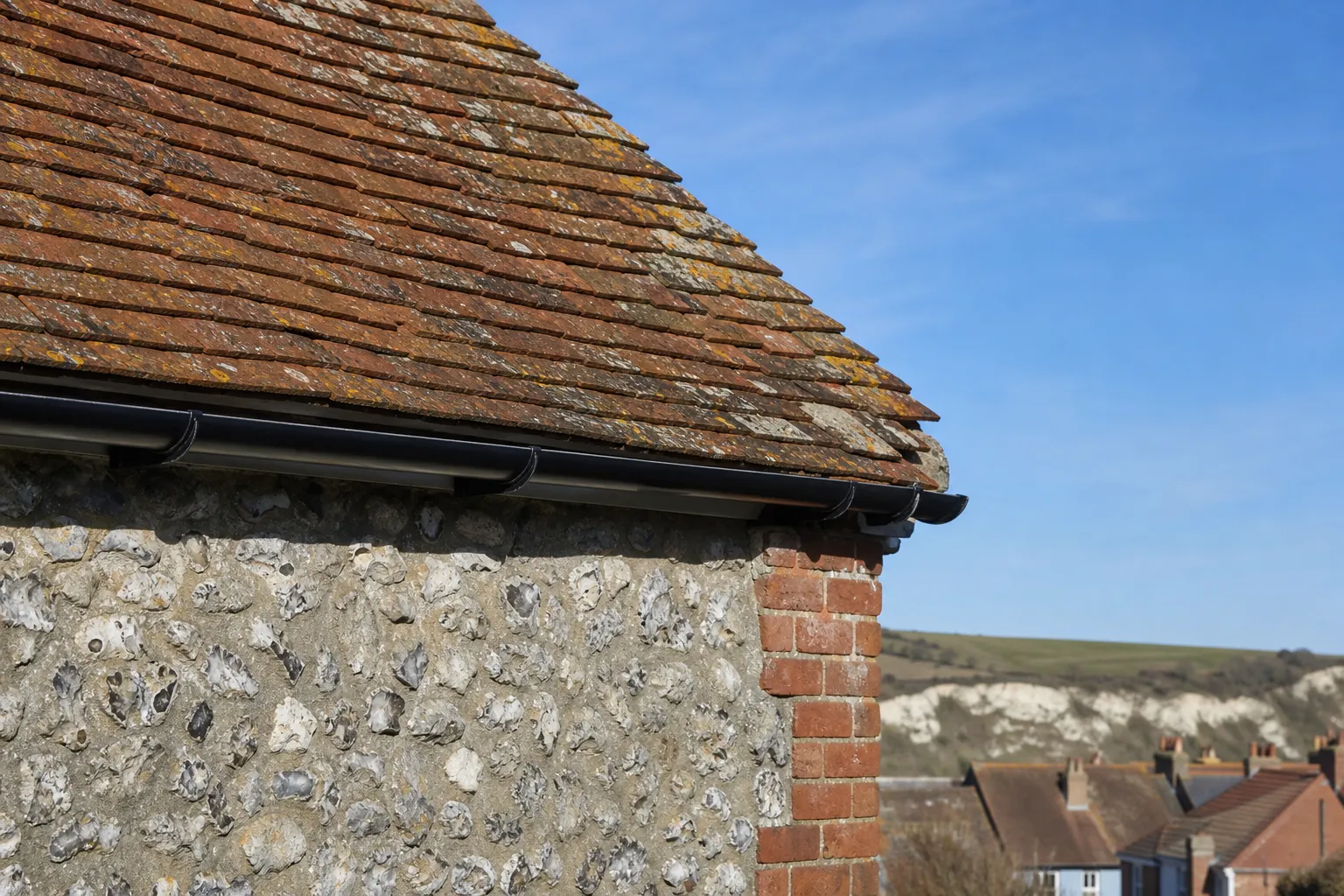
Parapet gutters: where water collects
The parapet gutter lies between the roof slope and the wall. It is lined with lead, asphalt or a single-ply membrane, and must fall gently to an outlet, usually a rainwater pipe that discharges through the wall or round the corner. For flat roofs IKO, citing the 2018 edition of BS 6229 (since revised), advises designing to 1:40 so that 1:80 is still achieved once built, and a flat channel like this needs the same thinking.
Gutters of this type fail in a few predictable ways. Leaves and moss block the outlet, so the water rises and finds the edge of the lining. The fall is too slight, leaving pools that attack the surface. Or the upstand, where the lining climbs the parapet wall, has pulled away and no longer stops water entering behind it.
Water marks high on an internal wall in storms, but nothing in dry spells, point to an overflowing parapet gutter. A clogged valley behaves much the same; why a blocked valley leaks explains the roof side.
Lead linings and upstands
Lead is the traditional lining for these channels and the weatherproof cover where the roof meets the parapet. Leadworx lists Code 5 as a general choice for vertical and pitched work, and Code 4 as the standard for general flashing. Less says a lead flat roof can last 50 to 100 years, so a leak usually means a joint or fixing has failed, not that the sheet has worn out.
Look for splits across folds, creases where the metal has rolled on a long run, loose clips along the top edge, and open joints in the wall where the upper edge is tucked in. Long bays without expansion joints stretch and tear as the lead warms and cools.
A repair may be a patch and a re-pointed chase, or relining a length of gutter. Checkatrade (June 2026) lists Code 5 lead flashing at £50 to £70 per metre, stepped work at £80 to £120 per metre, both excluding VAT, as typical UK ranges. Tall walls often need scaffold. Lower roofs have similar joints; see porch roof repair.
How the leak is traced and put right
We start in the room, reading the stain: where it begins, how it spreads and whether it grows after rain from one direction. Then we go up to see the coping, the outlet, the lining and the pointing. A hose test, one section at a time, shows which part admits water. Pictures of your own parapet come first, then the written quote.
The fix is matched to the fault. A blocked outlet needs clearing and a leaf guard. Open joints need raking out and repointing in a suitable mortar. A failed lining needs lead dressed properly into the wall, not mastic. Because the wall has taken in water, we also look for wet timber where joists and beams bear on it.
A soaked wall can take months to dry, so a stain may linger after the repair. For other places where a slope meets masonry, see leaks where the roof meets a wall. The hub for all of this work is roof repairs.
Parapet problems: two more questions
Is damp on the top-floor wall always a parapet fault?
No. Condensation, a leaking gutter at roof level or a failed chimney flashing can leave similar marks. A parapet fault tends to show as damp running down from the roofline, worse after rain, often on the wall that carries the parapet. The check from above separates the possibilities.
Can the parapet gutter be cleared and left alone between visits?
Clearing it helps, and doing so before autumn and again after leaf fall keeps the outlet running. A leaf guard can cut how often it silts up. But clearing only stops the overflow. If the lead has already split, water will keep entering, so the lining needs inspecting as well.
Tell us about your roof
Describe what is happening and we will call you back to arrange a visit.
- Photographs of what we find
- A written quote with one total price
- Or call 01903 299063
10-year workmanship guarantee, in writing.