
Question answered
Leaking where the roof meets a wall
The short answer
A leak where the roof meets a wall almost always comes from the weatherproofing at that joint, called an abutment. A lead flashing may have lifted or split, a soaker beneath the tiles may have corroded or slipped, a cavity tray behind the brickwork may be missing, or a mortar fillet may have cracked. The cure is to renew or re-dress the failed part, not to smear the joint with sealant.
The seam where a sloping roof runs into a brick wall is among the hardest joints to keep dry. Leaks there usually trace to a flashing, a soaker or a cavity tray rather than the tiles.
Why the wall line is a weak point
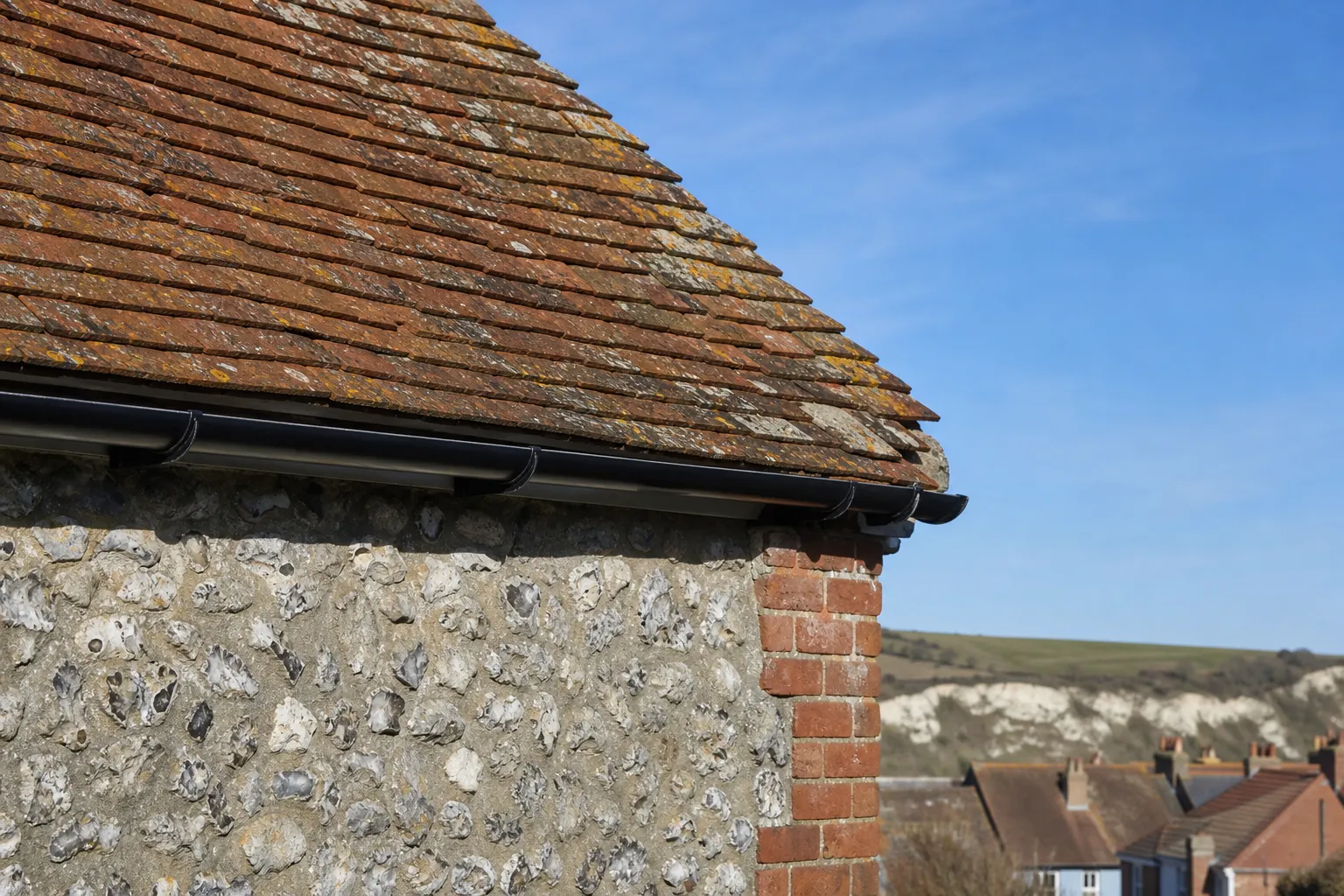
An abutment is any place a roof slope finishes against a vertical face: the side of a chimney, the wall of a taller neighbour, an extension butting up to the house, a dormer cheek. Rain runs down the wall and lands on the roof at exactly this seam. Brick, metal and tile each swell and contract by their own amount through the seasons, so the joint is always on the move.
The water has several ways in. It can run behind the weatherproofing and into the wall, sneak under the tiles beside the wall, or soak into brickwork above the flashing and travel down the inside. Because it follows timber and masonry before it drips, the stain on a bedroom wall or ceiling is often a metre from the fault. That is why a good repair starts by tracing the water upwards instead of treating the damp patch.
Wind-driven rain tests the joint hardest, which is why these leaks so often show up in a gale and then vanish in the dry spell that follows.
Lead flashings and soakers
The flashing is the sheet metal, normally lead, that spans the join between slope and wall. One edge goes into a slot cut in the mortar joint (a chase) and is wedged and pointed. The other edge rests on the roof covering. Along a side wall it steps up in pieces that follow the brick courses.
Soakers are separate small sheets of lead, one for each course of tiles, bent to an L shape and slid beneath the tile edge so water is shed on top. Out of sight, a corroded or slipped soaker can leak for years before anyone notices.
Leadworx names Code 4 as the usual weight for general flashing, Code 3 for soakers only and Code 5 for general, vertical and pitched work. MyJobQuote says lead flashing can last over 80 years. When it fails early, the fault is normally the fixing rather than the metal: wedges that have worked loose, pointing that has gone hard, stiff corners that have split, or lead stretched by decades of warming and cooling.
Cavity trays and what hides inside the wall
Where a roof stops against a cavity wall, rain that gets into the outer brick leaf can run down the cavity and straight onto the ceiling below. A cavity tray catches that water and sends it out through small weep holes in the outer leaf just over the slope. When it is missing, torn, blocked with mortar droppings or lapped the wrong way, the damp appears inside the room as a tide mark running down the wall.
This is common where an extension has been added, or where a porch or lean-to was butted to the house wall years after it was built. Proper detailing there means the lead flashing and the tray work together, each overlapping the other so the water falls toward the outside.
If the problem is in the tray, no amount of work on the visible flashing will cure it. We check the wall from the loft or the room below as well as from outside, and the weep holes get looked at too, since stuffing them with filler to "tidy" the brickwork shuts the exit.
Mortar fillets and sealant: why they crack
Some houses have a fillet, a sloped bead of cement mortar, running along the roof edge in place of lead. It looks neat on day one. Mortar is rigid, and the roof moves with the weather, so hairline cracks open within a few winters. Water gets in behind, frost works it wider, and the fillet drops out in lumps.
Sealant and bitumen tape applied over a cracked fillet are the usual "quick fix". They seal the surface while the real damage goes on behind, and they hide the very joint a repairer needs to see. For the same reason tape and mastic rarely last through a second winter on an exposed coastal gable.
Where the wall allows it, the better answer is to rake out the fillet and fit new lead. Leaks that show up only in gales are often a loose flashing, and our page on why a roof leaks only in heavy rain covers that pattern.
Tracing the fault and what repair costs
We begin with the inside: tide marks on the wall, wet timber, a damp chimney breast. Then we look at the flashing from outside, test the pointing and check the soakers where they can be seen. You get photographs of your own abutment, and the written quote follows with one total price.
On cost, MyJobQuote gives a typical UK range of £150 to £250 for patching lead work on a chimney and £350 to £460 for full replacement without scaffold, or £700 to £920 with it (22/09/26). Checkatrade (June 2026) puts Code 5 flashing at £50 to £70 per metre and stepped flashing at £80 to £120 per metre, excluding VAT. Access, length of run and how much brickwork must be opened up drive the figure.
Sister problems at other junctions are covered in parapet wall leaks and porch roof repair. The full list of jobs is on the roof repairs page.
Roof-to-wall joints: two more questions
Why does the damp show on a chimney breast inside when the flashing outside looks fine?
The water may be entering higher than you can see, through the chimney stack's brickwork, a failed back gutter or a cracked flaunching, and then travelling down the flue wall. A flashing that looks sound from the ground can still be lifted at its upper edge. Tracing from the room back up the stack finds the true entry point.
Can an abutment flashing be repaired, or does it need replacing?
A small split or a loose section can sometimes be repaired or re-wedged and repointed. If the lead is stretched, cracked along several folds or has failed at the corners, patching tends to leak again and a new length is the sounder choice. The survey photographs show which case applies.
Tell us about your roof
Describe what is happening and we will call you back to arrange a visit.
- Photographs of what we find
- A written quote with one total price
- Or call 01903 299063
10-year workmanship guarantee, in writing.