
Question answered
Porch roof repairs
The short answer
A leaking porch roof usually comes down to the covering, the pitch or the wall junction. Lead, felt, GRP and tiles break down differently, and a small low roof leaves little margin for error. Repair can be a patch to the covering, new flashing where it meets the house, or a full re-cover when the structure has been soaked. The cause decides which.
A porch roof is small, low and often built as an afterthought, which is why it leaks so often. The covering, the pitch and the joint with the house wall each get checked in turn.
Why porch roofs leak more than they should
Most porches were added after the house was built, often by a general builder working to a modest budget. The roof is shallow, the timbers are light, and the junction with the main wall was usually detailed with whatever was to hand. A porch on a 1930s semi may be a small tiled hip, a flat lead-covered slab or a lean-to in felt, and each of those has a different weakness.
There is also little to hide faults. A porch has a tiny catchment, but the water has few places to go. A single slipped tile, a blocked gutter outlet or a split in the covering shows up quickly, usually as a stain on the porch ceiling or damp on the front door frame. Wind off the Channel strikes the front of a house first, so these small roofs take the weather head on.
Rot spreads fast once a season of wet has reached the boards and rafters. Early attention is cheaper.
Lead and felt porch roofs
Lead porch roofs are common on older houses and bay-fronted villas. A lead flat roof is quoted by Less at 50 to 100 years, so a leak normally traces to a joint rather than the sheet. Typical culprits are splits at folds, a lifted drip detail at the front edge, or a flashing at the house wall that has dropped out of its chase. Patch repairs with new lead and proper welts hold up better than sealant.
Felt is the usual cheaper choice, and Less puts torch-on felt at 10 to 20 years, and warns that a badly laid one may go within 10. It blisters, cracks along the edges and loses its mineral finish, then lets water through. Once brittle, a felt porch is generally re-covered rather than patched, with the boards beneath checked first.
Where the porch is flat, a fall toward the gutter matters. IKO, quoting the 2018 edition of BS 6229 (since revised), advises designing for 1:40 to achieve a finished minimum of 1:80. A porch that ponds is a porch that will leak sooner, whatever the covering.
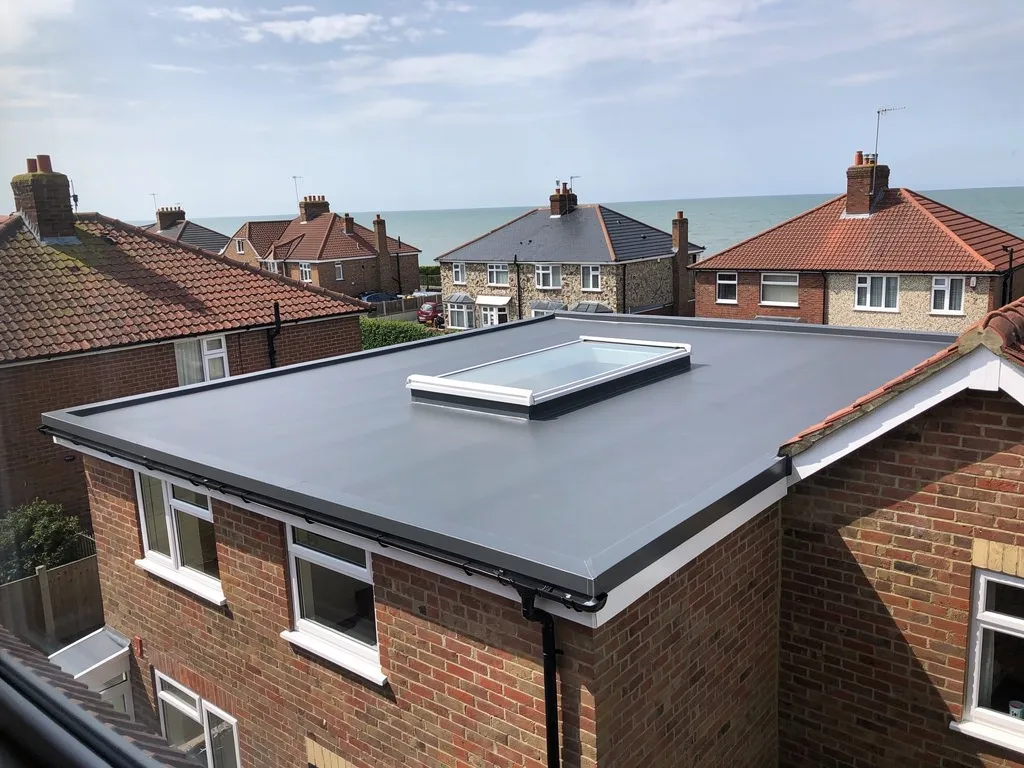
Tiled porches and the pitch problem
A pitched porch is covered like the main roof, though the angle is easily got wrong. Every tile or slate has a minimum pitch below which it cannot be relied on to shed water. Marley gives 35° for its concrete plain tile, 15° for the Lincoln clay pantile and figures between 12.5° and 25° for its interlocking concrete tiles, while Cupa says BS 5534 indicates 20° as the minimum for natural slate. Always check the maker's data sheet.
A porch roofed in a tile that needs a steeper slope can stay dry for years and then leak in a storm, when rain is driven up under the laps. Re-covering with the right material, or choosing a covering rated for a low pitch, solves the cause rather than the symptom.
Hips and ridges on a small roof need the same fixing as larger ones, because BS 5534 (2014 revision) expects a mechanical fixing alongside any mortar bedding. Cracked mortar on a porch ridge is an easy repair if caught before water gets to the rafters.
Where the porch meets the house
The joint with the main wall is the most frequent point of failure. A lean-to porch roof stops against brickwork, where a flashing or mortar fillet bridges the gap. Once the fillet cracks or the lead lifts, water slips behind and drips from the wall face inside. Our page on parapet wall leaking deals with similar upstands higher up the building.
The gutter is the second weak spot. A porch gutter is short and often fitted with a very small outlet, so a handful of leaves or moss stops it. Water then spills over the back and runs behind the fascia. Clearing it regularly and checking the fall prevents the commonest rot.
Finally there is the post or wall that carries the roof. A porch that has moved slightly away from the house opens a gap at the junction that no flashing can cope with. In that case the structure needs attention first, and the roof second. If water has already marked the ceiling, fixing a roof leak from inside sets out what can and cannot be done from below.
Repair or replace, and what drives the price
We examine the covering, the boards beneath, the fascia and the wall junction, and photograph each. Small faults get a small repair: a refixed tile, a lead patch, a new flashing. Where the boards are soft or the covering is spent, re-covering the whole roof is the sounder choice, and that is what the quote will recommend.
MyBuilder (21/08/2026) gives typical UK flat-roof ranges per square metre of £70 to £100 for felt, £90 to £130 for EPDM, £95 to £150 for GRP and £150 to £200 or more for lead. A porch is small, so the total is modest, but access, rotten timber and the need for a scaffold tower affect it more than the area does. Check that any quote you receive states whether VAT is included.
The written quote follows our survey. For broader cost guidance, read roof repair cost, and for the whole range of work see roof repairs.
Porch roofs: two more questions
Why does the leak show above the front door and not under the damaged tile?
Water follows the underside of the covering or the timbers before it drops. It can travel along a board, down a rafter or behind the fascia to the lowest point, which is often the door frame. Tracing the stain back up the slope finds where it entered.
Can I replace a porch roof with a different covering?
Often yes, subject to the structure and the pitch. A flat porch can be re-covered in EPDM, GRP or lead, and a pitched one in tile or slate if the angle allows. If the house is listed or in a conservation area, check with the Adur & Worthing planning team before choosing.
Tell us about your roof
Describe what is happening and we will call you back to arrange a visit.
- Photographs of what we find
- A written quote with one total price
- Or call 01903 299063
10-year workmanship guarantee, in writing.