
Question answered
Why do roof repair quotes vary so much?
The short answer
Roof repair quotes vary because each roofer may be pricing a different job. One prices a patch where another prices the cause, access by ladder differs from a tower or scaffold, materials differ, and VAT or waste may sit in one price and not the other. MyBuilder shows typical UK roof repairs from £150 to £1,500 (updated 21/08/2026). Ask what the one total price covers.
Two roofers can look at the same leak and quote very different prices. The gap usually comes from what each roofer believes is wrong, what the figure includes and how they will get to the roof.
Scope: patching the stain or fixing the fault
The biggest difference between two quotes is usually the job itself. One roofer replaces three slipped tiles. Another works out that the tiles slipped because the flashing above them has lifted, and prices the flashing too. Both are quoting for a leak, yet they are not quoting for the same work, and a figure placed beside another tells you very little until you know which is which.
MyBuilder's roof repair guide (updated 21/08/2026) gives typical UK figures of £100 to £300 for minor repairs, £500 to £1,000 for moderate ones and £2,500 or more for major work. A spread that wide is the market's way of saying the scope decides the price.
Our approach: size the repair to the fault and go no further. If a repair will hold, we tell you. If it will not, we explain why, and the page on roof repairs shows the range of faults we deal with.
Diagnosis: who found the way in
Water rarely enters where the ceiling stain is. It can run along a timber or down a wall for a metre or more before it shows. A roofer who prices from the stain, or from the ground with binoculars, is guessing at the cause, and a guess is quicker to write down than a diagnosis.
A proper diagnosis goes into the loft, follows the water marks up the slope and checks the matching spot outside. It takes longer, and that can be one reason a figure comes out higher, though it is also the reason the repair tends to hold.
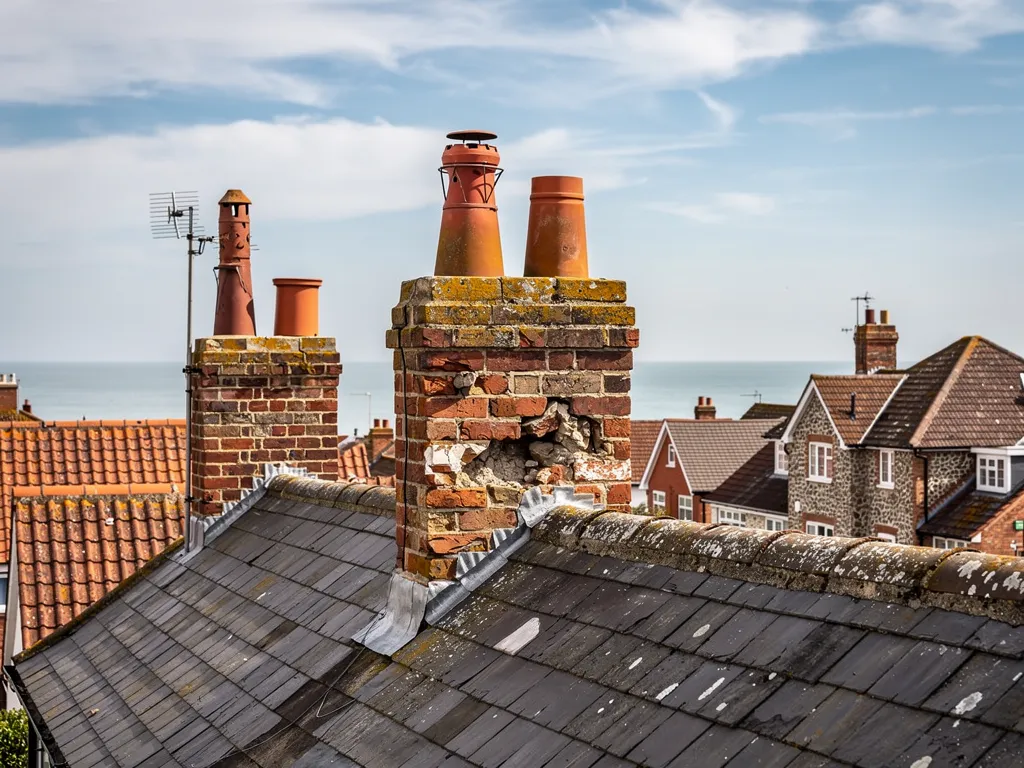
Ask to see photographs of the roof being quoted, not library pictures. Ours arrive with pictures from your own roof, letting you spot the faulty valley, flashing or ridge for yourself and judge whether the figure matches what is actually wrong with it.
A repair that fixes the wrong spot is the dearest one, because the leak comes back and the money is spent twice.
Access and the height of the job
How the roofer gets to the fault changes the cost. A ladder is enough for a low single-storey roof. A two-storey house, a steep slope or a chimney stack often needs a tower or scaffold, and the scaffold alone can be a big slice of the price.
In MyBuilder's scaffolding guide, putting up scaffold for an ordinary two-storey home runs at about £850 to £1,200 (updated 21/08/2026). Poles on the public highway need a licence first. The scaffold firm applies for it to West Sussex County Council, and the notice period adds time as well as cost.
Some quotes include scaffold and some assume you will arrange it, so check which applies before you compare. The page on whether roofers use scaffolding explains when it is called for and when a ladder or tower will do.
Materials and the method used
A repair can be done several ways. A split flashing can be sealed over, patched or replaced in a new piece of lead, and the price changes with each. Lead comes in codes of thickness, and a heavier code costs more. A ridge can be re-bedded in mortar or fixed with a dry-fix system, and ridge tiles have needed mechanical fixings beyond mortar ever since the 2014 revision of BS 5534.
Cheaper methods sometimes leave the cause in place. A bead of sealant on a cracked fillet costs little now and can fail by the next gale; the page on mortar fillet repair shows the difference. Even a small job around a pipe can be a collar swap or a relaid lead slate, as the guide to the soil vent pipe leak shows.
The matching of materials matters on older roofs too. Slate, clay or stone that suits the house costs more than a cheap substitute, and on a listed building the choice may not be yours to make.
What a quote should state
Every quote should be one total price, in writing, after a survey. It should say what the price covers, when the work starts, whether the figure carries VAT and scaffold, and what happens to the waste.
Timing and urgency shape the job as well, and the best time for roof repairs sets out what can wait and what cannot. A figure that sits well below the others deserves a question: does it cover the cause, the access and the clearing up?
We aim for prices that are good and fair, and you will have pictures of the roof itself in hand before deciding. If a low figure rests on a do-it-yourself style fix, the guide to DIY roof repair covers where that tends to lead.
Keep every quote you receive and ask each roofer the same questions, so the answers can be set side by side fairly.
Quote changes and the lowest figure
Is the lowest roof repair quote the one to avoid?
Not always, though it does deserve a question. A low figure that leaves out the cause, the access, VAT or clearing up is only low until those are added. Ask what it covers, and ask to see photographs of the fault it is meant to fix.
Can a quote change once the roofer is on the roof?
Occasionally, if something turns up that could not be seen from the survey, such as rotten timber under a flashing. A good roofer stops, shows you photographs and agrees any change before going on. A price written after a proper survey makes surprises less likely.
Tell us about your roof
Describe what is happening and we will call you back to arrange a visit.
- Photographs of what we find
- A written quote with one total price
- Or call 01903 299063
10-year workmanship guarantee, in writing.