
Question answered
Do roof sealants work?
The short answer
Roof sealant can work as a stop-gap on small, dry, stable gaps, such as a hairline crack or a worn joint, while a proper repair is arranged. It does not last on moving joints, lifted flashings or crumbling mortar, and it can trap water behind the bead and cover up the fault for whoever inspects next. If a leak is worth stopping, it is worth stopping at its cause.
Sealant has a place on a roof, but a narrow one. Used as a stop-gap it can buy time, and used as the repair it often hides a fault that is still open.
Where sealant helps
Sealant suits small, static gaps on a surface that is clean and dry: a hairline crack in a hard finish, a tiny gap round a pipe, a worn joint that has not moved. Used there, in a product made for the material, it can keep water out for a while and ease an urgent situation. A bead can also be a sensible temporary measure after a storm, when the weather prevents a proper repair and the first aim is a roof that sheds water safely.
The key word is temporary. A good roofer will tell you it is a bridge to the real job and say how long they expect it to hold. If someone offers sealant as the permanent answer to a leak that has already returned once, ask what they have found and why they think a bead will cure it. The answer should name a specific fault and a specific place on the roof, and a roofer who cannot do that has not yet found the cause. Vague answers such as "it was perished" are worth questioning.
Where it fails
Roofs move. They expand and contract in the sun, shake in the wind and shift as the building settles, and a bead on a joint that moves will crack along its edge. Surfaces that are dusty, damp, mossy or oily stop the bond forming at all. Sealant over a lifted lead flashing, a failed mortar fillet or a slipped tile does nothing about the movement that opened the gap, and sunlight, frost and salt air wear it down in time. Cheap sealant also yellows and hardens, which makes it more likely to split at the very first cold snap.
Gutters, valleys and flat roofs hold standing or running water, which is harder on sealant still. A smear over a valley liner cannot cure a channel that overflows in a downpour; the real question is why it overflows, and why a roof leaks only in heavy rain goes into the usual reasons.
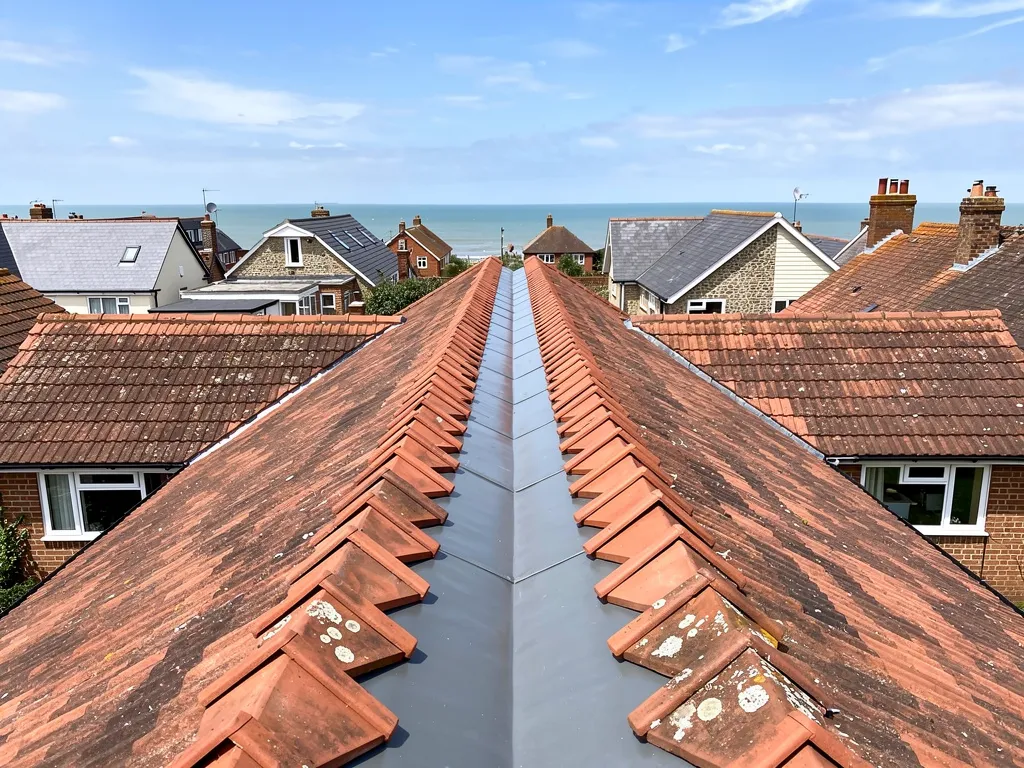
How it hides the problem
This is the costliest thing about sealant. A thick bead over a flashing looks like a repair. It closes the visible gap, but water driven behind it still gets in and runs down the inner face of the wall or drips onto the timbers. The ceiling mark may fade for a while, so the job looks successful. Months later the leak returns somewhere slightly different, and the cracked bead makes the original joint harder to read.
The next roofer then has to strip it back before the surface can be judged, and the survey takes longer. Meanwhile water may be sitting in the timbers, causing rot you cannot see. If a leak has come back after a patch, our guide to a roof that keeps leaking after repair explains the missed-cause route and what you can ask for.
What a lasting fix looks like
The lasting answer depends on the fault. A lifted lead flashing is dressed back into its chase or renewed. A cracked cement fillet is cut out and replaced, or swapped for lead. A slipped tile is refixed, and ridge tiles get mechanical fixings as well as a bed of mortar, since the 2014 revision of BS 5534 stopped relying on mortar alone to hold them. In every case the repair closes the way water gets in, instead of coating the place where it shows.
Sealant can still have a role in the finish, for example at a small abutment detail once the main work is done, but it is not the weather barrier. Where a whole surface is tired, a bigger repair may be the sensible answer, and we say which is which. A gap that lets light through the roof is a fault sealant should never be used to hide; daylight through the roof explains why.
What to put to the roofer first
Ask what is causing the leak, and how it was found. Ask whether sealant is the permanent repair or a stop-gap, and for how long it should hold. Ask to see photographs of the area before and after, and whether the surface will be cleaned and dried first, since a bond cannot form on a wet, mossy joint.
Ask, too, what happens if it fails. A roofer who has traced the leak can tell you. If the job is a temporary fix, ask for the permanent repair to be quoted at the same time so you can plan it. Timing the proper work for a dry spell is part of that plan, as the best time for roof repairs shows. The full list of faults we deal with is on our roof repairs page.
Sealant, a few specifics
Can I use roof sealant on a flat roof?
Only as a stopgap on a small, clean, dry area. A flat roof holds standing water and moves with temperature, so a bead on a split or blister rarely lasts. A patch of the correct covering, or a section of new membrane, is the repair that holds.
Will sealant affect a later repair?
It can. Old sealant has to be cleared back before new work will bond or before the fault can be seen, which adds time. On a listed home, the wrong product may also fail to be a like-for-like repair, so ask the conservation officer before applying anything permanent.
Tell us about your roof
Describe what is happening and we will call you back to arrange a visit.
- Photographs of what we find
- A written quote with one total price
- Or call 01903 299063
10-year workmanship guarantee, in writing.