
Roofers in Newhaven

Newhaven sits on the Ouse estuary's west bank, below the chalk headland of Castle Hill. We read roofs from Church Hill to the river bank, and send photographs of what we find.

Church Hill flint, shop rows and river wharves

  • Flint and brick cottage walls

    Church Hill flint and chalk

    Meeching Court House is two storeys of squared chalk rubble with flint facing and brick quoins. Where a roof meets walling like that, lead is tucked into the joints, and a crumbling joint is the first place we look.

  • A shopfront and roof junction

    Main-street shops that began as cottages

    Several shops on the main street are remodelled older cottages, so roofs and walls of different ages meet at awkward angles.

    Read more about Main-street shops that began as cottages

    Those joins, and the valleys running between them, are where we expect a leak to start.

  • A low-pitch warehouse roof

    Wharves and warehouses by the river

    In 1940 the Victoria County History judged some wharves and warehouses on the old river bank to be of some antiquity.

    Read more about Wharves and warehouses by the river

    Big roofs on buildings like these need their gutters, laps and outlets checked, because water that cannot drain finds its own way in.

Street map of Newhaven, east of central Worthing, with a pin on the town.

Roof rules to check in Newhaven

Planning authority
Lewes District Council
Councils
Lewes District Council and East Sussex County Council
Conservation area
Newhaven (Church Hill)
Article 4
No direction recorded near Newhaven
Parish church
St Michael's, Church of England, with a tower of the early or mid 12th century
From central Worthing
25.1 road miles, east, about 37 minutes by car

Newhaven roofs

Church Hill to the river bank

Three roof questions drawn from Newhaven's churchyard hill, its main street and its working waterfront.

Chapter one

Lead and flint on Church Hill

St Michael's tower dates from the early or mid 12th century, and roofs beside walls that old need patient, matching repair.

Church Hill is the old core of Newhaven, and the oldest thing on it is the tower of St Michael's, which the Victoria County History dates to the early or mid 12th century, with an apsidal sanctuary beside it. The double-aisled nave was built in 1791 on the site of the medieval one. Christ Church followed in 1881 and the Roman Catholic church in 1898. A hill with that many centuries of building on it carries roofs that meet walls of every age, and each meeting needs a seal that holds. Our survey takes those meetings one at a time rather than judging the roof as a whole.

At a glance

  • St Michael's has a 12th-century tower and a 1791 nave
  • Newhaven (Church Hill) is a conservation area
  • Church of England roof work goes through faculty, not the council
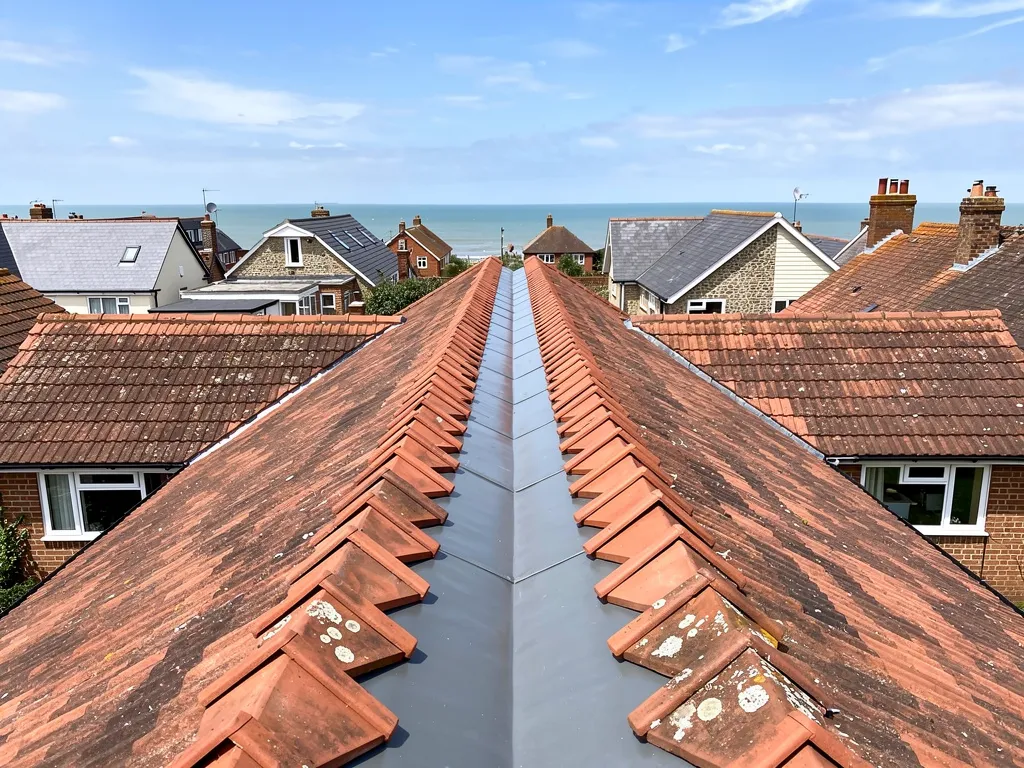
Lead-lined valley where two clay-tiled roof slopes meet

1.1 Lead against flint and chalk

Meeching Court House, possibly the manor house of the old village, is two storeys of squared chalk rubble with flint facing and brick quoins, the dressed stones at the corners. A roof that abuts walling like that is sealed with a lead flashing: a narrow band of metal laid over the join, with its top edge tucked into a raked-out mortar joint. Rubble faces are uneven, so the groove for the lead is cut into whatever the joint offers, and over decades that can mean soft or crumbling mortar. When it gives way the lead sags and water follows the wall down. We probe each joint, and where it has failed we repoint before the lead goes back, rather than wedging metal into a weak groove. Thick rubble walls also soak up water, so a damp patch indoors may show far from the true point of entry.

Lead-lined valley where two clay-tiled roof slopes meet

1.2 Consent on and around the hill

Work that keeps to the existing materials leaves a building looking as it did, so it seldom counts as development. A listed building is stricter: repairs using different materials from the original can call for consent under the listed building rules. St Michael's is a Church of England building, and while services continue, roof repairs there go through a faculty application rather than the council. The Roman Catholic church has a denominational procedure of its own, and either arrangement ends if a church closes for worship. For anything else on the hill, ask Lewes District Council's planning team, and see our lead roofing page for how flashings are cut and dressed. Bat roosts and wild birds' nests have legal protection, which is why an old roof gets checked for either before any stripping begins.

What people sayBecause Church Hill is a conservation area, every roof repair there needs a planning application.

What is trueRepairs that leave the building's appearance unchanged do not usually need planning permission; listed status and Article 4 directions are the points to check first.
Chapter two

Shopfront valleys and warehouse flat roofs

Main-street shops and river-bank warehouses carry roofs of different ages, shapes and pitches that all have to drain.

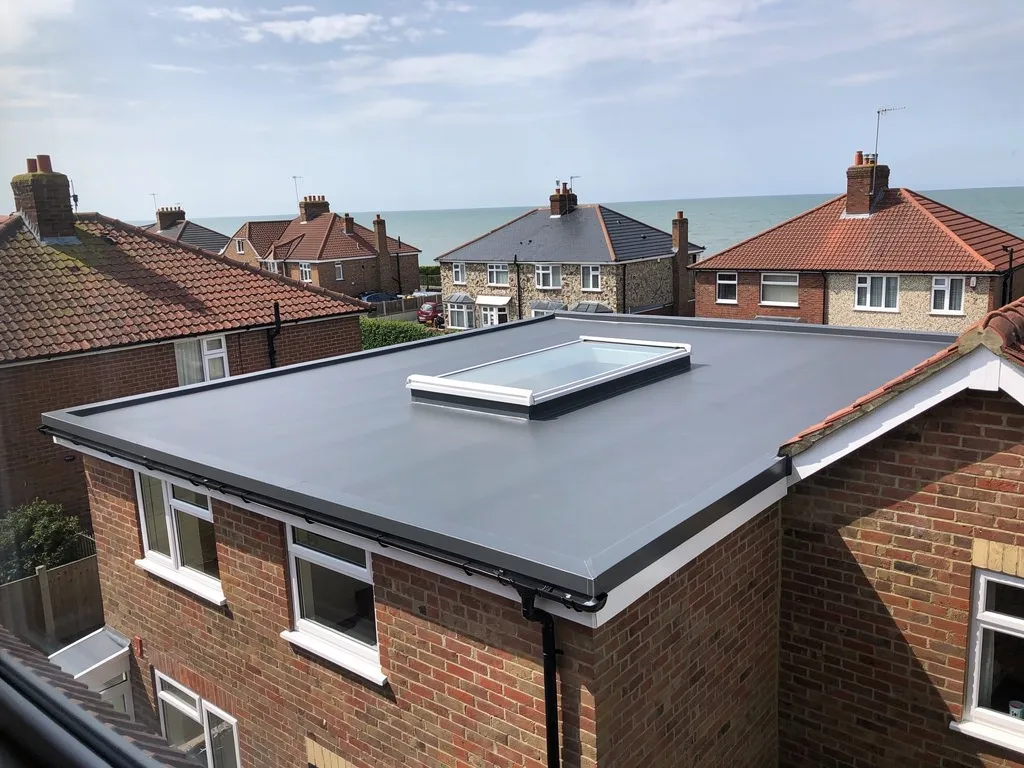
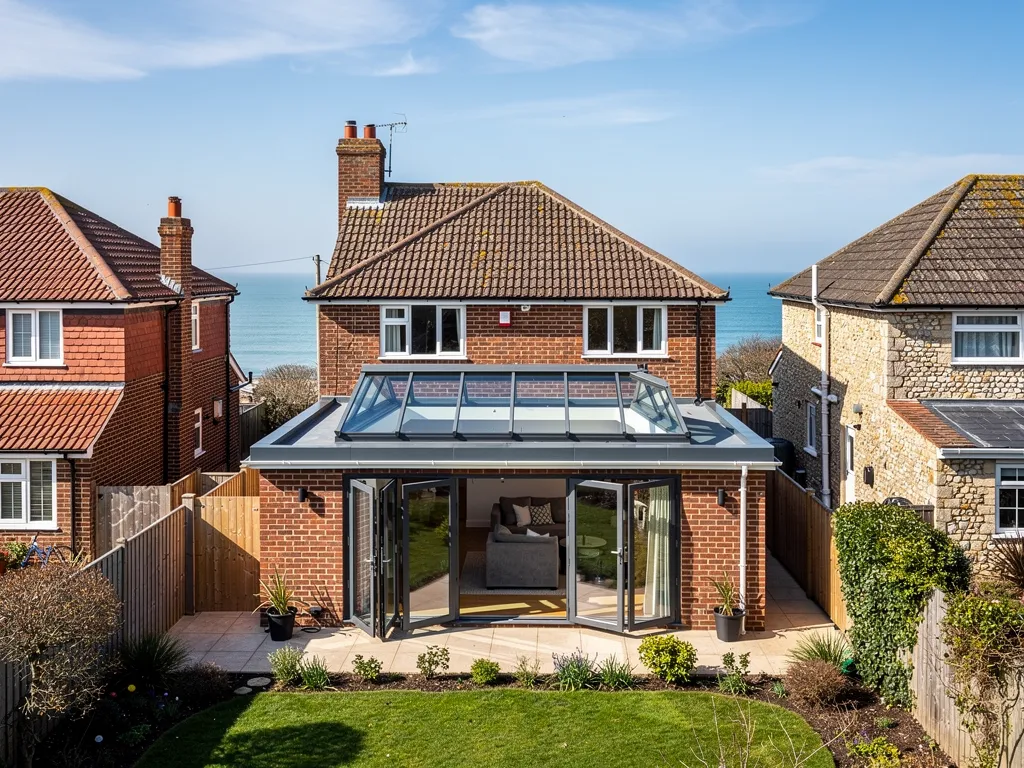
Glass roof lantern on a flat-roofed extension seen from the garden

Newhaven's shops and quays were not built to one plan. The Victoria County History records that several main-street shops are remodelled older cottages, and that some wharves and warehouses along the old river bank are probably of some age. Changes like these leave roofs of mixed ages side by side: a pitched slope here, a flat extension behind, a parapet where two properties meet. At each of those joins water can pool or creep sideways, and the survey starts there.

At a glance

  • A flat roof typically lasts 15 to 30 years (MyBuilder)
  • Design flat roof falls at 1:40 for a finished 1:80
  • Pre-2000 buildings may contain asbestos (HSE)
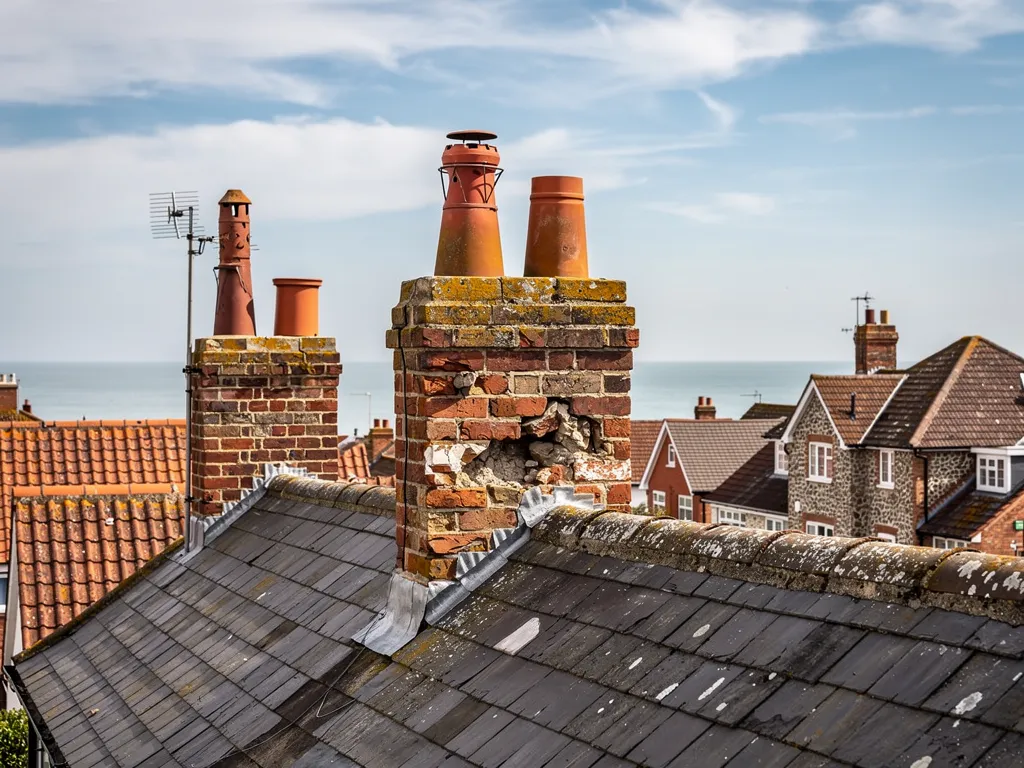
Victorian terrace chimney stacks with spalled bricks and old lead flashing

2.1 Valleys, parapets and hidden gutters

At an inside angle where two slopes meet, a valley collects the run-off of both. It is usually lined with lead or another sheet metal, sometimes half buried beneath the tiles. A parapet gutter serves a roof that stops at a taller wall. Leaves, moss and grit settle in either one, and when one blocks, the overflow backs up under the covering instead of away from the building. We clear them, inspect the lining and photograph it, so its condition is plain to see.

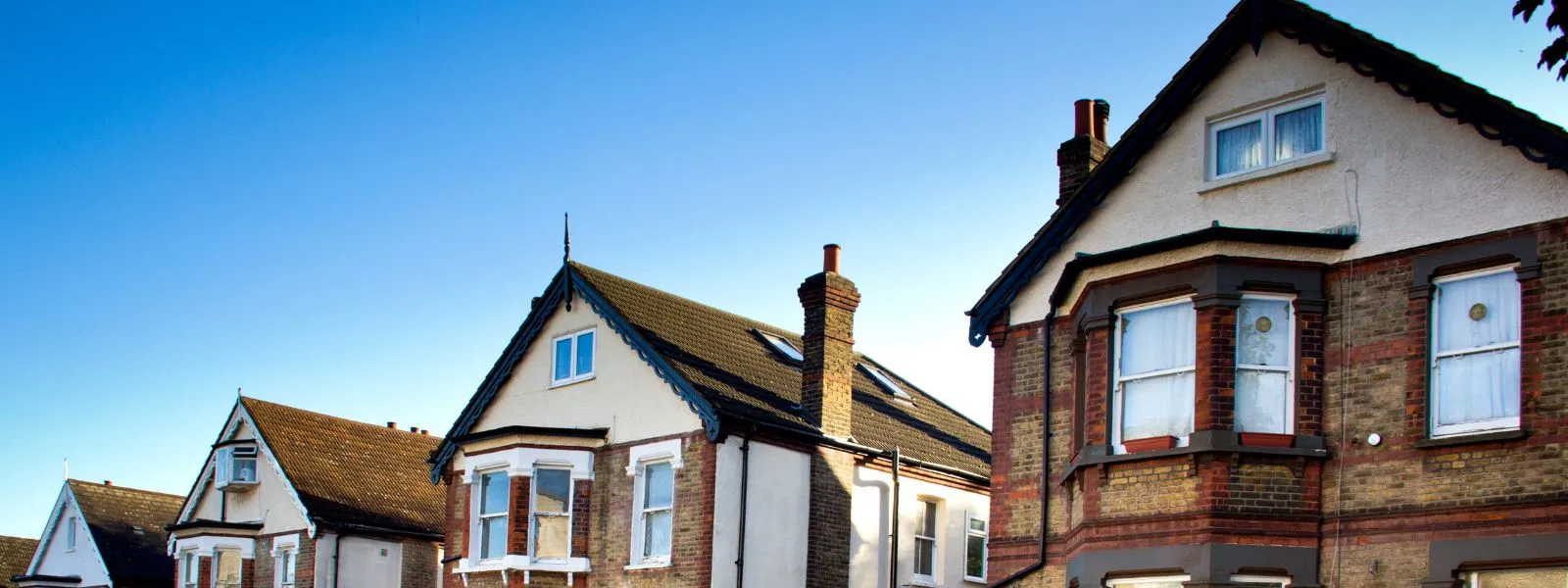
Victorian terrace chimney stacks with spalled bricks and old lead flashing

2.2 Flat roofs behind the shopfront

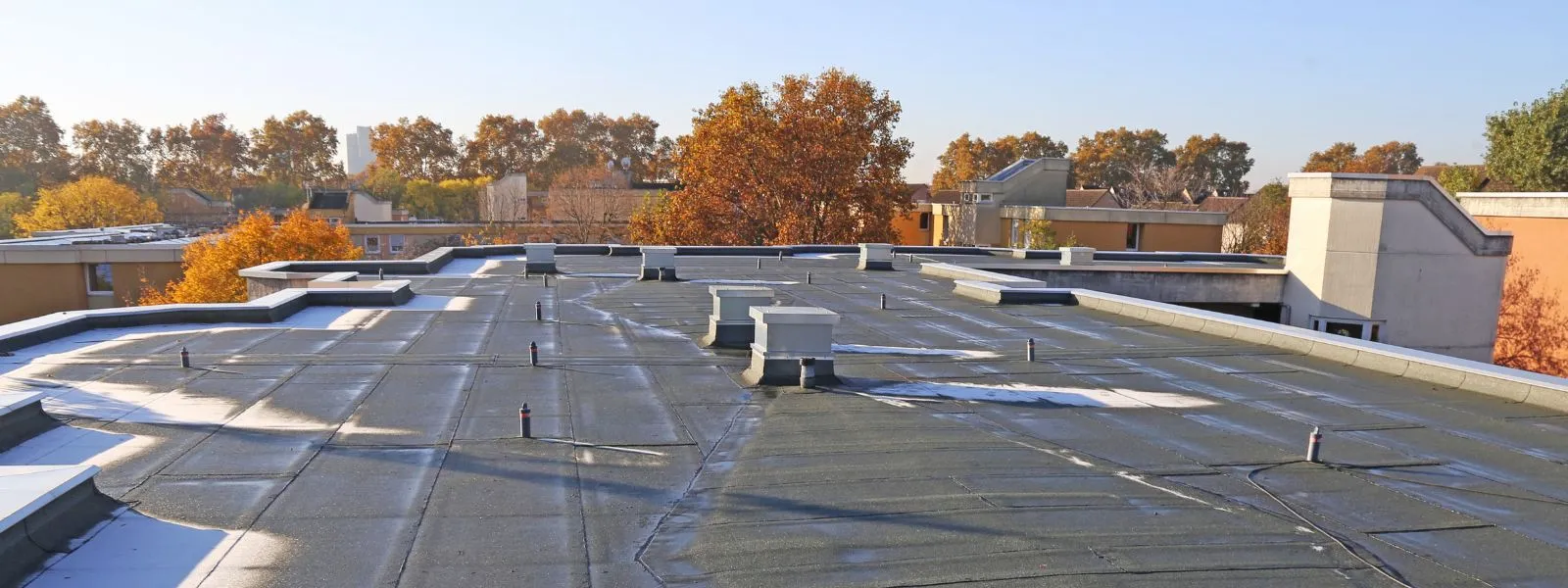
Many shop and warehouse roofs here will be flat or nearly so. The common coverings are felt, EPDM, which is a single rubber membrane, and GRP, a fibreglass laminate laid in resin. BS 6229:2018, as IKO reports it, recommends a finished fall of 1:80, and IKO suggests designing for 1:40 so that settlement and deflection still leave the finished roof at 1:80 or better. Ponding, meaning water that lingers after rain, tells you the fall has been lost. Our flat roofing and commercial roofing pages cover each material and the larger buildings.

2.3 Older buildings and asbestos

Warehouses and outbuildings of a certain age raise a separate question. HSE's rule for buildings that date from before 2000 is to presume asbestos until proved otherwise, and roof sheeting and external soffits are typical places for it. Careful removal of intact cement sheet is non-licensed work. Break the sheet and the job becomes notifiable. Insulating board, found in some soffits, is mostly higher-risk work under HSE rules. We want the material identified before any quote is written.

Flat roof coverings, typical UK prices per m²

  • Felt£70 to £100
  • EPDM£90 to £130
  • PVC£95 to £140
  • GRP£95 to £150

A roof of this kind is priced once the survey has measured it, and what reaches you is one written figure. Source: MyBuilder flat roof cost guide, updated 21/08/2026.

Chapter three

Estuary wind, salt air and Castle Hill

The Ouse runs out to the Channel past a fort-topped headland, and roofs here are fixed with that sea edge in mind.

Newhaven lies on the Ouse's west bank beneath Castle Hill, the chalk headland where a large fort went up in 1864 above a concrete breakwater half a mile long. The river's last mile and a quarter was recut and straightened, replacing a wide S-curve. Roofs in a harbour town on the Channel put up with gales and salt air as a matter of course. We put no number on how exposed any single address is. We read the roof.

At a glance

  • Castle Hill's fort dates from 1864
  • Zinc and soffits collect salt where rain cannot rinse them
  • Pitches under 30 degrees can face heavy suction (Marley)

3.1 Salt on metal and roofline

VM Zinc reports that its metal does well by the coast but can react to salt-laden air, leaving white deposits wherever rain fails to rinse the surface, soffits being the usual example. HomeBuilding raises the same issue for fascias and soffits in marine settings. Washing with clean water a couple of times each year is the maker's advice. When we survey, rainwater goods, roofline boards and metal flashings get a close look for staining, lifted joints and corrosion. MyBuilder puts gutter replacement at £30 to £70 per metre, and fascia and soffit work at around £150 per metre (updated 21/08/2026), which is worth bearing in mind once salt has eaten into a roofline.

3.2 Fixing a roof near the water

Wienerberger insists the fixing be specified for the site, taking in location, altitude and wind exposure, and states that a single-lap tile must be held by a mechanical fixing. Marley's warning is about shallow roofs: under 30 degrees, the windward slope may meet severe suction. Since the 2014 revision of BS 5534, ridge and hip tiles are mechanically held, not just bedded, and BS 8612:2018 covers the dry-fix alternatives. Our tile fixing in coastal wind guide shows how clips, nails and ridge fixings are chosen.

3.3 Repair, re-roof and the rules

Not every tired roof wants replacing. After the ladder and loft inspection we say whether the fault is local or general. The Planning Portal sets the trigger for a building control application at 25 per cent of the total building envelope or 50 per cent of the roof; remain beneath both and the application is not normally needed. Beyond them, building control approves the work and a Part L thermal upgrade can follow. Thinking of swapping a light covering for a heavy one? Where the new covering weighs 15 per cent or more than the old, approval applies, and a structural check comes first.

Fixing facts for a roof near the Ouse

Single-lap roof tiles
Each held by a mechanical fixing (Wienerberger)
Pitch below 30 degrees
Heavy suction on the windward side (Marley)
Ridge and hip fixing
Bedded and mechanically held, not mortar alone (BS 5534)
Zinc by the sea
Rinse with clean water twice a year (VM Zinc)

Source: Wienerberger; Marley; BSI; VM Zinc, fetched October 2026

Newhaven roof questions, from Church Hill to the river bank

How do you fix lead flashing against a flint and chalk wall near Church Hill?

We probe the mortar joint first. Where it has crumbled we repoint it, then cut the lead into a sound groove, dress it over the join and fix it so it cannot lift in a gale. Rubble faces are uneven, so each flashing is shaped to the wall in front of us rather than cut to a stock pattern. Photographs show the joint as found and as finished.

Does living below Castle Hill change how my Newhaven roof is fixed?

Possibly. A tile maker's fixing specification reflects the site's setting, height and exposure, and Marley says pitches under 30 degrees can meet heavy suction on the windward slope. We choose the fixings from your roof's own pitch and position, and every ridge or hip tile we lift goes back with a mechanical fixing alongside the mortar.

What happens if an old Newhaven warehouse roof turns out to have asbestos cement sheets?

HSE treats careful removal of asbestos cement as non-licensed work. Sheets that have split or crumbled turn it into notifiable work, with notice due before it starts, and AIB soffits are mostly licensed work. HSE warns that cement-sheet roofs are fragile, so they should never be walked on. The material is identified before anything is priced, and we tell you which route applies.

Newhaven (Church Hill) conservation area: where do I take a roof question first?

Newhaven falls under Lewes District Council for planning, and the Church Hill conservation area sits within it. A repair that matches what is there rarely needs permission, and no Article 4 direction is recorded near the town. Changing a covering, or working on a listed building, is a different question and worth putting to the council first. Where the building is a working church, its own denominational approval process applies instead.

Tell us about your roof

Describe what is happening and we will call you back to arrange a visit.

  • Photographs of what we find
  • A written quote with one total price
  • Or call 01903 299063

10-year workmanship guarantee, in writing.

Call Get a quote