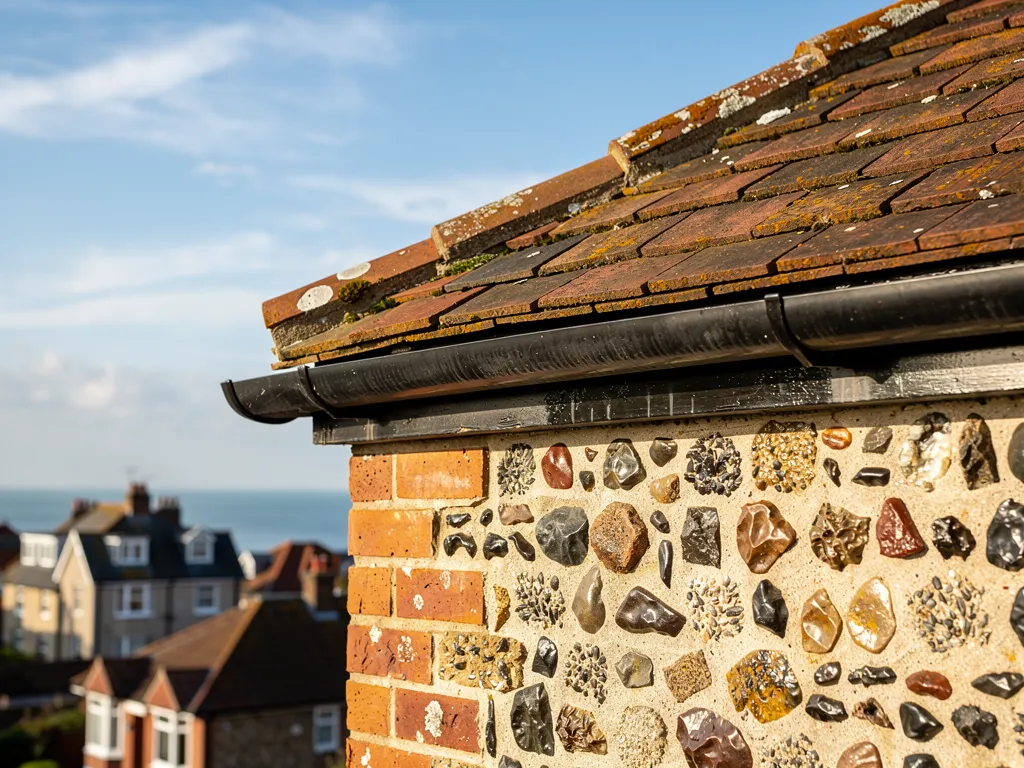
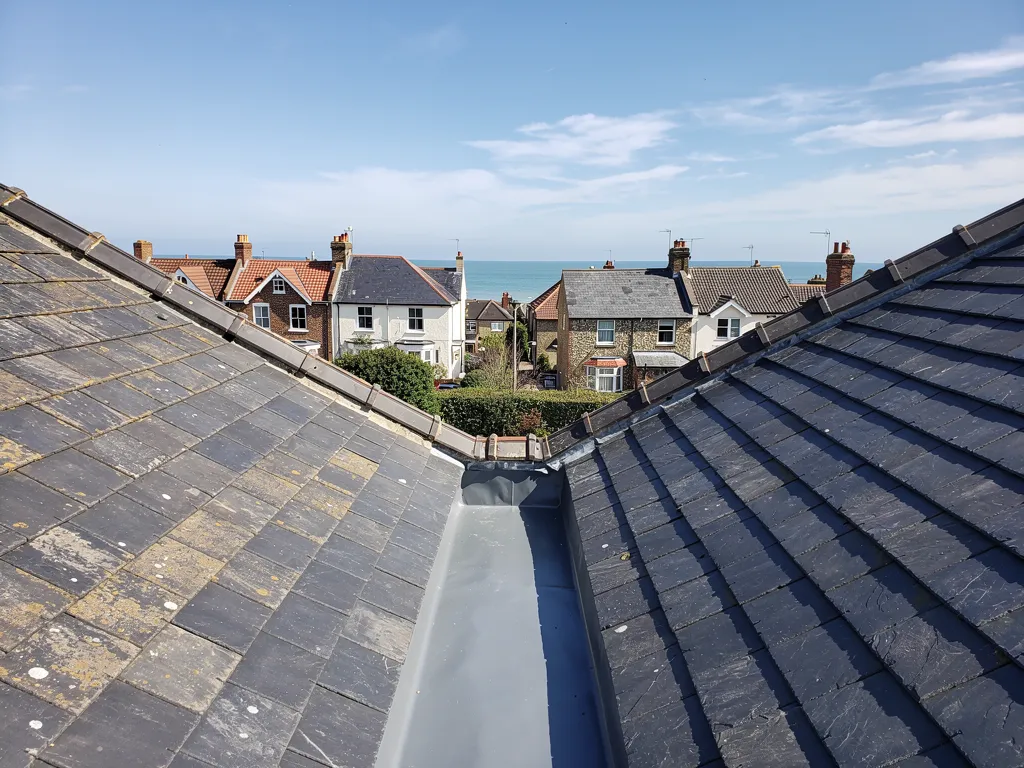
In roofing, a valley is the internal angle where two roof slopes join, and the rainwater from both runs down it. On many pitched roofs that channel is lined with sheet lead, laid over boarding with the tile or slate edges trimmed back to leave a strip of metal showing down the middle. Everything on both slopes drains through it, so a fault there lets in a lot of water quickly.
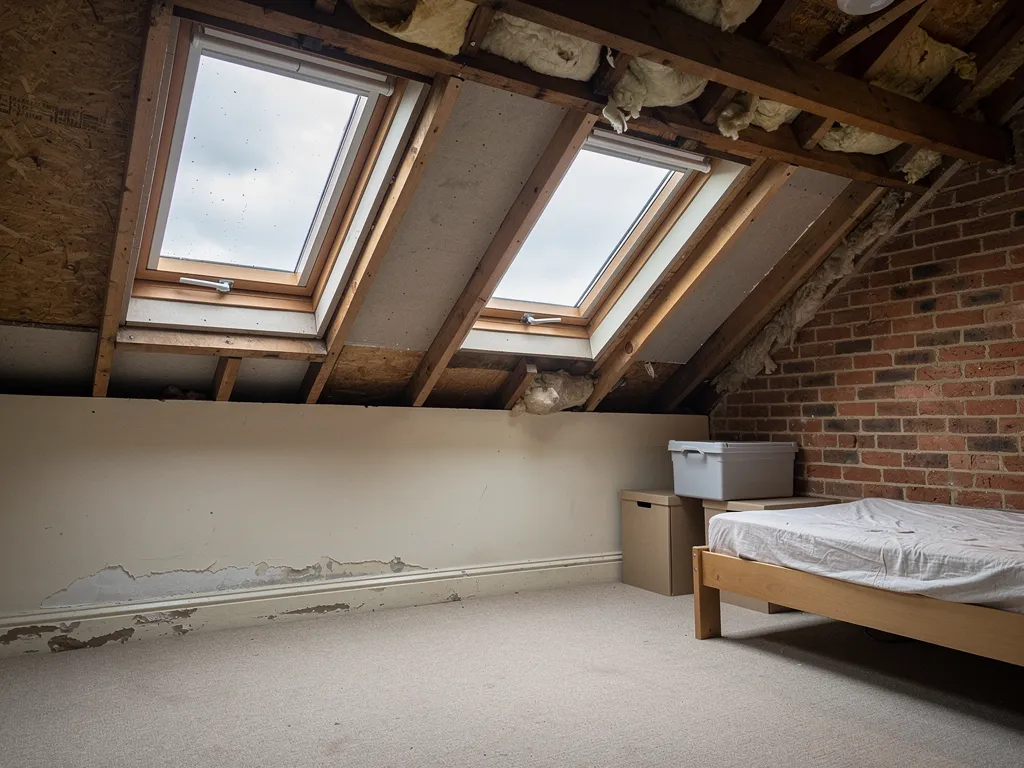
Valleys fail in ways that look alike from inside the house. A brown stain on the landing ceiling beside the chimney breast might come from a split in the lead, a lap that is too short for the pitch, a choked channel that has overflowed, or something else entirely. The repair or replace question can only be answered once the lead has been seen, from above and from the loft, and measured against the length of the run.
This guide goes through how lead valleys fail, what a repair can honestly achieve, the signs that point to relining, and the costs that sit behind each choice. The aim is a decision you can check against photographs of your own roof, not a sales pitch for the bigger job.
How a lead valley is built and why it splits
Under the lead sits boarding or a timber valley board, and on top of it a sheet of lead cut to the width of the channel, with enough spare on each side to run up under the tiles. Where one sheet ends and the next begins, the upper piece laps over the lower. That lap is the weak point of any long valley, because water is moving fast down the slope and a gale can push it up the joint.
Lead is soft and heavy, and it moves with temperature. Warm sun stretches the sheet and a cold night pulls it back. A short run copes with that easily. A long run laid in one length, or fixed too tightly at its edges, cannot slide, so the metal fatigues and a hairline crack opens, usually across the width of the channel. The answer on why roof lead cracks covers the mechanism.
Other causes of a split
Footfall is a common one. A valley is a convenient place for a ladder or a boot, and lead dents and thins under weight. Moss and leaf litter trap water against the metal and keep it wet for days. A nail driven through the lead where a tile was refixed leaves a hole that no one sees until the ceiling shows it. Old repairs matter too: a blob of bitumen or sealant over a split may hold for a winter, then lift and hide the crack beneath.
None of these faults looks dramatic from the ground. The tiles at the valley edge can sit perfectly neatly while the lead beneath them is open, which is why a stain inside the house is only the start of the search.
What we check before calling it a repair
The first look is from the loft, where we follow the tide marks along the valley board and the rafters either side of it. Staining that stops short of the valley points somewhere else, perhaps a chimney flashing or a broken tile. Wet timber running the whole length of the board suggests the lead has failed in several places or the channel has been overflowing.
Outside, we walk the valley from the ridge to the eaves, ideally from a ladder or scaffold tower rather than the slope itself. We are looking for several things at once:
- a crack or pinhole in the lead, and whether it follows an old kink or crease
- the lap between lengths, and whether the upper sheet really covers the lower one by enough to resist driven rain
- the width of exposed lead down the middle, because a channel cut too narrow chokes with debris
- tiles or slates at the edges that have slipped, cracked or been cut ragged
- moss, leaves or roof-cleaning residue sitting in the channel
- old sealant, felt or bitumen added over earlier trouble
We photograph each point so you see what we saw. The sample matters as much as the closeness of the look: three small defects spread along a long run of lead tell a different story from one split at the bottom of an otherwise sound run.
If the cause is a blocked channel or a single tile, that is a modest job and we will say so. If the lead itself has gone, the next two sections explain how the choice is made.

When a patch or a section is enough
Repair is the better choice where one spot has failed and the lead around it remains sound. One split near the head of a short valley, a hole where a nail went through, or a worn spot under a regular footpath can all be dealt with by cutting out the damaged area and letting in a new piece of lead. The new piece is dressed over the sound lead around it, with a lap sized to the pitch, and fixed so it can still move.
A repair also works where the cause was debris. Clearing a choked valley, re-bedding a couple of disturbed tiles and checking the lead underneath can end a leak that looked serious. Where the lead has simply been walked on, flattening and re-dressing a dented stretch can restore the channel.
MyJobQuote (22/09/26) gives a typical UK range of £150 to £250 for a patch on chimney leadwork, which gives a feel for how modest a localised fix can be, though a valley needs access along its length and tile work on both sides. The written quote follows our survey, as one total price.
What a repair cannot do
Patches do not cure a lining that is failing everywhere. If new splits open beside the old ones every winter, you are paying again and again for the same fault, and each repair puts more stress on the metal beside it. Sealant smeared across lead is not a repair either. It is a stop-gap, and our guide to lead flashing repairs explains where that line falls. A repair we recommend is one we expect to last.
When relining the valley is the better job
Replacement makes sense when the failure is general rather than local. Several splits along one run, thin or crushed lead from years of foot traffic, laps that are too short to shed driven rain, or boarding that has gone soft underneath are all signs that the valley has reached the end of what patching can do. Replacement also comes into question when an earlier repair has been covered by a second and a third, and nobody knows what is under them.
Relining means lifting the tiles or slates along both edges of the valley, taking out the old lead and checking the boarding, then laying new lead with correct laps and a clear channel. The edge tiles go back, and any that break in the lifting are replaced. On a short valley this is a day's work for a small team. A long valley on a large roof takes longer, and scaffold may be needed, which has its own cost. MyBuilder (updated 21/08/2026) gives a typical UK scaffold figure of about £850 to £1,200 for a normal two-storey house setup.
The sheet is chosen by thickness, set out as a code. Leadworx lists code 5 for ordinary pitched and vertical leadwork and code 6 for large roofs, and our lead code for flashing page covers the table. You get our proposed code with the reason for it, and the old lining is shown to you so you can judge its condition.
Checkatrade gives a typical UK range of £50 to £70 per metre for code 5 lead flashing, before VAT. Valley work adds boarding checks and tile handling, so the survey sets the figure.
Valley options other than sheet lead
Lead is not the only way to line a valley, and on some roofs it is not the best way. Pre-formed valley troughs in GRP (glass-reinforced plastic) or in plastic are made in standard lengths with raised edges, so the tiles sit on a ready-made channel. They are quicker to lay on a plain gable-to-gable valley with a regular pitch, and they do not rely on the long laps that cause so much trouble with sheet lead.
They suit simple junctions on newer tiled roofs. They suit awkward junctions less well: a valley that changes pitch, meets a dormer cheek or runs into a flat section usually needs the shaping that only sheet metal gives. On a conservation-minded roof the choice may also be limited by what the building has always had. Our guide to alternatives to lead flashing covers where each material fits.
Valleys near flat roofs and bays
Where a pitched valley feeds onto a flat lead bay or a small flat roof, the two details have to work together. Water from a long valley arrives with force, and if the flat section below it is poorly drained the whole assembly is affected. In those cases we look at the valley and the flat together, and the guide to lead flat roofs explains the rolls, drips and falls on the flat side.
The point of comparing materials is not to steer you away from lead. A correctly lapped lead valley can last for decades. The comparison is there so the recommendation is a reasoned one, and so you can ask why the surveyor prefers one lining over another.

Coastal weather, access and aftercare
Along the Worthing coast, valleys take driven rain, gales off the Channel and salt in the air. Lap length and the clear channel matter more here than on a sheltered roof. A lap that is only just adequate in calm weather can let water past in a gale, and a slightly narrow channel that fills with windblown leaves will overflow in the first heavy shower. We set out the laps and the width for the exposed roof, not the average one.
Access shapes the job as much as the lead does. Valleys often sit between a chimney and a gable, or tuck behind a bay, where there is little room to work. A tower scaffold, a roof ladder or a full scaffold may be needed, and the price should say whether scaffolding is included. When quotes arrive, look for VAT and scaffolding in each.
Once the work is done, a valley still needs looking after. Clear leaves and moss from the channel in autumn and again in spring, using a ladder at the eaves or a camera pole rather than by walking on the slope, and never tread in the lead itself. Anyone who works on the roof later for an aerial or a repair should be told to keep off it.
Lead is also a target for thieves, so after new lead goes in it is worth reading what to do if lead is stolen from your roof. The survey comes first and the price follows it in writing. You can read more about our work on the lead roofing page.