
Question answered
Moss in roof valleys
The short answer
Moss in a roof valley matters more than moss on an open slope, because the valley carries the run-off from two roof faces. Growth narrows the channel and holds debris, so a heavy downpour can overflow the edges and wet the underlay. Clear it by hand, inspect the lead or liner beneath, and mend any damage before water finds it.
A valley is the one place on a pitched roof where water from two slopes arrives together. When moss settles in it, the channel narrows, and the first warning is often a ceiling stain, not anything visible from the garden.
Why the valley is the weak spot
A valley is the channel formed by the inward angle at which two roof slopes join. It is lined with lead, a plastic or metal liner, or on some roofs a run of specially cut tiles, and everything that lands on both slopes ends up in it. On an average house that is a great deal of water, delivered in one narrow stream.
Because the channel is deep and shaded by the tiles on either side, it stays damp longer than the open roof. Spores settle in the fine silt that washes down, and moss takes hold quickly. Leaves, seed pods and fragments of broken tile lodge in the same place.
Left alone, the growth builds into a pad across the width of the channel. Water that ought to run straight to the gutter meets the pad, slows and goes looking for another route. Where a bungalow has been extended at the back, the valleys are often short and steep, and the effect shows in the first heavy storm after a dry spell. A valley that took a wet autumn's leaves and was never cleared is a common starting point, and the signs inside the house can look nothing like a blocked channel.
How a blocked valley sends water under the tiles
Tiles and slates keep rain out by overlapping and shedding it downhill. They are not built to resist a flow that backs up and rises. Once moss dams a valley, the water level in the channel climbs above the edge of the lead or liner and creeps sideways beneath the first row of tiles.
From there it reaches the underlay, the sheet laid under the covering to catch anything that gets past it. Old underlay, or a lap that has been pierced by a nail, lets the water through to the battens and rafters. That is why a stain on a ceiling or at the head of a wall can appear weeks later, in a different room from the valley itself.
Moss also keeps lead damp for long spells. Lead tolerates water, but it can be split by foot traffic, scraping or an old patch repair, and a wet mat prolongs the exposure. Our page on whether roof cleaning is worth it weighs this against leaving growth in place. Where the valley is the only place with heavy growth, clearing it on its own is often the sensible, modest job.
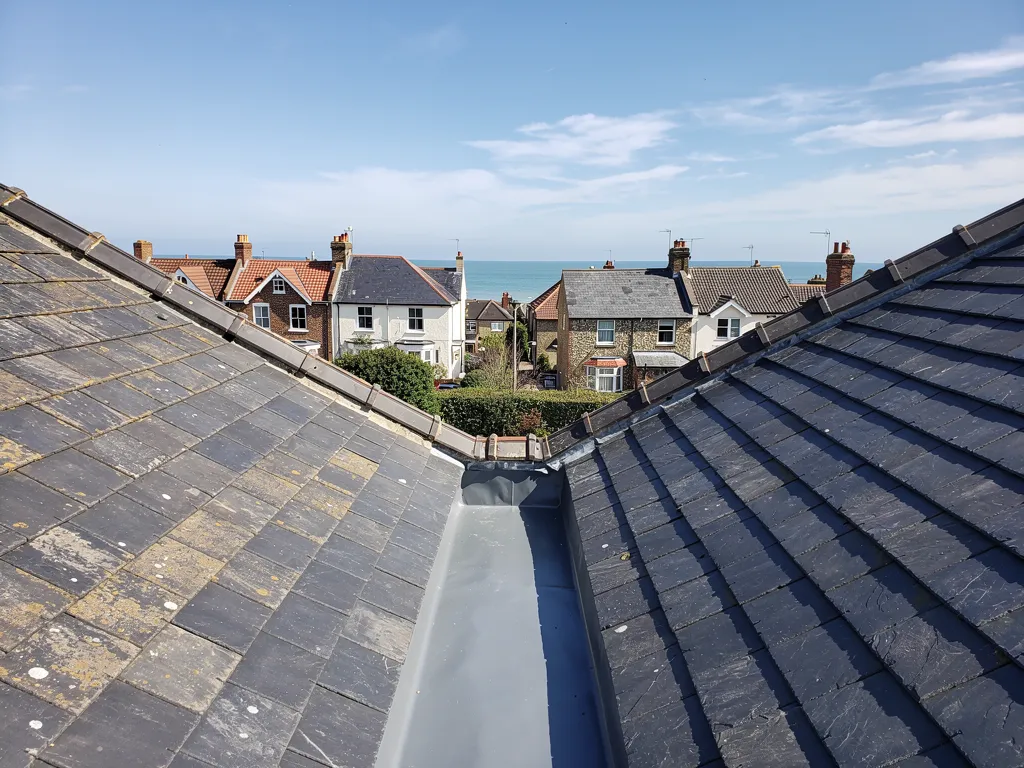
Clearing a valley without making it worse
Work by hand. A soft brush and a plastic or wooden scraper lift growth without cutting into the lead. A steel blade can nick the metal, and a pressure jet pushes water up and under the edge tiles, which defeats the purpose.
Bag the moss and debris rather than washing it down to the gutter, where it will block the next length. Then run clean water down the channel and watch the flow. If water lingers or backs up, the valley needs closer attention than a clean.
Look at the lead as the growth comes away. Splits, lifting at the edges, pinholes and old sealant smears are the usual findings. A short crack can sometimes be repaired, but sealant smeared over a split only covers it for a season. Tiles that are cracked or disturbed along the valley edge should be replaced while access is easy. Cut tiles are often trimmed to a thin wedge along the channel, and those thin edges chip and lift sooner than whole tiles do, so they deserve a close look.
All of this means working at height from a ladder or roof ladder, so it is not a job to take lightly on your own.
What we look at first on a leaking roof
When we trace a leak, valleys rank among the earliest places we inspect, starting with a look through binoculars and then a close inspection where needed. Ceiling stains inside the house are matched against the position of each valley, because the line the water took across the timbers often leads back to one. We photograph the channel, the state of the lead, the tile edges and the underlay where it shows, so you can see exactly what we are describing.
If the lead is sound, regular clearing is usually all it needs. If it has failed, relaying the valley is the right repair, and a proper job beats patching it yet again. Coatings are sometimes offered for roofs, and roof coatings explains what they can and cannot do.
Valleys under overhanging trees need clearing more often, so add them to the autumn gutter check. Have them looked at before listing a house too, as discussed in cleaning the roof before selling. The wider service sits under roof cleaning and moss removal, and a written price follows each survey.
Valley moss: two more questions
Can moss in a valley cause a leak by itself?
It can contribute. Moss does not cut through lead, but it dams the flow and pushes water sideways under the tiles. If the underlay or lead is already tired, the extra water finds the weakness. Clearing growth early takes that load off the roof.
Should I treat the valley with moss killer instead of scraping it?
A treatment on its own leaves dead growth in the channel, and that still blocks the flow. Remove the bulk by hand first, then consider treating the surrounding tiles. Follow the product label, and keep run-off away from plants, ponds and drains.
Tell us about your roof
Describe what is happening and we will call you back to arrange a visit.
- Photographs of what we find
- A written quote with one total price
- Or call 01903 299063
10-year workmanship guarantee, in writing.