
Question answered
What is a lead apron flashing?
The short answer
A lead apron flashing is a sheet of lead that covers the joint where a roof slope runs into the front of a chimney stack or the foot of a wall. Its top edge is tucked into the brickwork, and the lower edge lies over the tiles so water runs off it. It leaks when the lead lifts, splits or loses its wall joint.
An apron is the piece of lead that covers the joint at the lower face of a chimney or the foot of a wall. It is one of the flashings that most often fails, because it takes the water running down the roof.
Where the apron sits and what it does
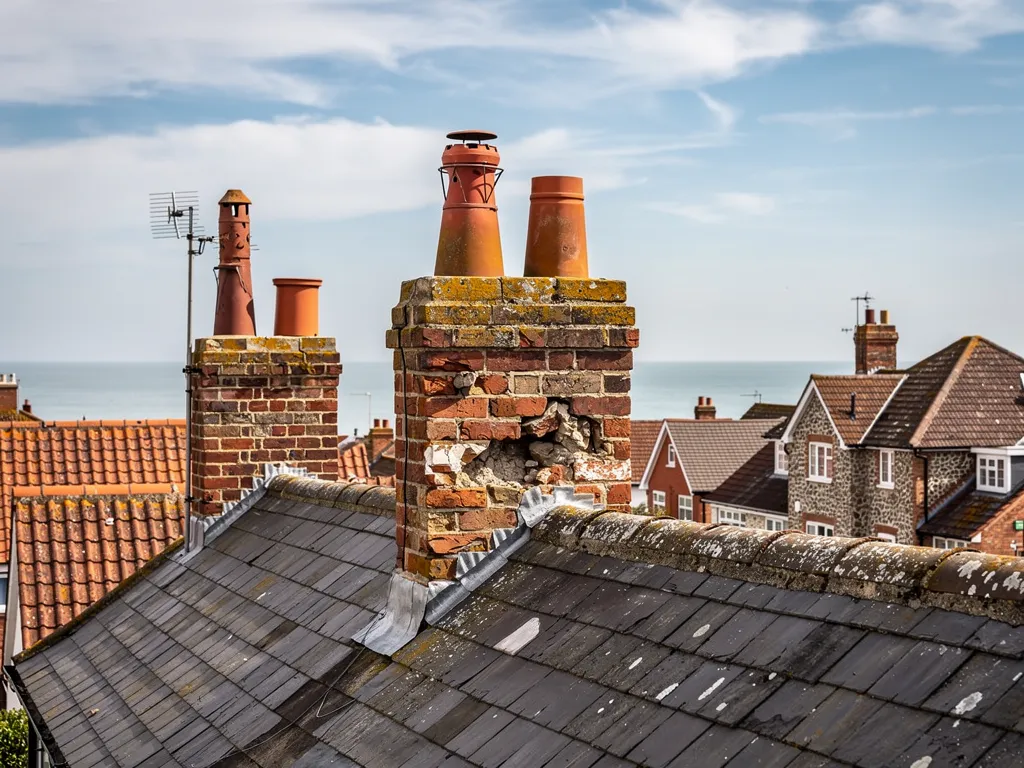
On a chimney, the lead flashing is made in separate pieces: a front apron, side step flashings, a back gutter and sometimes a saddle on the ridge side. The apron is the front one. It sits on the lowest face of the stack, where water running down the slope arrives first, so it carries more water than the others and wears first.
Along a wall, the same idea appears at the foot of a taller building, such as where a lean-to roof meets the house. The wall rises above the roof, and a long apron covers the joint between them, running with the wall instead of across a stack.
The aim is simple. The apron must shed water forwards, away from the brickwork, onto the tile or slate below. If it does that cleanly, the joint stays dry, and the timbers and plaster behind it do too.
How a lead apron is built
The top edge of the lead is turned into a raked-out mortar joint in the brickwork, locked with lead wedges and pointed. The body is dressed down the face of the stack and onto the roof covering. On tiles it follows the profile; on slate it sits flat over the top course.
Thickness is given as a lead code. Leadworx lists code 5 for general and vertical work, with heavier codes where the lead is wide or exposed. The apron is cut so it has room to move, because lead grows and shrinks with the weather.
Each apron should be separate from its neighbours, with overlaps sized to throw water over the piece below. A single wrapped piece, or one sealed at every edge, cracks sooner. The edge that lies on the roof is left free so that the lead can slide, and its lower margin is cut with a drip to throw water clear.
Why aprons leak
Common causes are simple. The lead has lifted in a gale because the wedges were missing or the pointing fell out. A crack has formed across the width of the apron where it was folded once too often. The tiles below have slipped and let water run behind. Or the top edge was never pointed into a groove, and a bead of sealant was left to do the work.
Chimneys on this coast take driven rain off the Channel in a gale, and a loose apron lets it through. We do not assume the apron is the only fault; the back gutter and side flashings are checked at the same visit, since a stack leaks wherever its weakest piece sits.
A damp stain in the room under a chimney points to the flashings, but failed stack pointing leaves similar marks. Tracing the source comes first, which is why the survey is done before any repair is chosen.
Repair, renewal and cost drivers
Where the lead is sound and has only lifted, it can be dressed back and refixed. Where it has split or been damaged, a new apron is cut and fitted. Most chimney leadwork is replaced as a set, so the apron, side flashings and back gutter match each other.
MyJobQuote's guide for chimney leadwork gives a typical UK range of £150 to £250 for a patch and £350 to £460 for a full replacement without scaffold, rising to £700 to £920 with it. Those figures are national guides, not our prices; what chimney leadwork costs goes through them.
Access is the biggest swing. A bungalow chimney reached by a short ladder is a different undertaking from a stack on a tall terrace. Photographs of your stack go with the written quote, which gives a single price for the job once the survey is done. If the stack itself is crumbling, we tell you before pricing the lead, since new flashings on poor brick will not last.
Related details worth knowing
The saddle, a small piece of lead where the stack meets the ridge, often ages alongside the apron. The lead saddle page explains how it is made. If you are weighing another metal for the job, copper or lead sets out how they compare for look and cost.
In a conservation area or on a listed building, check with the council before changing materials. Like-for-like repair is usually straightforward, but a changed appearance may not be. We photograph the existing lead before work starts, so there is a record of what was there.
The wider family of lead topics, from codes to theft, is gathered under lead roofing. Lead flashing is quoted at over 80 years in typical UK guides, and over 100 years for higher codes, so a good apron deserves repair before replacement.
Apron flashing: two more questions
How long should a lead apron last before it needs renewing?
Typical UK guides give over 80 years for lead flashing, and over 100 years for higher codes. In practice aprons fail earlier when they were badly pointed or are cracking from movement, so the condition of the lead matters more than the year it went on.
Can a leaking apron be repaired without replacing the other chimney flashings?
Sometimes, if the rest are sound and tight. We check the side flashings, back gutter and pointing at the same visit, because a repaired apron beside a worn flashing often just moves the leak a few inches along.
Tell us about your roof
Describe what is happening and we will call you back to arrange a visit.
- Photographs of what we find
- A written quote with one total price
- Or call 01903 299063
10-year workmanship guarantee, in writing.