
Question answered
What is a lead saddle?
The short answer
A lead saddle is a folded piece of lead that covers the point where a ridge meets a wall or chimney, or where a valley meets a wall. It sheds water over the junction and ties the flashings on either side together. It leaks when the folds open, the lead lifts, or it was cut too small to lap properly.
A saddle is a small, shaped piece of lead that finishes a flashing where two slopes, or a slope and a wall, come together at an angle. It is the corner piece that hurried repairs tend to miss.
Where a saddle is used
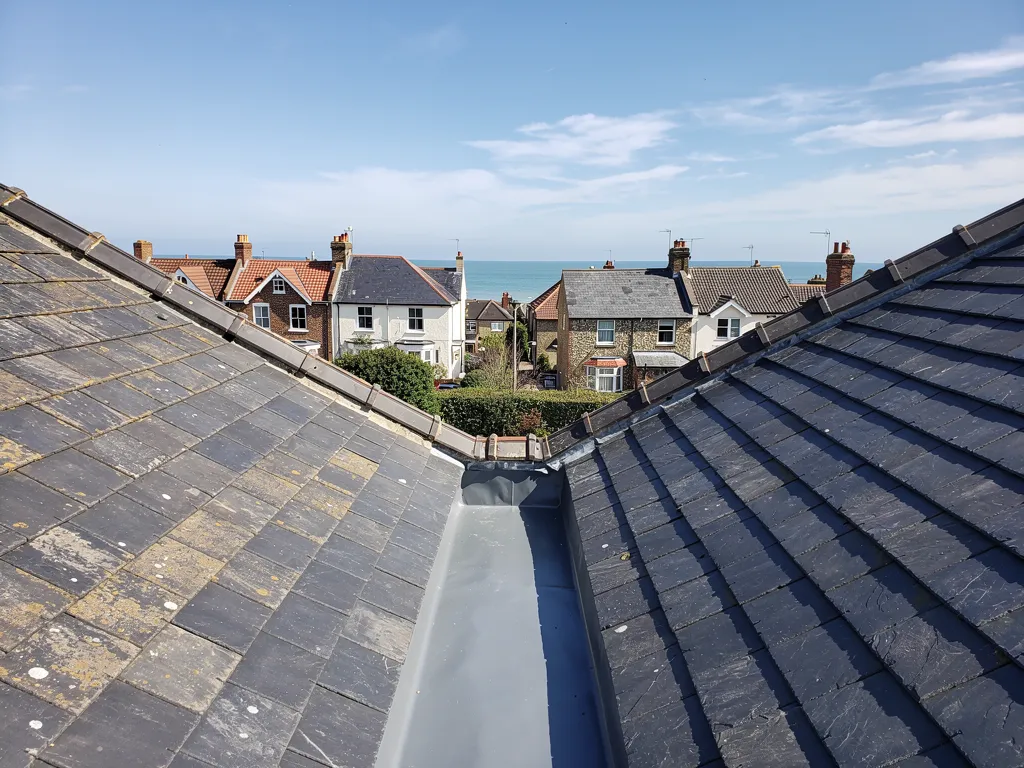
Most flashings follow a straight line, along a wall or round a chimney. A saddle is for the places where lines meet: the top of a chimney where the back of the stack rises out of the ridge, the point where a ridge ends against a gable wall, or the junction of a valley and a wall. These angles leave a gap that straight flashings cannot cover alone.
The saddle sits over the top, folded and shaped so that water running to the junction is thrown to either side and down the roof, not into the joint. At a chimney it is often the highest piece of leadwork, which means it takes the most wind.
Because it is small and high, it is also the piece most likely to be missed when a roof is checked from the ground. A saddle that has lifted can let water in while the apron and side flashings look perfectly sound.
How a saddle is made
A saddle is cut from a single sheet of lead and bossed into shape. Bossing is the traditional craft of working lead with mallets and dressers so that it takes a curve or an angle without being cut and joined. The aim is a piece with as few joins as possible, since every join is a place water can try.
It lies over the pieces beside it and under the ones above, following the direction water takes. The tucked edge goes into a joint in the wall with a wedge and pointing. The rest of the lead is dressed down firmly onto the roof, with enough overlap on each side to carry water away.
Leadworx puts code 4 down as a light, general-purpose grade and code 5 as the grade for vertical and general work. A saddle needs lead soft enough to shape yet thick enough to hold its form when the wind pulls at it, so the grade is chosen for the position, not just the price.
Why saddles fail
The usual cause is wind. A small piece of lead standing proud of the roof catches gusts, and if the wedges are missing or the pointing has gone, it lifts and flaps. Repeated flapping hardens the lead, and it cracks along the fold. On a coast that sees gales off the Channel, that happens sooner than on a sheltered site.
Poor cutting is the next. A saddle cut too small leaves too little overlap with the pieces beside it, and water finds the gap in driving rain. Sealant used to close such a gap is a temporary step only; does lead flashing sealant work explains why.
Lastly, the roof itself moves. Ridge tiles shift, the stack cracks, or the mortar bed beneath falls away. A sound saddle on a loose base will not stay watertight, so we check what the lead is resting on as well as the lead.
Repairing or replacing a saddle
Lead that is intact but has lifted can be pressed down again and refixed with new wedges. If it is cracked, torn or too short, a new saddle is made. Patching rarely suits a piece with folds; a patch seldom lies flat across them, and the patch edge becomes the next weak point. Where the old saddle is a good fit, its shape is kept as a template for the new one.
Because the saddle ties other pieces together, it is often replaced with them. A chimney that needs new leadwork usually gets a matching apron, side flashings and back gutter, so the set is consistent. The chimney leadwork cost page gives typical UK ranges, and lead apron explains the front piece.
Everything else on the metal is gathered under lead roofing.
What we look at before quoting
We study the saddle from the roof where that is safe, and photograph it together with the other flashings. We look at the pointing in the wall joint, the state of the ridge or valley beneath, and whether water marks in the loft line up with the junction. The written quote then follows, with one total for the whole job.
Access changes the cost more than the lead does. A saddle on a low bungalow chimney is simple; one at the top of a tall stack may need scaffolding, and the scaffold firm handles any highway licence. Ask every roofer whether the figure includes scaffolding and VAT, because the answer can swing a comparison.
Where a valley meets the wall, lead valleys covers the channel itself, since the saddle and the valley lining have to work as a pair. If the chimney stands in a conservation area, ask the council before altering its appearance, even for a repair that looks routine.
Lead saddles: two more questions
Is a saddle the same as a back gutter?
No. A back gutter is the channel of lead behind a chimney that carries water round it. A saddle is the shaped piece at the top where that channel meets the ridge or wall. They sit close together and are often replaced as a pair.
Can a damaged saddle be fixed with a piece of lead and sealant?
It can be patched for a short time, but the folds make a patch hard to lay flat, and sealant gives way at the movement joints. A proper repair replaces the saddle with a new piece cut to the junction and wedged into the wall.
Tell us about your roof
Describe what is happening and we will call you back to arrange a visit.
- Photographs of what we find
- A written quote with one total price
- Or call 01903 299063
10-year workmanship guarantee, in writing.