
Question answered
Copper or lead on a roof?
The short answer
Lead is the customary metal for flashings, valleys and gutters on British houses because it is soft, easy to dress and costs less per job. Copper suits visible features, such as bay roofs, porches and dormer cheeks, where its colour is wanted. Neither is better in every case; the building, the detail and the budget decide it.
Both metals have been used on British roofs for centuries, and both can be dressed to the same details. The choice usually comes down to appearance, the building and what the job costs.
How the two metals look as they age
Fresh lead is a bright silver-grey that quickly dulls to a flat, matt grey as an oxide skin forms. It tends to disappear into the roof, which is why it suits flashings tucked against brickwork and stone. Lead can also be patinated to reach that mellow grey sooner.
New copper is a bright salmon pink. It darkens to brown within months and, over many years in damp air, can turn the blue-green colour known as verdigris. That change is part of its appeal on a church spire or a bay window, and a drawback to anyone who wants the roof to stay the colour it was fitted.
Copper can also carry a green tint onto the brickwork or render below as rain washes over it, so the design of the drip edge matters. Lead can leave a pale streak on walls in the same way, which is covered in our page on white staining on lead.
How each is worked and where it is used
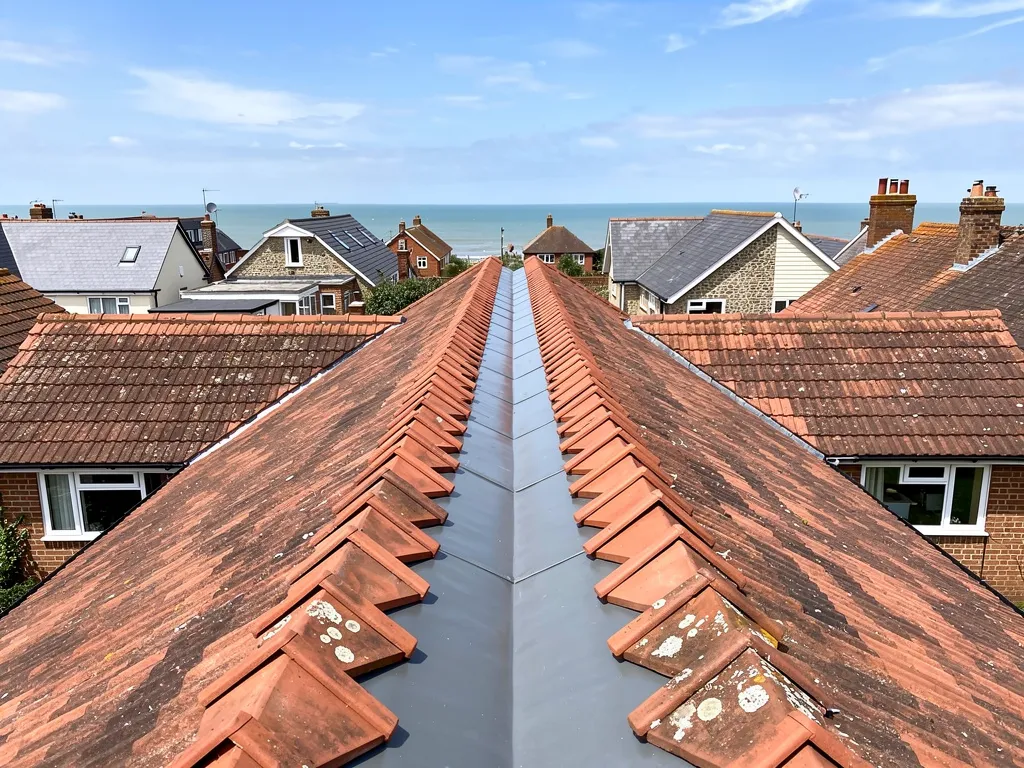
Lead is heavy, soft and forgiving of awkward walls. A roofer can dress it into corners, around chimney stacks and over uneven brick with hand tools, which is why it is the norm for flashings, soakers and valleys. Its thickness is given as a code, and Leadworx lists code 5 for general and vertical work.
Copper is lighter and harder. It is usually supplied in thin sheet or strip, folded into standing seams or roll joints, and soldered or welted rather than dressed like lead. That makes it well suited to clean, crisp lines on a flat or curved roof, and less forgiving of awkward masonry.
Sometimes the sensible answer is both, each where it works best: lead where it meets the wall and has to follow it, copper for the feature seen from the road. The details for chimneys are on our lead apron and lead saddle pages.
Cost: what moves the price
For lead, MyBuilder's flat roof guide (updated 21/08/2026) gives a typical UK range of £150 to £200 or more per m² for lead sheet, and Checkatrade lists code 5 flashing at £50 to £70 per metre, excluding VAT. Those are typical national figures, not our prices.
Copper is generally the dearer metal, and its working methods take longer, so a copper detail usually costs more than the same detail in lead. A fair copper range depends on the sheet thickness and the joint system, and only a survey settles those, so no figure is offered here. The written quote then gives a single total.
Beyond the metal, access has a large effect on the price. A chimney that needs a scaffold, a roof that is hard to reach or work on a listed building changes the job, whichever metal is chosen. Confirm whether any figure you are given covers scaffolding and VAT before you weigh one against another.
Lifespan, without the promises
For copper, life turns on the sheet, the detailing and the exposure, so we judge it on condition. For lead, MyJobQuote gives over 80 years for flashing, and over 100 years for higher codes, while Less gives 50 to 100 years for a lead flat roof. Those are ranges seen across the country, and workmanship and upkeep decide how any metal behaves on one house.
What shortens the life of a metal roof is usually the detail and not the metal. Lead that cannot expand freely will crack. A flashing pointed in with poor mortar can lift. A gutter that ponds wears out its lining early. In every case the design is what we study first, before the metal.
If you have an old lead roof that is cracking, types of lead flashing shows how each detail should be laid, and lead roofing gathers the rest.
Choosing for your own roof
Start with what the metal is for. A flashing that must follow brickwork and sit unseen suits lead. A small roof that you want to be a feature suits copper if the budget allows and the building can take it. On a listed building the council may need to consent to a change of metal, and in some conservation areas Article 4 directions bring roof coverings under planning control, so ask the Adur & Worthing planning team before swapping one for the other.
Where the two metals meet, the water path needs thought, so that run-off from one does not stain or wear the other. A roofer should separate them or detail the drainage deliberately, and the position of the join should be agreed before the first sheet is cut.
We recommend whichever suits the roof, and explain why, with photographs of the area. A tube of sealant is not a stand-in for either metal; does lead flashing sealant work covers that.
Metal choice: two more questions
Does copper last longer than lead on a roof?
Copper is judged on its detailing and exposure, so we compare the two on your roof itself. Lead flashing is quoted at over 80 years in typical UK guides. What matters more than the metal is the detail: movement joints, falls and fixings decide whether either lasts well on your roof.
Can I replace lead flashing with copper on a conservation-area house?
Possibly, but check first. Changing the material may alter how the building looks, and a few Adur and Worthing conservation areas have Article 4 directions that remove permitted rights for roof coverings. The council's planning team can say what applies at your address.
Tell us about your roof
Describe what is happening and we will call you back to arrange a visit.
- Photographs of what we find
- A written quote with one total price
- Or call 01903 299063
10-year workmanship guarantee, in writing.