
Question answered
Lead or zinc?
The short answer
Lead is the traditional metal for flashings, valleys and flat roofs, and a fitter can dress it into awkward corners on site. Zinc is lighter, weathers to a blue-grey and is usually formed from seamed sheet. Both can last many decades. Near the sea, zinc needs thought about salt deposits. The choice follows the detail, the look wanted and whether the building is protected, not one winner.
Both metals can give a roof detail a long life. Which one suits yours depends on the shape of the job, the look you want and how close the house is to the sea.
What each metal does well
Lead is soft and heavy. A fitter can bend it over a chimney corner, press it into the curve of a stone or work it round the awkward geometry of an old roof, and it stays where it is put. That is why it is the default for flashings, valleys and gutters on tiled and slated houses. Our main lead roofing page covers the whole range.
Zinc is stiffer and lighter. It is supplied as flat or profiled sheet and shaped into straight runs with folded seams. It suits long, clean lines such as a dormer cheek, a flat roof with standing seams or a bay roof where the geometry is simple.
A flashing dressed into the face of a brick wall favours lead. A long straight covering favours zinc. Seams are where the two differ most: lead is lapped, rolled or welded, while zinc is folded. Dormers can go either way, and our guide to lead on dormers shows how the choice plays out there.
How long each lasts and what it costs
Typical lifespans are long for both. Lead flat roofs are put at 50 to 100 years by Less, and MyJobQuote puts lead flashing at over 80 years. For zinc, one maker says a roof can last in excess of 100 years, while HomeBuilding, quoting a contractor, gives 60 to 100 years. These are ranges seen in guides and not promises.
On cost, MyBuilder (updated 21 August 2026) gives lead flat roofing at £150 to £200+ per m², as a typical national range. For a chimney, MyJobQuote shows a patch repair at £150 to £250 and a full replacement at £350 to £460 without scaffold. Those are published guide figures, not ours.
Zinc work is priced on its profile, its seams and the access, so the figure is set after the survey. Our written price is a single sum, and if a repair will do the job in preference to a renewal, the quote is for the repair.
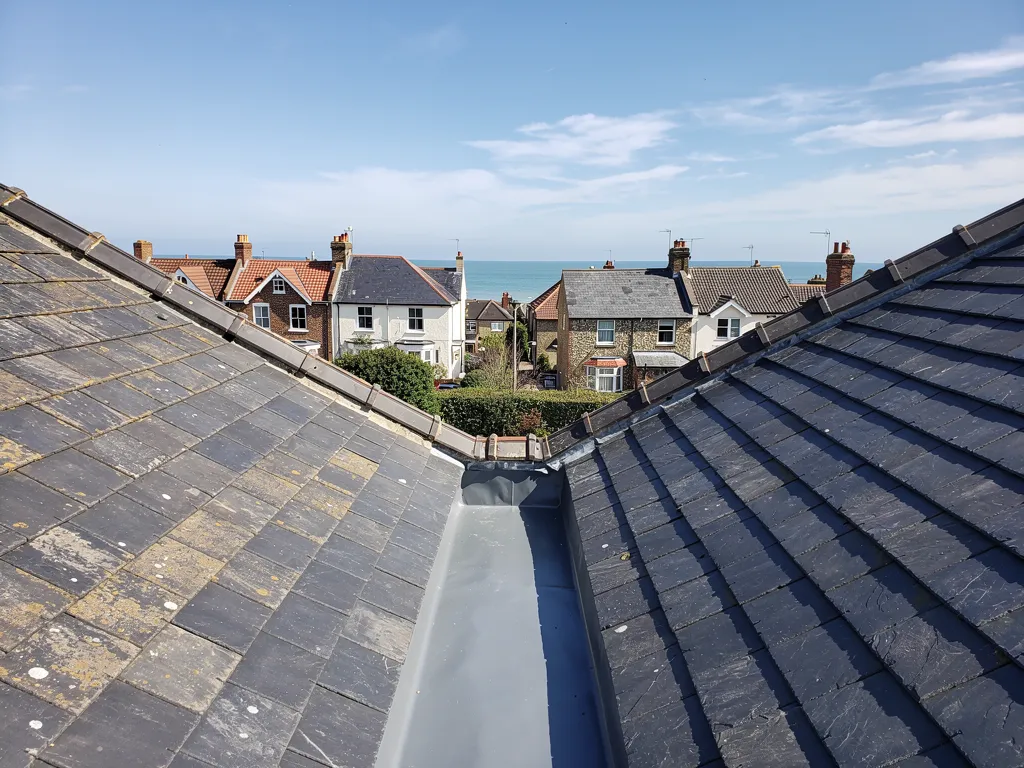
Look and weathering
New lead is bright and soon dulls to a soft mid-grey. Early on it can show white powder and run-off streaks, as set out in white powder on new lead, then it settles. It blends with slate, stone and old brick, and it looks right on older buildings.
Zinc starts as a lighter, cooler grey and develops a blue-grey tone, sometimes with slight variation across the sheet. Pre-weathered zinc is supplied already dulled, which helps it sit beside existing materials. It looks crisp and contemporary on a new roof, and a little out of place against hand-made clay tiles.
If new work has to match an old roof, lead is nearly always the closer match. For a modern extension, zinc may be the better fit, and some owners like the contrast between the two metals.
What zinc makers say about the coast
A leading zinc manufacturer says the metal copes very well on the coast and that its standard warranties cover coastal sites. It also notes that zinc can react with air carrying a lot of salt, and it splits the shoreline into three bands: up to 1 km is the most severe, 1 to 3 km is the middle band and 3 to 20 km shows low maritime influence.
The white deposits gather on faces that rain never reaches, like the underside of eaves and walls under cover. Rinsing with fresh water twice a year or more keeps the salt down, according to the maker, who adds that pre-weathered sheet within 1 km of the shore will probably still stain for good. HomeBuilding makes the same point about salty air and metal surfaces.
On a house close to the sea, zinc can be used, but the detail and the cleaning need planning.
Listed buildings, conservation areas and how we decide
On a listed building, changing the metal is not a free choice. Adur & Worthing Councils say that repairs made in different materials can call for listed building consent. A like for like repair in situ, by the South Downs National Park Authority's account, does not. Swapping lead for zinc is a change of material, so speak to the council's conservation team before work starts.
On other homes the choice is yours, and it is worth weighing up the look, the seams and the cleaning before you decide. We study the detail first, say which metal we would pick and why, and back it up with photographs of the actual junction.
Lead rewards experience; see can you fit lead flashing yourself for why we do not suggest it as a home project, and what lead welding is for a joint that lead allows and zinc does not.
Lead and zinc: two more questions
Is zinc a sensible choice for a roof detail close to the seafront?
It can be, as the maker says it performs well on the coast. Within 1 km of the sea, though, salt staining is more likely on sheltered faces and washing with clean water is advised. We would talk through how the detail drains and how it can be cleaned.
Does zinc cost less than lead for a flashing?
Not necessarily. The price follows the profile, the seams and the access, not the metal alone. Seeing the detail in person and photographing it comes first, and the figure follows in writing.
Tell us about your roof
Describe what is happening and we will call you back to arrange a visit.
- Photographs of what we find
- A written quote with one total price
- Or call 01903 299063
10-year workmanship guarantee, in writing.