
Question answered
Steam cleaning a roof
The short answer
Steam cleaning uses hot water or steam at modest pressure to loosen growth on a roof, without the harsh force of a pressure washer. It suits small areas, delicate surfaces and spot work, such as porches, extensions and flat roofs. On large, thickly mossed pitched roofs it is slower, so hand removal and a biocide treatment are usually part of the job.
Steam and hot water are sometimes offered as a gentler alternative to a jet wash. They suit certain roofs and certain jobs, and they are not the answer to every mossy slope.
What steam cleaning actually is
The name covers several methods. Some machines heat water and spray it at moderate pressure, others produce true steam at lower volume. Heat and moisture soften moss and algae, so the growth loosens from the surface and can be brushed or rinsed away with little force.
The attraction is the force. A hard jet can scour the face off a concrete tile or push water under the laps, and a steam clean works more on temperature than on blast, so the surface takes less punishment. Ask the operator what temperature and pressure the machine runs at, and whether the settings can be lowered for fragile areas. The same logic applies to old clay and weathered slate, where every knock counts.
It can also use less chemical in some set-ups, which appeals to people with ponds, pets or vegetable plots nearby. But heat does not leave a lasting protective film, so regrowth depends on how damp the roof stays afterwards.
Where it suits
Steam works well on small and awkward areas: porch and bay roofs, garage roofs, dormer cheeks and low-level extensions where an operator can reach the surface safely. It also suits some flat roofs, where a gentler approach protects the membrane, as described in moss on a flat roof.
Fragile and older materials are another use. Soft clay tiles, stone slates and weathered slate can be damaged by a hard jet, and a lower-force method lets the operator control how much is taken off. Even so, old roofs need a look at their fixings first.
Spot work is a further use. If one slope has stained or been shaded while the rest is fine, treating only that area saves cost and time. A conservatory roof, a bay canopy or a lean-to is often a good candidate, because the surface can be reached from a short tower and rinsed in a morning. In each case the surface and the access decide, not the machine.
Where it falls short
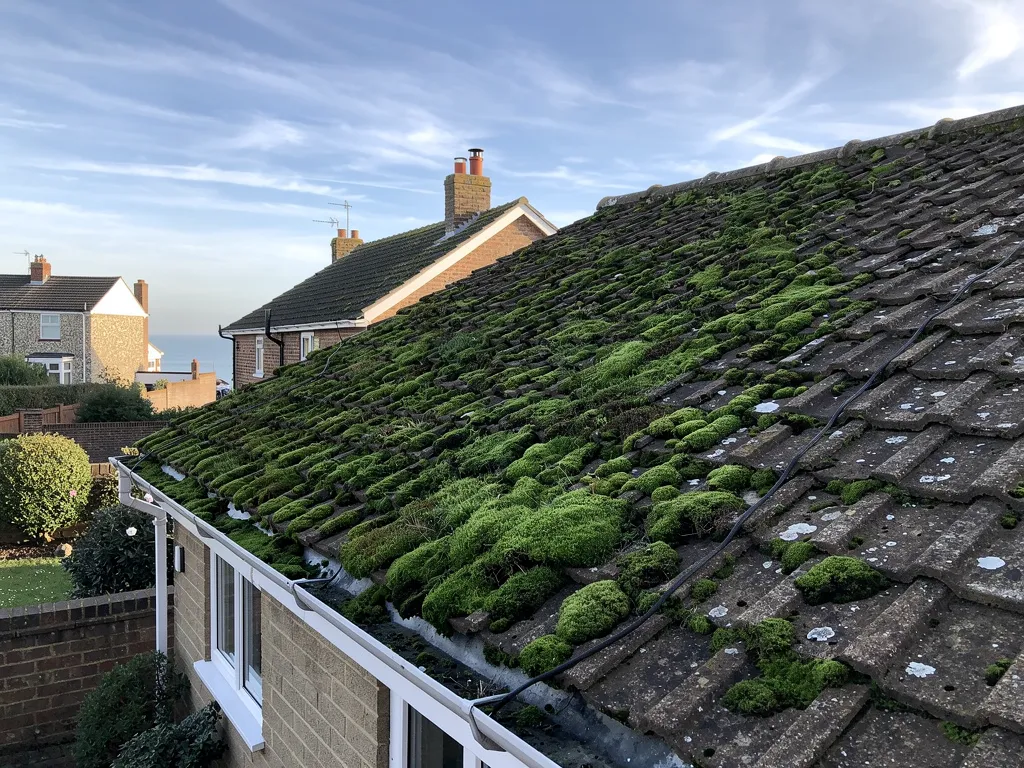
On a large pitched roof with thick moss, steam is slow. The operator has to cover every square metre with a lance, which takes time at height, and the thick mat still has to be scraped or brushed off first. Hot water also cools quickly on a cold or windy day, and water left standing on a slope can freeze overnight.
Heat on its own does not reach roots and spores below the surface. Without a follow-up biocide, growth can come back sooner than owners expect, which is why the two are often combined in one visit.
Equipment and water supply matter too. A machine needs power and a water source, and a hose run up to a roof adds weight and trip hazards. Hot spray can also scald, so it has to be handled with care on a slope. These are practical limits, and they are why steam is not the answer for every house.
Steam before a sale, and other timing
A roof that looks tired can put off buyers, and the quickest visible improvement is a clean. Our page on cleaning a roof before selling sets out what is worth doing and what a surveyor might still note.
Steam gives fast results on the right surface, but the full effect of a biocide appears over weeks. If the sale date is close, a visible first clean is possible, with the treatment finishing the job afterwards. Treat the sale date as a deadline for tidying up, not for the repairs the survey may find.
Do not let a clean hide a fault. A buyer's surveyor looks at cracked tiles, ridge condition and flashings, and a clean roof with a failing ridge is still a failing ridge. We check those points at the survey, and the photographs show them to you.
How we advise on method
We look at the roof, the material, the pitch and the thickness of growth, then recommend the gentlest method that will do the job. That might be hand removal with a biocide, a low-pressure rinse, steam on a delicate section, or a combination of them.
The survey photographs show you the moss, stains and any damaged tiles on your own roof. A written quote follows, carrying one total price, and you can ask why a method was chosen and what it will leave behind. Ask to see the survey photographs before agreeing, so you can see what the operator is looking at.
If steam is not right for your roof, we explain the alternative. For the full range of approaches, the biocide roof treatment page shows what treatment adds, and the roof cleaning and moss removal hub gathers the rest in one place.
Steam questions
Is steam safer for my roof than a pressure washer?
Usually gentler on the surface, because it relies on heat rather than force. It is not risk free. Hot water can still lift loose tiles or find its way under the laps, and the operator needs a safe way to work. The survey decides which method fits.
Does steam stop moss growing back?
Not by itself. It removes the growth that is there, but a damp, shaded slope will grow moss again. A biocide treatment, trimmed branches and clear gutters slow the return, and a periodic look at the roof tells you when it needs attention.
Tell us about your roof
Describe what is happening and we will call you back to arrange a visit.
- Photographs of what we find
- A written quote with one total price
- Or call 01903 299063
10-year workmanship guarantee, in writing.