
Question answered
Do zinc strips stop moss?
The short answer
Zinc and copper strips are fixed under the ridge tiles in the hope that rain running over the metal will discourage growth on the slope below. They are an optional extra, and they can only act on the area below them. They do nothing for moss already on the roof, so the roof is cleaned first, and keeping it dry and clear remains the main defence.
A strip of zinc or copper along the ridge is a popular idea for keeping moss away. It is an extra to think about, not a substitute for a clean, dry and well-drained roof.
How a metal strip is meant to work
The idea is simple. A strip of zinc or copper is fixed under the ridge tiles, with a short length showing, so that rain running over it carries traces of metal down the slope. Those traces are meant to make the tile surface less welcoming to spores.
Rain only reaches what it runs across, so a strip can only act on the slope immediately below it. Areas it does not wet, such as the lower part of a long slope, the sides of a valley or a roof with a deep eaves overhang, are left out of its reach.
Strips are sold as a preventive measure for a roof that is already clean. They are not a cleaner, and a thick mat of existing moss will not be shifted by one. That is why we treat them as something to discuss after the roof is cleaned, never before, and never as a reason to skip the cleaning.
What a strip cannot do
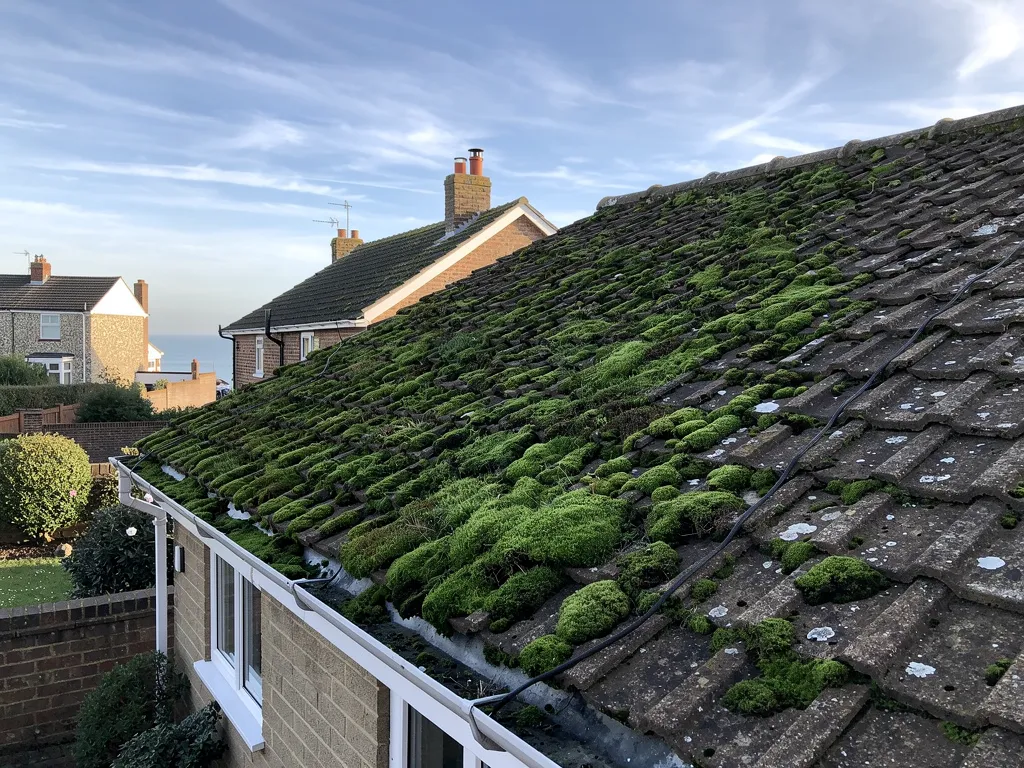
A strip cannot dry a damp roof. Moss thrives where tiles stay wet, and a shaded north slope or a roof under trees will keep its moisture however many strips are fitted. Dealing with the cause of the dampness, by trimming branches and clearing gutters, does more than any metal.
It cannot clear a blocked valley or mend a sagging gutter either, and moss in those spots is often a sign of a drainage fault. Our page on moss on a flat roof describes a surface where a ridge strip would not apply at all.
Nor does a strip replace a periodic look at the roof. Even with one in place, a visit from the ground each year to check for growth, slipped tiles and debris is sensible, and a quick glance after a gale costs nothing.
Questions to ask before paying for strips
Ask what the supplier claims, and ask them to put it in writing. A fair answer explains which part of the roof the strip will protect, how long the metal is expected to last, and what it will do if the slope is shaded. Be wary of any promise that a roof will stay free of moss.
Ask how the strip is fixed. It sits under the ridge tiles, so fitting it means lifting them, and the ridge then has to be refixed properly. BS 5534 was revised in 2014, and since then a ridge has had to be held by more than mortar, so a ridge lifted for a strip needs fixing back with clips or screws too.
Ask too whether the strip is guaranteed, for how long and by whom, as a supplier warranty and a roofer's workmanship are different promises. Finally, ask whether the cost is worth it for your roof. A strip is a small item on an otherwise sound ridge, but it adds to the bill if the ridge has to be rebuilt.
Run-off, neighbours and sensible expectations
Because the metal travels with rainwater, it ends up in the gutters and downpipes. Where that water drains matters if you keep a rainwater butt or a pond, and it is worth asking the supplier about it before anything is fixed.
Neighbours are rarely affected, but if your gutter drains close to a boundary it is courteous to mention any treatment. Our page on roof cleaning run-off and the neighbours covers notice and protection.
Set your expectations at a modest level. A strip may help in the right place, but regrowth still needs watching, and a periodic clean is part of owning a tiled roof, strips or no strips. Treat any strip as one small part of a wider routine of clean gutters, trimmed trees and an occasional look from the ground.
What we would look at first
On a survey we look at why the moss is there. Is the slope in shade, is the gutter overflowing, is a tile out of line, is the pitch shallow? Often the answer is a combination, and each has a different fix. Photographs of your own roof show you the picture.
We then clean by hand and treat the surface, and we talk through whether a strip makes sense for your roof. If it does, we explain where it goes and what the ridge work involves. If it would add cost without much benefit, we tell you that plainly.
For other ways of keeping growth in check, see steam cleaning a roof, which suits some surfaces. The roof cleaning and moss removal hub has the wider picture, and our written quote carries one total price.
Strips, briefly
Is zinc or copper the better metal for moss strips?
Both are sold for the purpose, and copper is the more expensive metal. We would not choose on the metal alone. Where the strip sits, how the ridge is refixed and whether the roof is clean to begin with all matter more than which metal it is.
Can I fit strips myself on a clean roof?
It means lifting ridge tiles at height, which is risky, and the ridge must be refixed correctly afterwards. It is better treated as roof work for a contractor with safe access, particularly on a coastal roof where a loose ridge is exposed to gales.
Tell us about your roof
Describe what is happening and we will call you back to arrange a visit.
- Photographs of what we find
- A written quote with one total price
- Or call 01903 299063
10-year workmanship guarantee, in writing.