Slate is one of the longest-lasting roof coverings. MyBuilder describes a well-installed slate roof as one that will last 80 to 100 years or more, and Checkatrade says the range runs from 50 to 200 years, with most easily lasting over 100. Those are typical ranges, not promises, and they vary with exposure, quality of work and upkeep. The last word in that list is the one you control.
What usually fails first is not the slate. It is the metal nails that hold it, the lead that seals the joints, the mortar on the ridge and the stack, and the gutters that carry water away. Each of those gives warning before it lets water in: a slipped slate on the path, a darker patch under the valley, a stain on the ceiling after a gale. A routine of looking, with a few jobs done at the right time, turns those warnings into small repairs.
Here is what to check and when, how to deal with moss, what valleys and flashings need, what belongs in the loft, which jobs to leave to a roofer, and how much help from a roofer typically costs. If your roof is on an exposed site, read it alongside our guide to fixing slates in exposed coastal sites.
A yearly routine that catches problems early
Once a year, and again after any severe gale, take ten minutes to walk round the house and look up. Binoculars help. You are looking for change: anything that was not there last time.
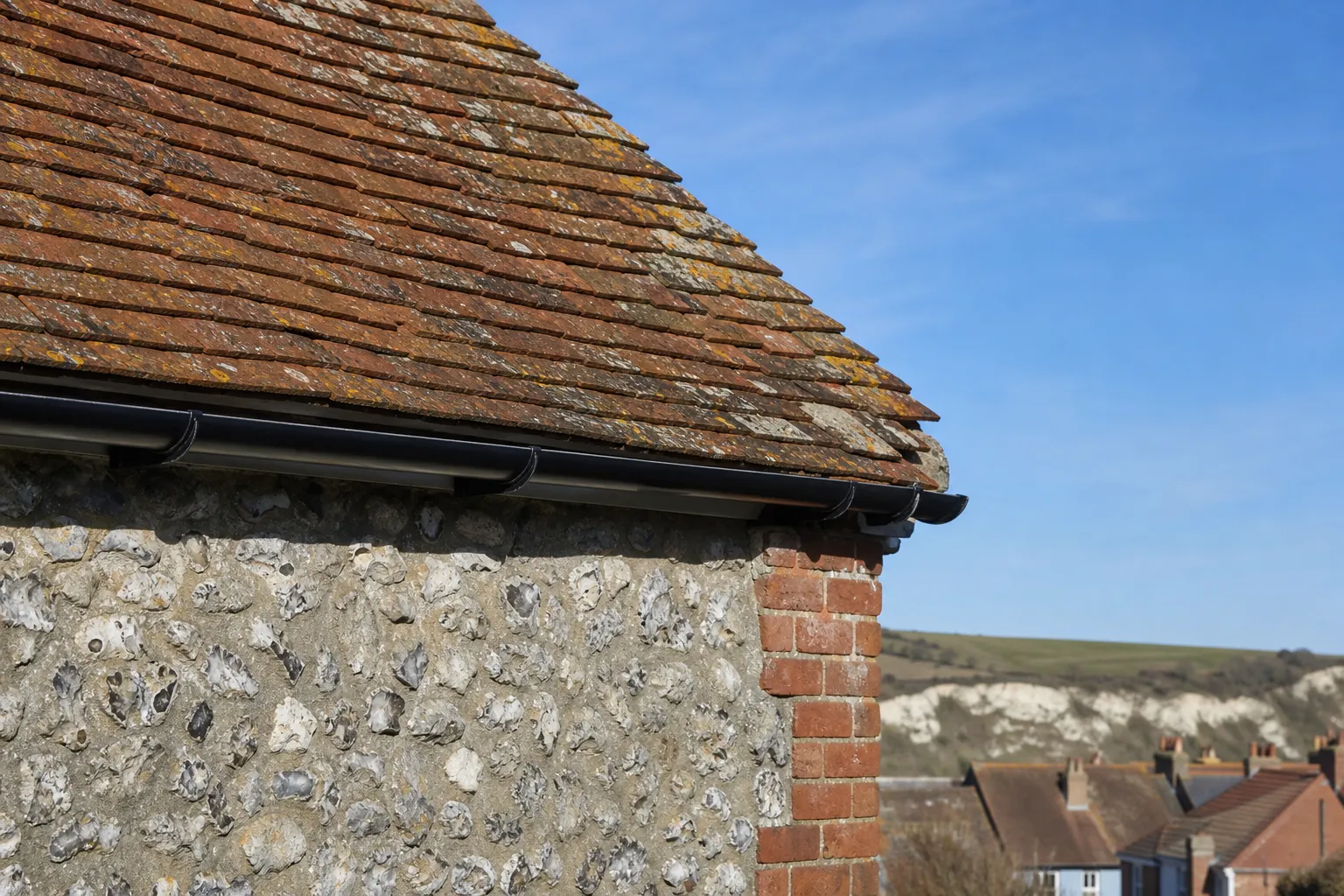
Start at ground level. Check the paths, flower beds and gutters for pieces of slate, which can be the first sign of a failing nail. Then look along the courses. They should run in straight, even lines, and a slate that has slipped will show as a notch or a darker tongue. Look at the ridge line at the top for gaps and shifted tiles, at the chimney stack for crumbling mortar or a leaning pot, and at the lead along any wall for a lifted or curling edge.
Inside, a torch in the loft on a dry, bright day does much of the rest. Daylight showing through the roof means a missing slate or an open joint, and pale tide marks on the rafters or damp insulation show water has found a way in before. If the roof has no underlay, you can see the back of the slates and the battens directly, which makes faults easier to spot.
When to add an extra check
After a storm, look again. After work by anyone on the roof, such as an aerial fitter or chimney sweep, look again. Walking on slate cracks it, so keep your inspection to the ground and the loft. The short answer on walking on slate explains why.
Note the date and take a photograph each time. A series of pictures shows whether a mark is spreading, and it helps whoever repairs the roof.
Moss, lichen and algae on slate
Slate gets a coat of green, grey or orange growth in damp and shaded spots, and it is the most visible sign that a roof is ageing. Most of it is cosmetic. A light film of lichen stays on the surface and does little harm.
Thick moss is another matter. It holds water against the slate, collects soil that feeds more growth, and can pack the joints between slates and block a valley or gutter. Over time that trapped moisture can speed up nail rust. If growth is heavy across a north-facing slope, or collecting in the lap of the slates, it is worth treating.
How it is cleared matters. MyBuilder cautions against pressure washing delicate roofing, and a hard jet can blow water up under the laps, strip the surface from old slate and loosen weak nails. Gentle methods are safer: soft brushing, careful scraping and a biocide treatment that works over several weeks while rain washes the dead growth away. Our guide to cleaning a slate roof covers the choices.
For a typical price, MyBuilder (updated 21/08/2026) gives slate roof cleaning as £500 to £1,000, with manual scraping at £5 to £10 per m². Those are national typical figures. On a particular house the cost depends on the roof size, access and how heavy the growth is, and after the survey you receive the price in writing, as one figure.
Do not clear moss from the roof by climbing on it yourself. If it needs doing, it needs access equipment and someone who knows where slate is likely to crack.
Valleys, gutters and the places water collects
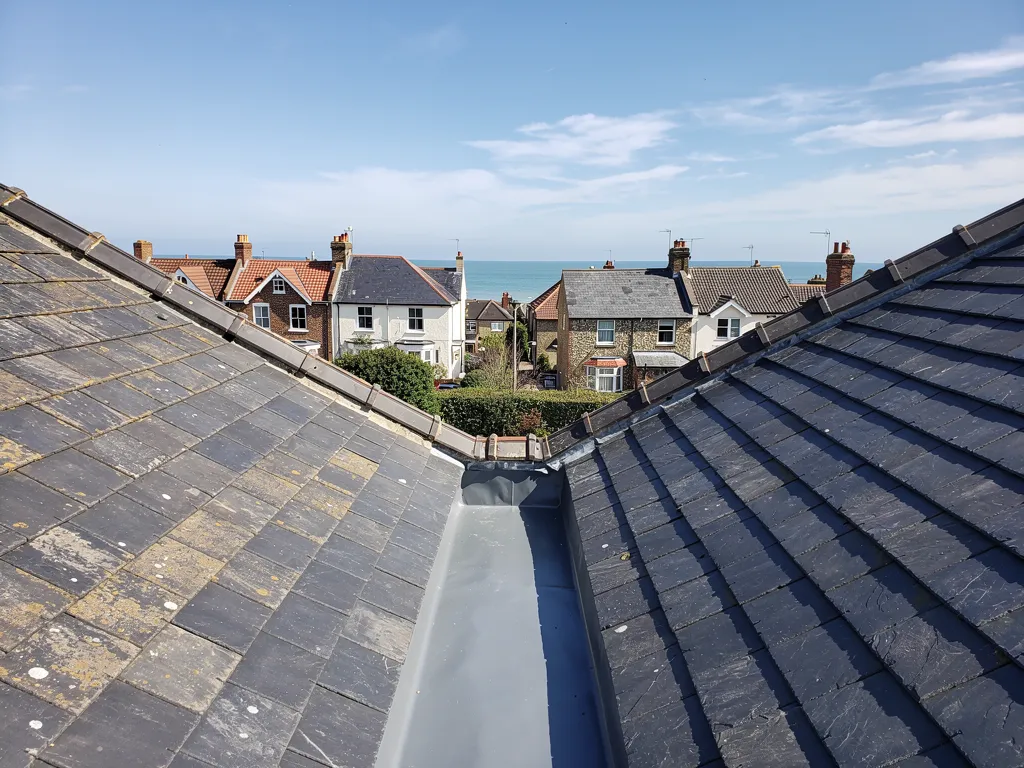
The valley is the trough at the inside corner of two meeting slopes, and it carries water off both. In slate it is normally lined in lead, and slates are cut to fit the line along each side. Because so much water arrives in one channel, it is where a small blockage becomes a leak quickly.
Keep valleys clear. Leaves, moss and slate fragments collect in the channel and make a dam, and water then spills sideways under the slates. Where you can see the valley from a window or from a safe position on the ground, look for debris, for sagging lead and for splits along the base. A valley that is blocked in a storm can send water straight into the ceiling below.
Gutters need the same attention. Slate roofs shed a lot of water quickly, and a blocked or sagging gutter overflows at the back, behind the fascia, and runs down the wall. Makers generally advise a slight fall towards the outlet, somewhere between 1:600 and 1:350 depending on the system, so a gutter that holds standing water has probably dropped out of line. On many period terraces the gutter sits behind a parapet or on the front wall, and an overflow there can soak the brickwork for months before a stain shows indoors.
Clearing safely
If you can reach a gutter from a stable ladder, clear it by hand and flush the downpipe. Anything above the first floor, any valley, and any gutter you cannot reach with both feet on the ground, belongs to a roofer with proper access. A fall from a ladder is a far bigger risk than the leak.
Flashings, soakers and chimney stacks
Every place where a slate roof meets something solid is sealed with lead. A flashing is the lead band bridging the joint between roof and wall or stack, and soakers are the folded lead tabs under the neighbouring slates that guide water back onto the slope. These details are the second most common source of leaks after slipped slates, and they are the ones that suffer from the roof moving in heat and cold.
Lead stretches and thins as it warms and cools, and it can crack where it has been bent sharply or dressed too tight. According to MyJobQuote, lead flashing can last for over 80 years, and over 100 years for higher codes. Leadworx says code 4 is now the usual standard for general flashing work. When we look at a flashing we check whether the top edge is still wedged into the brickwork, whether the lead has split at the corners, and whether the mortar fillet or pointing above it has cracked.
Give the stack its own yearly look. Mortar joints crumble, flaunching, the angled mortar cap bedding the pots, can crack and admit water, and a stack that is exposed on all sides weathers faster than the wall below. Repointing and re-flaunching are routine jobs, and MyBuilder gives chimney repointing as around £750 on typical jobs, with a range of £500 to £2,000. Repair is much cheaper than rebuilding a stack.
Small lifts in lead, or mortar that is dusty to the touch, are warning signs worth acting on in good weather. Left through a winter, they become damp on the chimney breast.

Looking after the slates, the nails and the loft
Slates are only as secure as their fixings. On most Victorian and Edwardian roofs the nails are iron, and rust gradually eats them away until the slate slips. Our short answer on hooks versus nails compares the fixing methods, and the one on nail sickness explains the failure. Maintenance here means replacing a slipped slate promptly with a properly fixed one, because a missing slate puts weather on the batten and the exposed nail beside it.
If slates are slipping regularly across one slope, the nails there are probably near the end of their life, and repeated small repairs start to add up. At that point it is worth asking for an assessment of whether the slope should be re-fixed or re-laid. If that means swapping slate for another covering at some point, our guide on changing from slate to tile sets out the decision.
If a few slates need replacing, matching matters. Second-hand slate of matching size and shade usually blends in best on an older roof, and our guide to reclaimed slate explains what to look for.
The loft
Keep the loft dry and ventilated. Condensation from bathrooms and kitchens can rot battens and rust nails from the inside, and a blocked eaves gap makes it worse. Do not stack boxes against the eaves where air needs to enter. Under BS 5250 as Marley summarises it, a roof using high-resistance underlay needs a 10 mm ventilation slot running the length of the eaves once the pitch exceeds 15 degrees. If you see damp timber, have it looked at before it spreads.
Which jobs need a roofer
Some jobs are simple enough to do yourself from the ground. Others need a roofer, and it is better to know the difference before anyone climbs a ladder.
You can check the ground, clear low gutters you can reach safely, and look at the roof from the loft. A roofer should handle anything that involves going onto the slope: replacing slipped slates, re-fixing a run of them, dressing lead, repairing a ridge or chimney, clearing a valley and treating moss. Slate is brittle underfoot, and a roofer will use crawling boards or a roof ladder to spread the weight.
A professional inspection is worth booking if the roof has not been looked at for some time, if you have just bought the house, or after a bad storm. MyBuilder (updated 21/08/2026) gives a typical UK range of £150 to £250 for a standard roof inspection and £200 to £400 for a drone survey. We survey a slate roof from the loft and outside, take photographs of anything we find, and show them to you with a written quote. We put forward the lightest repair that cures the fault.
What the work carries
The site is left tidy with the waste removed, and any slates lifted for access are checked once more before the ladders come down. What moves the price is access, the covering, the extent of the work and whatever the survey uncovers; you get the figure as one written total.
If you are on an exposed site, or the roof is in a conservation area, tell us at the start. Both change how a repair is specified, and our guide to slate roofs in conservation areas covers the consent side. Photos of the roof from the street and from the loft are a good start, and we will say what we would examine first. Our slate roofing page covers the wider service.