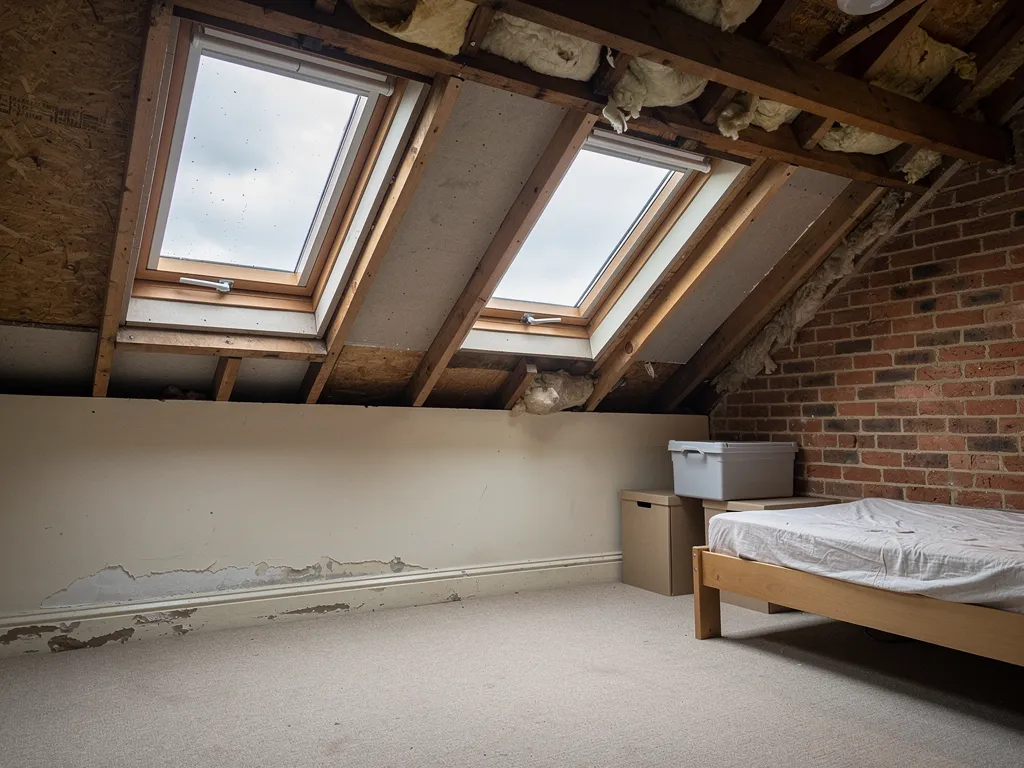
Roofs are built to outlast the people who first paid for them, yet plenty fail in their second or third decade. The covering is seldom the reason. A tile, a slate or a sheet of rubber is a tough, simple material. What gives out first is a detail around it: a ridge bedded in mortar, a flashing at a chimney, a gutter that held water against the fascia, a loft that never dried out.
That is good news, because details can be looked after. A roof that gets a little attention each year tends to outlast one that is ignored until it leaks. None of this is a promise about any particular roof, and how long yours lasts depends on the covering, the workmanship, the exposure and the upkeep.
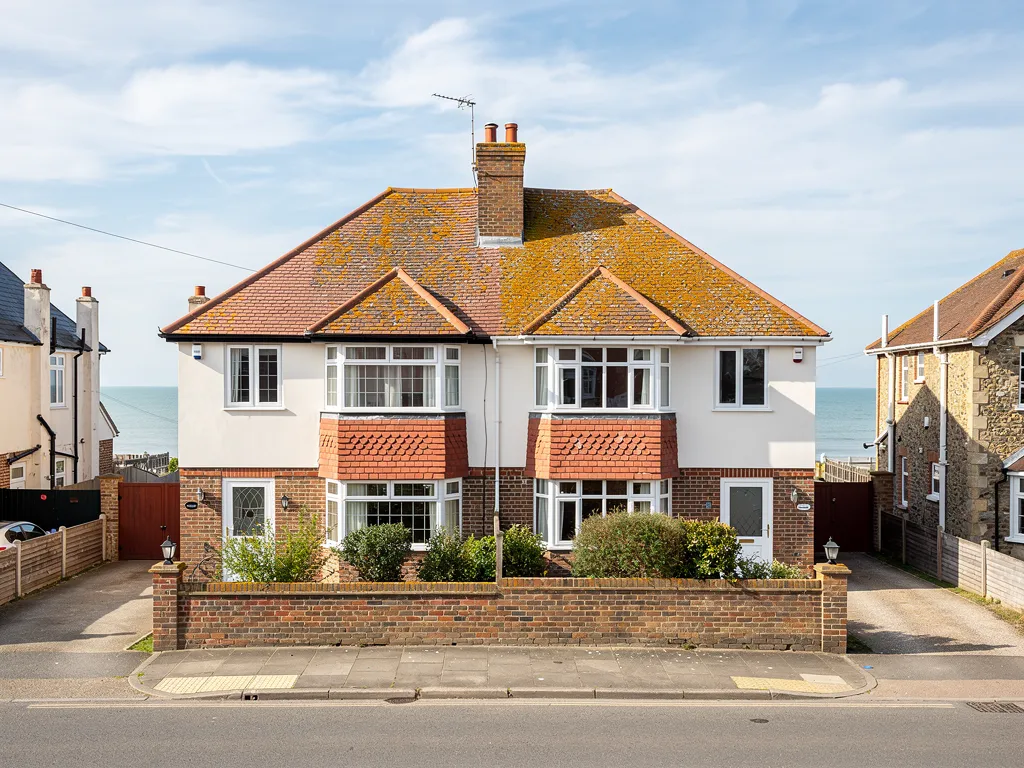
On the Sussex coast the exposure matters more than on a sheltered inland street. Salt air, gales and driving rain all test a roof harder, so the routine below is worth more here. We start with what the published lifespans say, then move through the upkeep that protects them. It sits within our wider roof repairs advice.
What the published lifespans really tell you
Cost guides and manufacturers publish typical lifespans for each covering. They are useful for planning, and they are not guarantees. A manufacturer's warranty is another matter, and says little about how many years a roof will actually keep the water out.
| Covering | Typical life as published |
|---|---|
| Natural slate | 80 to 100 years or more (MyBuilder) |
| Clay tiles | A minimum of 60 years (Marley, citing the Building Research Establishment) |
| Concrete tiles | Often 30 to 60 years (MyBuilder, Marley) |
| EPDM rubber flat roof | 20 to 30 years or more (GreenSpec, Less) |
| GRP fibreglass flat roof | 25 to 40 years (Less) |
| Torch-on felt | 10 to 20 years (Less) |
Two things stand out. The ranges are wide, and the low end is not what a neglected roof achieves, it is what a typical one does. Less is blunt about felt: 20 years from a good job, under 10 from a poor one. Workmanship and upkeep decide which end you get.
Second, the covering is not the whole roof. MyBuilder says fascias and soffits are normally renewed every 10 to 20 years, far sooner than the tiles above them. Old clay peg tile roofs do not follow the 60-year rule at all: on historic roofs, the Building Conservation Directory says the 60 years quoted is clearly not a reliable guide.
So think of lifespan as a budget that care can protect, and the sections below as the ways to protect it. A roof that is checked, cleared and repaired on time spends that budget slowly. One that is ignored spends it in a few bad winters, and the bill for the damage arrives long before the covering has really worn out.
Looking at the roof after storms and once a year
You can learn a lot from the ground. After a gale, walk round the house and look at the roof with binoculars if you have them. You are looking for gaps in the pattern of tiles, a ridge tile that has shifted, bits of mortar or tile on paths and flower beds, a flashing that is lifting, and anything hanging from the gutter or fascia. Run your eye along the verges and the base of any chimney stack as well.
Once a year, look in the loft with a torch on a dry day. Stand only on boards or joists. The things to note are daylight where it should not be, tide marks or dark staining on the timbers, damp insulation, and any smell of mould. A phone photograph of each finding, with the date, builds a record that shows whether a mark is growing.
Stay off the roof itself. Roofs are slippery, slates and old tiles are fragile, and falls from them are serious. If you want it checked, an inspection from a roofer is the better route. In MyBuilder's inspection guide (updated 21/08/2026), a standard roof inspection is £150 to £250 and a drone survey £200 to £400, which spares you access equipment on a high or awkward roof.
Fitting it into the year
Autumn, after the leaves, and spring, after the winter, are sensible times to check. Our roof maintenance checklist turns this into a list you can print. The aim of both visits is the same: find the small fault, take its photograph and deal with it while it is still small. Our guide to how roofers trace a leak shows what a trained eye looks for beyond the obvious.
Gutters and the roofline
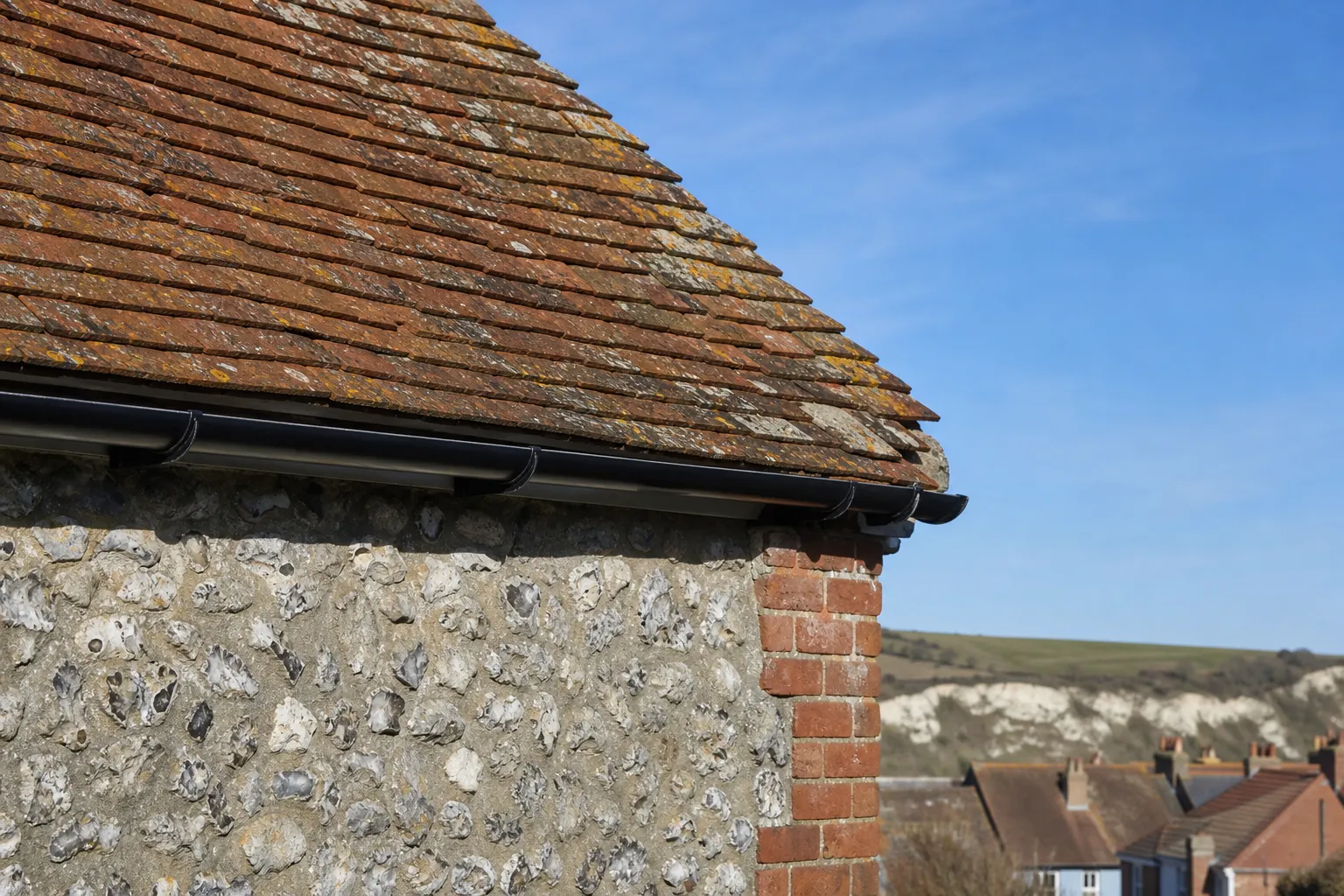
Gutters seem separate from the roof, but they decide whether the lowest part of it stays dry. A gutter choked with moss, leaves and grit from the tiles cannot carry water away. It overflows, usually at the back, soaking the fascia board and the ends of the rafters, and it can send water down the wall inside the cavity. The damp then appears on a ceiling and gets blamed on the covering.
The upkeep is straightforward. Clear the gutters in autumn and again in spring, flush the downpipes, and watch the joints and brackets for signs of leaks or sag. Gutter makers publish falls of roughly 1:600 to 1:350 to the outlet, which varies by system. If water lies in a section of gutter after rain, the fall has been lost or a bracket has dropped, and refixing it is a small job.
The fascia and soffit need the same attention. Salt carried on sea air builds up on these boards, and HomeBuilding observes that salt collects on soffits and fascias, where rain never reaches to rinse it off. A wipe down with fresh water now and then is a cheap way to stop deposits building up.
Look at the timber of the fascia where it meets the gutter. Soft, flaking or stained board is the early warning that gutters have been overflowing for some time.
If the gutter run is very long, or the house is three storeys, the job may need a tower or a platform, and it is safer left to someone with the right access equipment. Our guides to gutter cleaning and roofline maintenance cover the routine, and what to do when a gutter is past saving.
A ventilated loft is a drier roof
Warm air from kitchens, bathrooms and living rooms carries moisture. When it leaks into a cold loft, it condenses on the coldest surface it meets, and that is usually the underside of the underlay and the roof timbers. Over a winter or two, that can mean mould, damp insulation, stained ceilings and rafters that never quite dry out. All of it looks like a leak, and none of it is one. Our guide to condensation or leak shows how to tell them apart.
The fix is airflow. Marley sets out the BS 5250 figures. With high-resistance underlay, a continuous 10mm gap is wanted along the eaves on pitches above 15° and 25mm on pitches of 15° or less. Roofs steeper than 35°, spans over 10m and lean-tos want a further continuous 5mm gap at high level. The ordinary 3mm eaves gap can be enough where the underlay offers low resistance, the ceiling below is well sealed and the covering lets air through, provided the underlay maker's independent certification conditions are met.
Keeping the vents clear
Ventilation only works if the openings stay open. Insulation pushed hard into the eaves, stored boxes against the rafters, or a newly fitted vent blocked by paint can undo years of good design. When topping up loft insulation, keep it back from the eaves so air can still move.
Extractor fans in kitchens and bathrooms should vent outside, not into the loft. Using them while cooking and showering cuts the moisture reaching the loft in the first place, and is the lowest-cost roof maintenance there is.
If condensation has been a problem for years, the ventilation may be worth a survey, since adding vents is usually cheaper than replacing damp timbers.
Small repairs, made on time
This is where most of the lifespan is won or lost. A tile refixed in a week costs a visit. A tile left for a winter can mean wet battens, damp insulation and a stained ceiling, with a bill to match. Our guide to what a small roof fault costs if you leave it traces the whole chain.
Some faults deserve particular attention because they tend to fail again if they are patched cheaply.
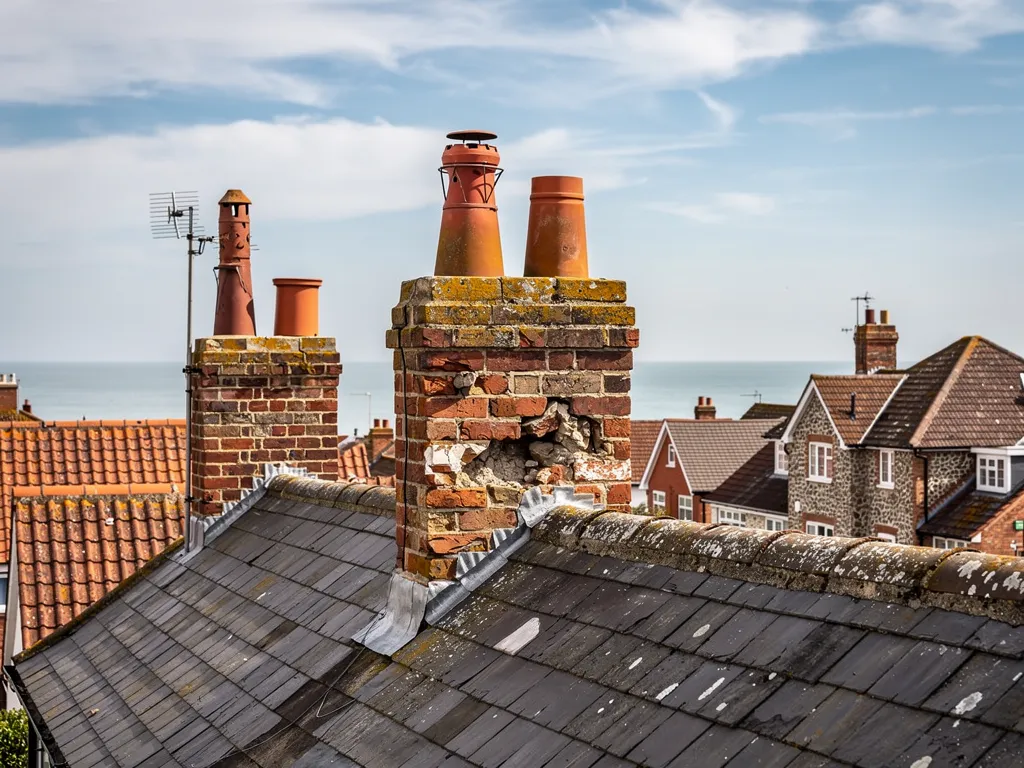
- Ridge and hip tiles. Ridge and hip tiles need more than mortar: since the 2014 revision of BS 5534 they also take a mechanical fixing. A ridge that is only re-pointed will crack again. Re-bedding with mechanical fixings, or a dry-fix system to BS 8612:2018, is the lasting repair.
- Flashings. Lead that has lifted at a chimney or wall should be renewed and dressed, not smeared with sealant. Leadworx calls code 4 the lead most often used for flashings in general.
- Flat roof seams. A split along a seam lets water into the insulation and deck, where it spreads. Repair it early, and keep the surface free of debris so water can run off to the outlet.
When you do use a roofer, ask for the cause in writing and photographs of the fault, so there is a record of the work. Dated invoices for each repair add to that record. A careful repair history also helps when you sell or re-roof, since it shows the surveyor that the roof has been looked after.
Sealants and coatings have a place, but they are not a lasting substitute for repair, and applying one to a failing detail often hides the fault.
Moss, lichen and keeping the surface clean
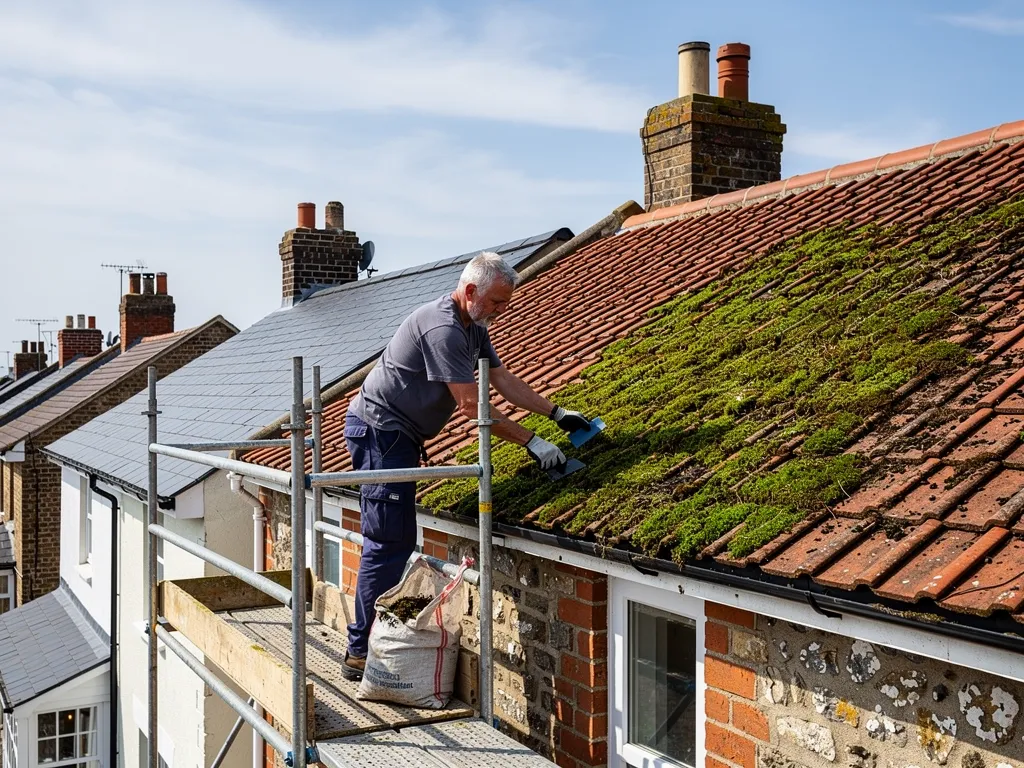
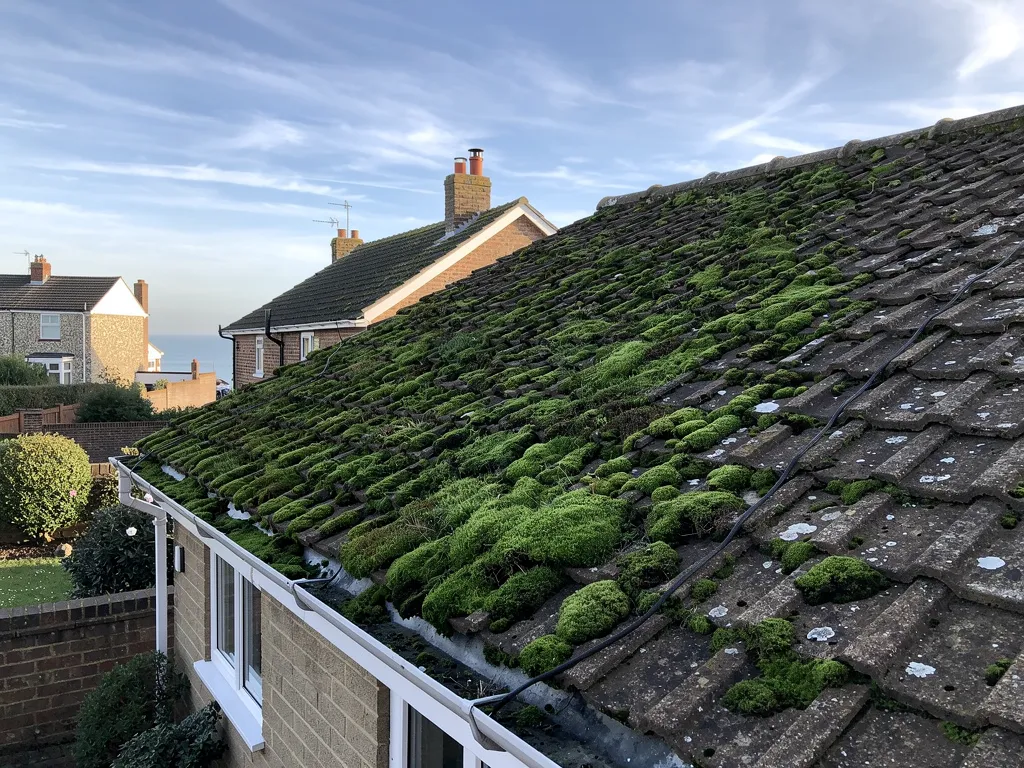
Moss and lichen are the most visible sign of a roof that has been left alone. They grow on shaded and north-facing slopes first, and on rough concrete tiles and old clay. Lichen is a flat crust, usually grey or orange, and moss is the green cushion that builds in the laps and along the valleys and gutters.
They are not always harmful in the short term, but they hold moisture against the covering and feed debris into valleys and gutters, so a heavy growth is worth dealing with. Our page on whether moss damages a roof covers the question properly.
Cleaning without causing harm
How a roof is cleaned matters as much as whether it is. MyBuilder's roof cleaning guide (updated 21/08/2026) cautions against jet washing, which can crack fragile tiles, and puts hand scraping at £5 to £10 per m2. Its typical roof cleaning figures start from around £300, with pitched roofs at £450 to £850, depending on size and covering. A careful clean, done by hand or with a treatment, is gentler than a jet wash that can strip surface granules and drive water under laps.
Treat any cleaning as an inspection too. A roofer who is on the roof can spot cracked tiles, loose ridge mortar and failing flashings while they work, and lifts debris out of valleys and gutters. If your roof is a shared terrace or has fragile or unusual materials such as asbestos cement, do not clean it yourself. Our roof cleaning and moss removal pages explain the options by covering.
Do the rest as set out above, and the cleaning becomes a periodic job rather than a rescue. Seen together, inspection, clear gutters, dry lofts, timely repairs and a clean surface are what keep a roof working for the long end of its published range.